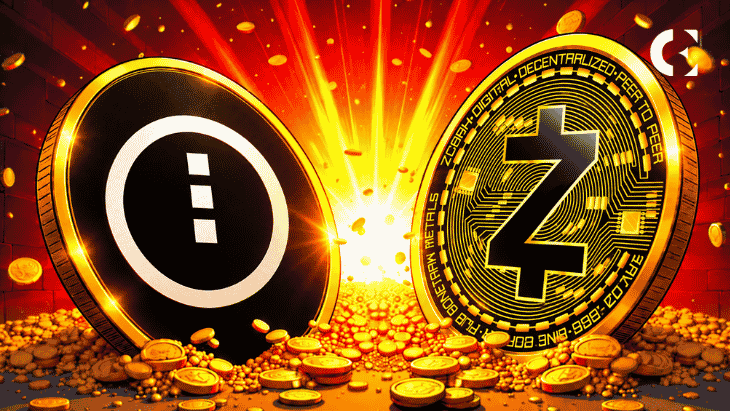

- NIGHT trades near $0.038 with a $635M market cap, while ZEC trades near $1,384.
- Cardano participants received 50% of the Glacier Drop, linking ADA users to NIGHT.
- NIGHT stays unshielded while generating shielded DUST for transactions and contracts.
NIGHT is drawing attention as traders compare Midnight’s programmable privacy model with Zcash’s established role in private digital money. However, the two networks place privacy in different parts of their systems, creating a clear distinction between their approaches.
In an X post, David Gokhshtein, founder of Gokhshtein, renewed the comparison on October 3. He linked a possible ZEC-like cycle to the development of useful applications, reliable infrastructure, and sustained user activity.
Gokhshtein cited payroll, lending, and compliance as potential use cases, while also disclosing that Midnight sponsors his show. Meanwhile, Cheeky Crypto placed the project within a broader Cardano catalyst stack.
For ADA holders, however, the connection extends beyond market commentary, as Midnight has direct structural links to the Cardano ecosystem.
Zcash vs. Midnight Shows Why NIGHT Is a Different Privacy Bet
Zcash primarily targets private digital money, and its privacy architecture changed materially this year. Ironwood NU6.3 activated on July 28 after a soundness vulnerability affected Orchard.
As part of that upgrade, Zcash introduced a new shielded pool and restricted the original Orchard pool. Funds leaving Orchard must now pass through a turnstile before entering Ironwood. In addition, Ironwood received machine-checked formal verification focused on supply integrity.
Midnight, on the other hand, takes a different approach to zero-knowledge technology. Its applications can combine public and private state while proving required facts without exposing the underlying sensitive information.
That distinction also applies to NIGHT. The token itself remains public and unshielded, serving as both a utility and governance asset while generating DUST for network execution. DUST, by contrast, is shielded, non-transferable, and decaying.
As a result, Midnight places privacy primarily within network execution and application activity rather than directly inside the transferable token.
| Feature | Midnight | Zcash |
| Core model | Programmable selective disclosure | Private digital money |
| Transferable asset | NIGHT is unshielded | ZEC supports shielded transfers |
| Privacy mechanism | Shielded DUST and private application state | Shielded transaction pools |
| 2026 milestone | Permissionless contract deployment | Ironwood NU6.3 |
The distinction is central. ZEC represents private money, while NIGHT links holders to infrastructure where applications consume privacy through DUST.
Cardano Links NIGHT to DUST and the Glacier Drop
Midnight operates as a Cardano partner chain, while NIGHT launched as both a Midnight native token and a Cardano native asset. That connection also shaped the Glacier Drop, which allocated 50% to eligible Cardano participants and 20% to Bitcoin participants.
The remaining 30% was distributed across six other ecosystems. However, Cardano’s link extends beyond the initial distribution. Midnight documentation states that cNIGHT held on Cardano can generate DUST for use on the network.
Institutional integrations add another layer to that relationship. Fireblocks supports custody for NIGHT, while Monument Bank targets £250 million in tokenized, interest-generating retail deposits on Midnight.
At the same time, permissionless smart contract deployment is live on the mainnet. Developers can therefore deploy contracts without a mandatory Preprod review, although testing there remains recommended before production use.
Even so, that milestone does not make every network function permissionless. Midnight says block production remains federated during the bootstrapping phase, while decentralization is expected to continue in stages.
EU Rules Highlight Midnight’s Selective Disclosure Model
That phased development also matters as privacy-focused networks face tighter regulatory scrutiny. From July 10, 2027, European rules will prohibit regulated crypto service providers from maintaining accounts that enable anonymization or increased transaction obfuscation. The rule includes anonymity-enhancing coins.
However, it excludes self-hosted wallet providers when they lack access to or control over those wallets. Meanwhile, Midnight’s selective-disclosure model addresses a different privacy problem. Applications can prove required information while keeping unrelated data private, although the technology alone does not establish regulatory compliance.
Against that backdrop, the market valuations remain far apart. NIGHT recently traded near $0.038 with an estimated $635 million market capitalization, while ZEC traded near $1,384 with an estimated $23.4 billion market capitalization.
Bottom Line
Overall, NIGHT presents a different privacy proposition rather than a direct ZEC replacement. Its model connects an unshielded asset to shielded network usage and programmable applications. For ADA holders, the link includes distribution, Cardano-native assets, and DUST generation. However, for ZEC followers, it provides a separate model of blockchain privacy demand.
Zcash vs. Midnight Frequently Asked Questions
Not exactly. Zcash focuses on private digital money, while NIGHT remains unshielded and supports privacy-enabled applications through Midnight’s shielded DUST resource.
NIGHT is the network’s transferable utility and governance token. Holding NIGHT generates DUST, a shielded, non-transferable resource used for transactions and smart contracts.
Midnight operates as a Cardano partner chain, and NIGHT launched as a Cardano Native Asset. Cardano participants also received 50% of the Glacier Drop allocation.
Yes. Midnight documentation states that cNIGHT held on Cardano can generate DUST for activity on the Midnight network.
Both projects address blockchain privacy, but through different models. Zcash emphasizes shielded money, while Midnight applies selective disclosure to programmable applications and network activity.
Disclaimer: The information presented in this article is for informational and educational purposes only. The article does not constitute financial advice or advice of any kind. Coin Edition is not responsible for any losses incurred as a result of the utilization of content, products, or services mentioned. Readers are advised to exercise caution before taking any action related to the company.