

- Brent futures hit $112.55 on October 22, while December WTI traded near $99.19.
- November WTI expired at $101.79 versus $97.82 for December, a $3.97 difference.
- Cushing crude stocks rose 987,000 barrels even as U.S. inventories fell 3.06 million.
Oil benchmarks diverged sharply Thursday as renewed Middle East attacks heightened supply concerns. Brent cleared $111, but WTI struggled to hold $100, prompting questions about deliberate suppression. At 11:04 GMT on October 22, Brent futures climbed 2.81% to $111.88 after reaching $112.55, their highest since May.
Meanwhile, December WTI traded near $99.19 after briefly touching $101.11, creating a $12.69 spread. However, the divergence reflected differences in delivery markets, contract maturities, and geopolitical exposure rather than established evidence of price manipulation.
Follow us on X for real-time crypto updates.
Middle East Supply Threats Widen Brent-WTI Spread Above $12
The divergence emerged as attacks on Saudi infrastructure intensified regional uncertainty. Saudi Aramco instructed employees to evacuate its Dhahran headquarters amid renewed attacks on Saudi infrastructure.
Washington also ordered some diplomatic personnel and families to leave the country. Separately, Iran’s Revolutionary Guard reported incidents involving seven vessels near the Strait of Hormuz, although those claims remain independently unverified.
The International Energy Agency estimates that 20 million barrels of crude and petroleum products crossed Hormuz daily in 2025. That represented 25% of global seaborne oil trade. Because Brent reflects international seaborne shipments, threats to tankers can raise freight costs, insurance premiums, and oil delivery uncertainty.
Further disruptions could therefore strengthen prices without a corresponding change in U.S. oil inventories. However, reports of regional exports recovering toward pre-conflict levels suggest the market is pricing both observed conditions and potential losses.
Why WTI Remains Below $100 Despite Brent Surging Above $111
Unlike Brent, WTI futures are tied to physical delivery at Cushing, Oklahoma, rather than international tanker routes, making U.S. storage conditions important. This difference emerged on October 20, when expiring November WTI settled at $101.79, compared with $97.82 for December contracts.
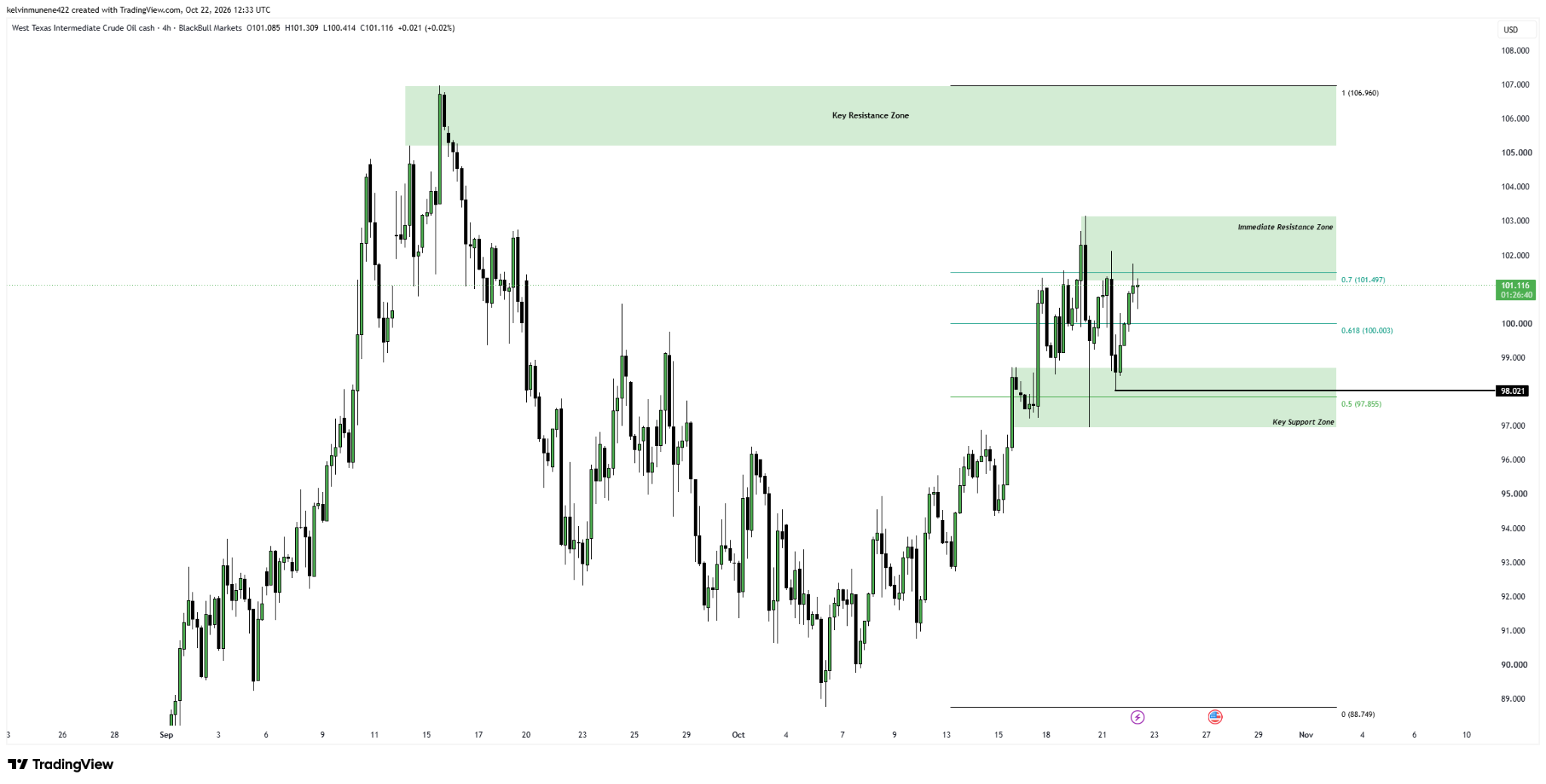
The $3.97 premium signaled backwardation, as traders paid more for immediate delivery than deferred supply. Meanwhile, a four-hour TradingView chart placed WTI’s cash quotation near $101.12.
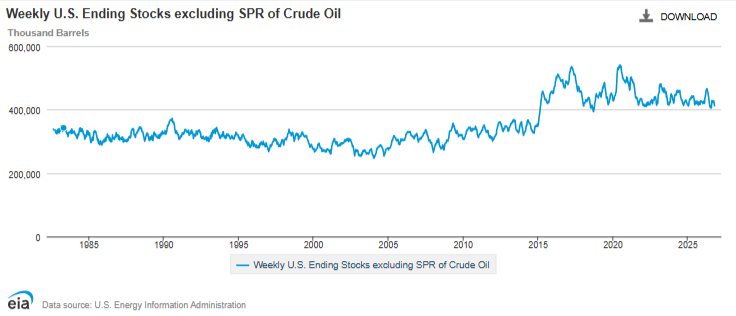
Comparing that figure with December futures could misleadingly imply that prices were being suppressed below $100, although the instruments represent different markets. Adding to the supply picture, U.S. crude inventories declined 3.06 million barrels to 412.52 million during the week ending October 16.
Source: U.S. Energy Information Administration
Yet Cushing oil stockpiles rose 987,000 barrels to 27.59 million. That mixed inventory picture helps explain the regional discount. Positioning and reactions to psychological thresholds can intensify fluctuations, but the supplied figures do not document coordinated trading or unlawful price manipulation.
WTI and Brent Breakout Levels Signal Rally or Peace Deal Selloff
On the four-hour cash chart, WTI faces initial resistance between $101.50 and $103, followed by $105 and $106.96. Conversely, rejection near resistance and a sustained move below $100 would expose support at $98.02, then $97–$97.85.
Source: TradingView
Meanwhile, Brent must surpass Thursday’s $112.55 high to extend its rally. However, a decline below $108.82, followed by $107.68, would undermine the bullish structure. In both markets, four-hour closes beyond resistance, rising volume, and successful retests would offer stronger confirmation than temporary price spikes.
For Brent and U.S. crude alike, a rapid reversal beneath resistance would raise the risk of a bull trap. The Brent premium is not itself proof that shipments have fallen by an equivalent amount.
More shipping interruptions could accelerate gains by tightening available supply. Conversely, a credible peace deal restoring safer shipping could trigger a rapid selloff, although damaged infrastructure and depleted inventories make an outright crash uncertain.
Subscribe to our YouTube channel for the latest crypto news.
Related: Asia Sell-Off Tests BTC’s $81,650–$82,350 Demand Zone as London Eyes $84,377 Rebound
Disclaimer: The information presented in this article is for informational and educational purposes only. The article does not constitute financial advice or advice of any kind. Coin Edition is not responsible for any losses incurred as a result of the utilization of content, products, or services mentioned. Readers are advised to exercise caution before taking any action related to the company.