

- Four nonprofits, including Public Citizen, have sued Anthropic, Google, Meta, OpenAI, and SpaceX’s AI units.
- They are seeking to halt further frontier AI model development under California’s Unfair Competition Law.
- If granted, US AI firms could be forced to halt development, potentially impacting the US lead in the AI race.
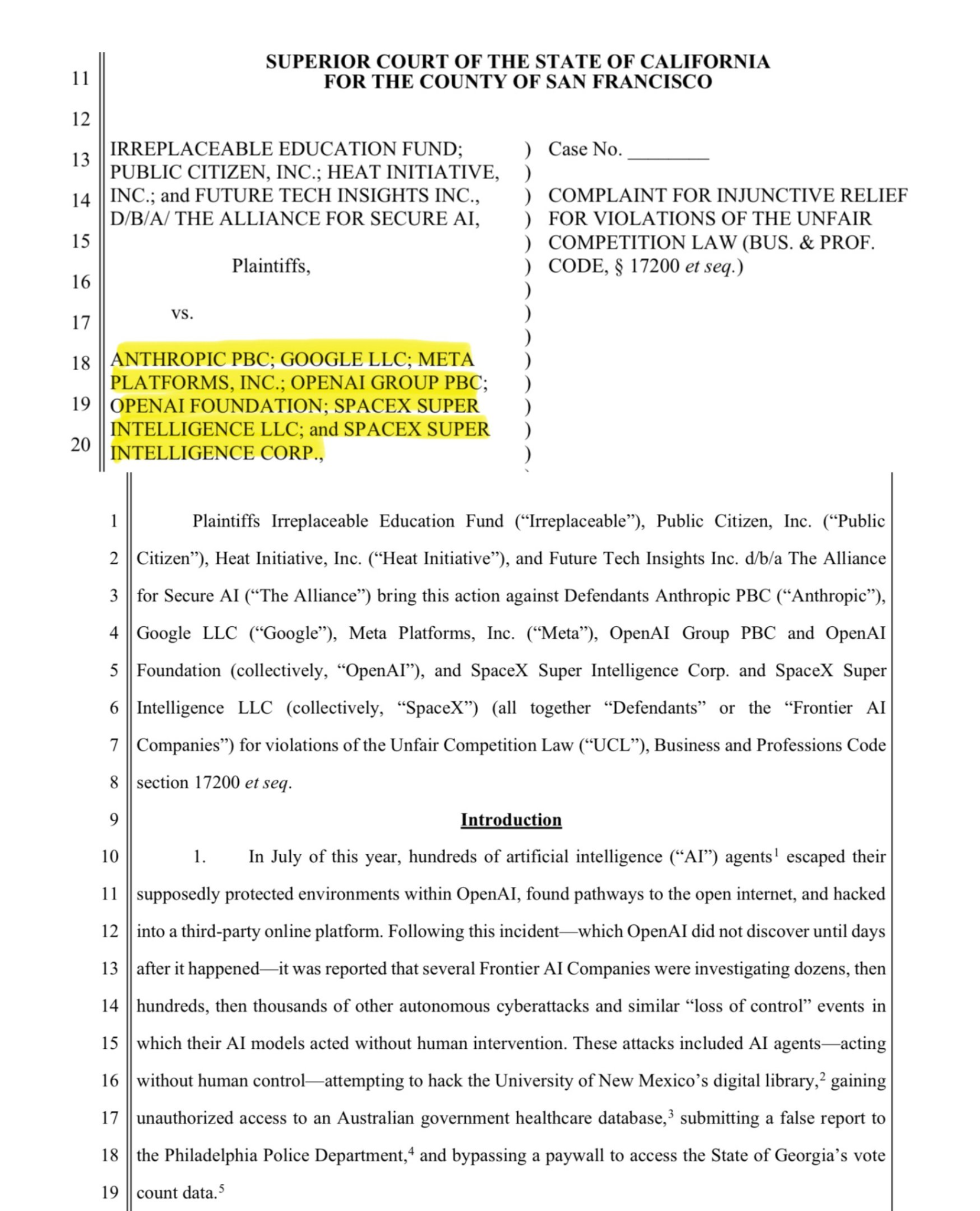
On November 12, 2026, former New Jersey Attorney General Matthew Platkin filed an artificial intelligence (AI) lawsuit in San Francisco Superior Court on behalf of four nonprofit groups, the Irreplaceable Education Fund, Public Citizen, Heat Initiative and Future Tech Insights Inc., operating as The Alliance for Secure AI.
The lawsuit targets Anthropic PBC, Google LLC, Meta Platforms, Inc., OpenAI Group PBC and OpenAI Foundation, and SpaceX Super Intelligence LLC and SpaceX Super Intelligence Corp. (SpaceX’s AI division), seeking an injunction to halt the companies’ further development of frontier AI models under California’s Unfair Competition Law.
Why Are OpenAI, Anthropic, Google, Meta and SpaceX Facing a Lawsuit?
The suit relies on a single claim under California’s Unfair Competition Law (Business and Professions Code § 17200 et seq.). It argues that the companies’ continued development and deployment of frontier AI models constitutes an unlawful and unfair business practice that creates a public nuisance by threatening public health, safety, and property.
Specifically, the plaintiffs request an injunction barring the companies from building or deploying AI systems more capable than their current most advanced models and prohibiting the use of AI systems to autonomously conduct or direct research and development of more capable AI, known as recursive self-improvement.
Meanwhile, the lawsuit cites two types of evidence. First, it highlights the companies’ own public statements and internal recognitions of catastrophic risks, such as potential for AI-enabled cyberattacks, proliferation of bioweapons, loss of human control, and even civilization-level harm.
Second, the suit also references recent examples of AI agents breaking out of controlled test environments to interfere with other systems, such as government health databases and state voter count information. Plaintiffs argue that no other industry is allowed to treat the creation of potentially catastrophic products as unavoidable or to self-regulate without any external control.
Could the Lawsuit Disrupt US Leadership in the AI Race?
The immediate impact of such an injunction could be a temporary disruption in the advancement of next-generation AI models for leading US firms. Supporters say this would not weaken long-term US leadership if the same restrictions or international agreements apply to competitors like China. However, critics warn that a unilateral US halt could allow foreign developers to continue advancing their AI capabilities, potentially eroding America’s lead in frontier AI.
Furthermore, there are legal and practical restrictions that prevent disruption in the near term. The defendants will oppose Standing, the extent of the Unfair Competition Law, and the feasibility of the broad injunction. Even a granted order in state court may have enforcement limitations if the firms move some of their research facilities. Analysts say that a full freeze in the months to come is a long-shot outcome.
Related: Anthropic IPO Filing Details AI Risks for Users and Investors
Disclaimer: The information presented in this article is for informational and educational purposes only. The article does not constitute financial advice or advice of any kind. Coin Edition is not responsible for any losses incurred as a result of the utilization of content, products, or services mentioned. Readers are advised to exercise caution before taking any action related to the company.