

- The Euro now makes up 11.8% of crypto trading volume across 33 leading fiat currencies.
- Western Europe’s crypto economy reached $2.08 trillion between July 2025 and June 2026.
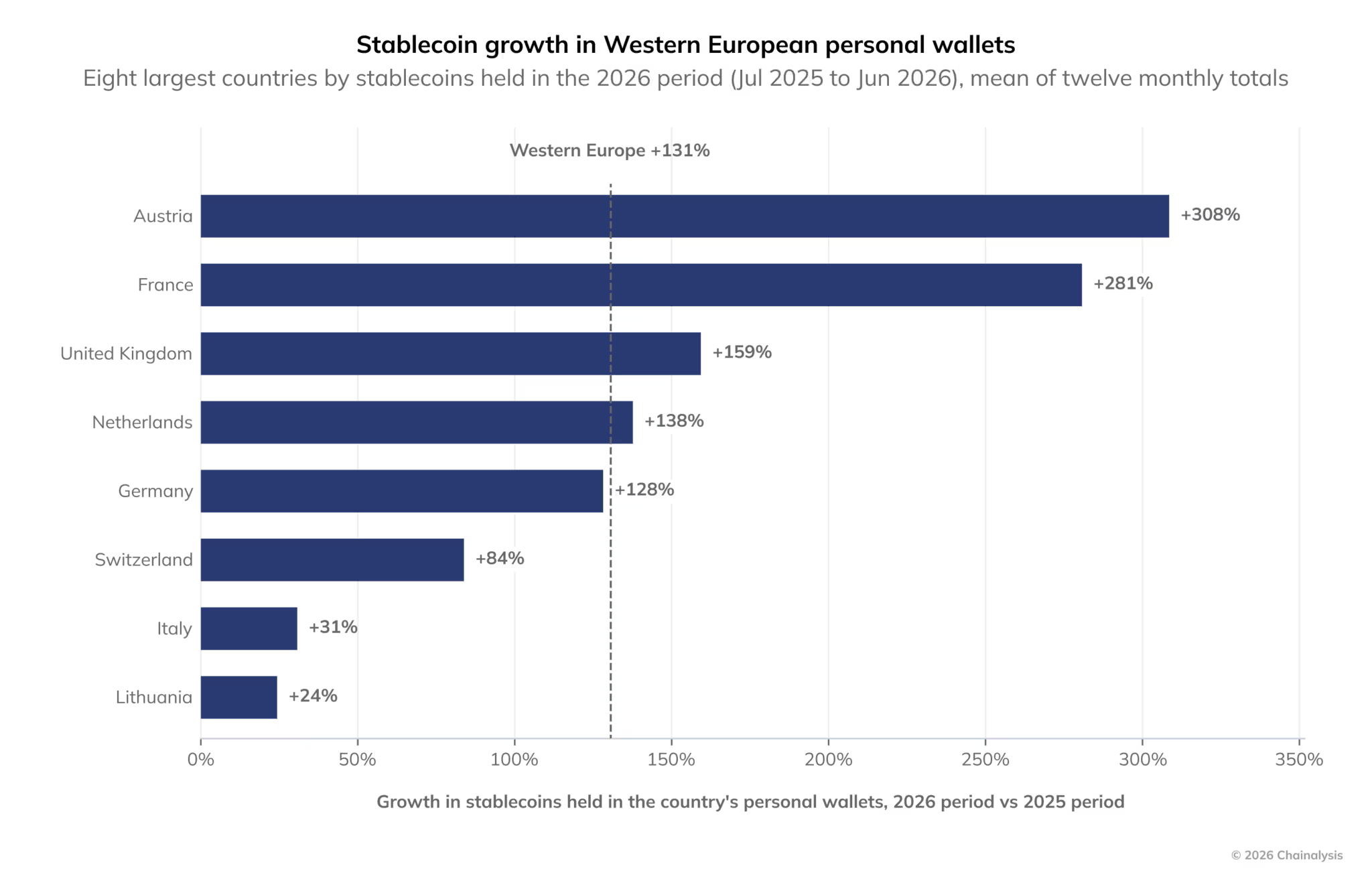
- Stablecoin holdings in the region jumped 131%, far ahead of 52% growth globally.
The US dollar still sets the terms for most crypto trading, from Bitcoin quotes to the stablecoins that move between exchanges. New data from Chainalysis suggests the Euro is starting to claim more of that ground.
Its 2026 Geography of Crypto report shows Europe’s currency gaining share across Western Europe, helped by MiCA regulation, fiscal worries and fast stablecoin adoption. The question is whether this growth can make European traders less dependent on USD liquidity.
Europe’s $2.08T Crypto Economy Gains Ground on the Dollar
Western Europe’s crypto economy held up while most of the world contracted. Between July 2025 and June 2026, on-chain value in the region totaled $2.08 trillion and grew 1.2%, making it the second-largest crypto economy worldwide.
The EU expanded 2.2%, while the UK shrank 8% and still remained the largest single market at 424.5 billion. Germany (288.8 billion), France (215.8 billion) and the Netherlands (207.8 billion) followed.
The bigger story for the dollar is currency share. The euro now accounts for 11.8% of crypto volume across 33 major government-issued currencies. Chainalysis compares that with a 14.5% benchmark drawn from its role in global FX markets, so the gap is closing. The rise lines up with MiCA’s full rollout, which gave exchanges one rulebook and passporting rights across the bloc.
Follow us on X for real-time crypto updates.
How EUR/USD Movements Affect European Crypto Investors
Most crypto assets are quoted in dollars, so a European investor carries two exposures at once. One is the token’s price. The other is the EUR/USD rate.
If Bitcoin climbs in dollar terms while the euro strengthens, part of that gain disappears once it is converted back. A weaker euro does the opposite and can inflate returns on paper.
Chainalysis found a related pattern tied to bond markets. As eurozone government yields rose against US yields, euro-denominated trading in Bitcoin and tokenized gold climbed relative to dollar trading.
A gap of around 2 basis points lined up with EUR trading about 7.5% higher. At 7 basis points, the figure reached roughly 12%. When the gap moved the other way, EUR activity fell 8% to 10%.
France sits at the center of this. Its 10-year bond yield passed 5.14% in October, the highest level in over 20 years. French self-custodied stablecoin balances grew 192% over the report period.
EUR Trading Pairs Challenge Dollar-Based Crypto Liquidity
Every EUR pair that trades directly against a token removes one step through the dollar. A trader in Madrid buying Ethereum with euros no longer needs to touch USDT or USDC first. Deeper order books in Europe’s currency also mean tighter spreads and lower conversion costs.
Spain offers a clear example of how this pulls activity together. Inflows from other Western European users to Spain-registered exchanges rose 79.1%, led by Italy and Portugal.
MiCA passporting makes it easier for one platform to serve customers across many EU states in a single currency. Dollar pairs still dominate global liquidity, though, and an 11.8% share leaves plenty of distance to cover.
Can Euro Stablecoins Reduce Europe’s Reliance on USD?
Stablecoins may decide this contest. Holdings across Western Europe grew 131% against 52% globally, lifting the region’s share of world balances from 3.4% to 5.1%.
Most of that supply is still dollar-backed, which keeps Europe tied to US liquidity no matter which currency a trade starts in.
Banks are trying to change that. A CaixaBank spokesperson told Chainalysis that Europe is “trying to avoid becoming solely dependent on USD-denominated stablecoins.” Jan-Oliver Sell, CEO of Qivalis, a bank-backed MiCA-regulated issuer, sees euro stablecoins serving “as the on-chain cash leg for tokenised assets.”
The dollar still leads in crypto, and that will not change quickly. What the Chainalysis data does show is a euro building its own lane through regulated EUR pairs, cross-border exchanges and euro-backed stablecoins, and that lane is getting wider each year.
Subscribe to our YouTube channel for the latest crypto news.
Related: ESMA Sets Firm MiCA Compliance Deadline for Stablecoins in the EU
Disclaimer: The information presented in this article is for informational and educational purposes only. The article does not constitute financial advice or advice of any kind. Coin Edition is not responsible for any losses incurred as a result of the utilization of content, products, or services mentioned. Readers are advised to exercise caution before taking any action related to the company.