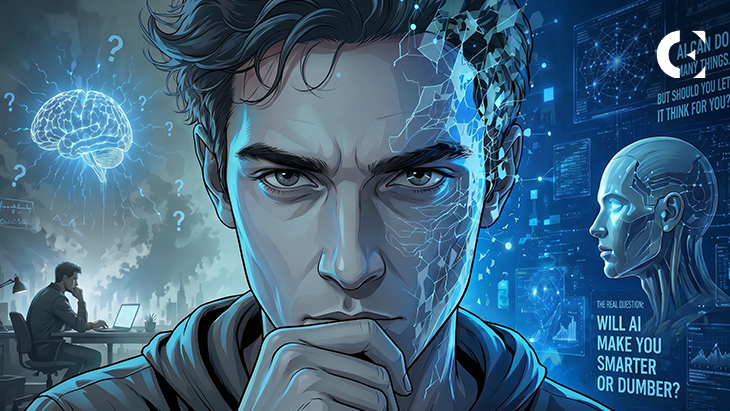

- Tech founders are becoming excessively reliant on AI for supposedly trivial tasks.
- AI should be used as a tool to boost cognition, not a replacement for the brain.
- Overdependence on AI solutions can weaken the mental abilities of an individual.
There is a growing debate about the use of artificial intelligence (AI) in cyberspace, particularly in the creation of communication pieces. Y Combinator co-founder Paul Graham is among those criticizing the growing dependence on AI.
In his latest post on X, Graham criticized founders who use AI to construct emails, noting that it is easy to identify such emails, particularly when a founder’s email reflects a hard-hitting journalistic style of writing.
Are Experts Becoming Too Reliant on AI?
According to Graham, founders are typically not so professional in written communication. Therefore, reading such perfectly constructed pieces feels like being lied to. Coming from Graham makes this issue critical, considering that many startups in cyberspace approach his firm for support and acceleration.
Graham’s latest position on the use of AI by founders could be termed “interesting,” considering his statement less than six weeks ago. On April 16, Graham posted on X saying that AI is giving a lot of hardworking founders the growth they deserve. He cited AI’s role in accelerating startups, particularly the struggling ones.
To clear up the mix-up his posts may have caused, Graham categorically stated that founders are supposed to use AI, but in the right way, just like using any technology.
What is the Right Way to Use AI?
The question among most cyberspace participants now revolves around how much AI implementation is right. Users are asking if they are supposed to use AI aggressively or not, or whether extensive use of the technology will negatively affect their cognitive abilities.
Indian tech intern Ojas Sharma has highlighted a potential issue for individuals and groups that are heavily reliant on AI. In his latest post on X, Sharma highlighted the increasing cost of using AI solutions, particularly Claude Opus 4.6, which is about to scale its subscription.
According to Sharma, Claude Opus 4.6 takes 3x tokens at the moment, but will increase costs to 27x from June 1, 2026. He thinks this change will significantly affect many companies, considering how quickly they will be exhausting their GitHub Copilot quota.
The main danger with this process that could deny users the AI access they have become used to resides in the need for them to readjust to old patterns after becoming reliant on AI tools. Praveen Verma, Associate Tech Lead at Paymentus, puts this scenario in perspective. The AI expert stated that if society treats AI like an external brain rather than a tool, basic problem-solving skills could wither.
Verma cited a similar scenario to Sharma’s observation, highlighting how small businesses could suffer from over-reliance on AI if things change drastically. According to Verma, skyrocketing prices could cause such businesses that might have automated their customer service, copywriting, and logistics to suddenly suffer unbearable overhead with no backup staff trained to cover up. That is a potential danger that over-reliance on AI could cause, according to the experts.
Is AI Making Us Stupid?
A research-based report by The Economist highlighted how prolonged AI use can make it harder to think critically and creatively. According to the report, having unfettered access to AI would certainly lighten the mental load of individuals. However, it reveals that this might come at the cost of users losing part of their cognitive abilities.
Most people argue that becoming stupid might not be the right description for the cons of AI. They think the actual side-effect of AI overuse is cognitive laziness. They argue that AI overuse will not lower one’s innate intelligence, but over-relying on it can weaken critical thinking and memory retention through “cognitive offloading.”
Some of the dangers associated with AI overuse include becoming used to outsourcing basic thinking, which could potentially cause one’s skills to fade. Too much AI in writing and brainstorming also has a way of weakening users’ ability to structure original thoughts.
Other side effects of AI dependency include the loss of deep processing, considering the brain would no longer engage in complex information processing to solve problems, which makes it more difficult to remember stuff. Additionally, AI has the potential to cause an illusion of knowledge. Individuals who overuse AI could be deceived into confusing access to information with actual understanding. This can lead to overconfidence in areas where such persons lack real expertise.
The Benefits of AI
Although most users argue over the side effects of using AI, the technology’s benefits do not have to be lost in that debate. It is worth noting that using AI to perform repetitive, low-level tasks could free up mental energy that can be used for more complex tasks. Additionally, AI can explain complex topics at any level and can be regarded as an infinite tutor. Meanwhile, it remains a significant tool that allows creators and developers to test multiple ideas in shorter timeframes.
As Verma stated, AI shouldn’t be the ultimate solution that humans use to replace cognitive ability. It should rather serve as a tool for aiding brain work and be used as a tool for scaling processes instead of being the ultimate problem solver.
Связано: AI-токены резко растут на фоне застопоривания биткоина; Ралли NEAR лидирует
Disclaimer: The information presented in this article is for informational and educational purposes only. The article does not constitute financial advice or advice of any kind. Coin Edition is not responsible for any losses incurred as a result of the utilization of content, products, or services mentioned. Readers are advised to exercise caution before taking any action related to the company.