
- Signum’s index places the likeliest Trump-Iran policy shift around July 26.
- Oil, shipping disruptions, and war costs are intensifying pressure on Washington.
- Past policy pivots followed market stress readings between 2.3 and 3.4 deviations.
Signum Global Advisors has turned Wall Street’s TACO (“Trump Always Chickens Out”) trade into a gauge tracking pressure around President Donald Trump’s approach toward Iran. Its Hormuz TACO Index points to a policy shift between July 22 and July 30, with July 26 leading the projection most.
Signum’s Four-Market Model Tracks Trump-Iran Policy Pressure
Signum policy chief Andrew Bishop built the model around four indicators linked to economic and geopolitical stress. They include Brent crude, U.S. 10-year Treasury yields, S&P 500 performance, and ship crossings through the Strait of Hormuz.
Each indicator becomes a weighted z-score against a March 7 baseline, allowing comparisons with earlier policy changes. Higher readings indicate pressure when energy costs, financial markets, and shipping disruptions worsen.
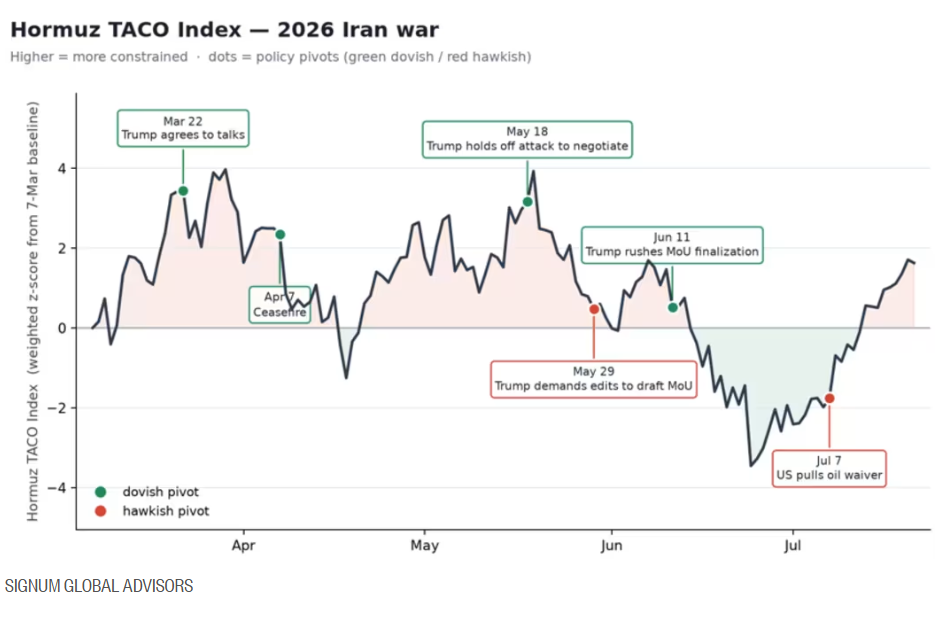
Signum found that earlier Trump-Iran policy pivots occurred between 2.3 and 3.4 standard deviations, with an average of about 2.9. They preceded the March 22 opening to talks, the April 7 ceasefire, the May 18 military pause, and the June 11 negotiations.
However, the Hormuz TACO Index remains experimental, not a verified forecasting system or guarantee of a diplomatic outcome.
Oil, Shipping Disruptions, and War Costs Raise Political Stakes
Meanwhile, economic and political pressure increased as Brent crude rose above $94 per barrel on July 22 amid threats to major energy routes. Shipping through the Strait of Hormuz largely stalled, while several Saudi tankers changed course following Houthi threats near the Bab el-Mandeb passage.
At the same time, average U.S. gasoline prices reached $4.02 per gallon on July 20, increasing household expenses and widening the conflict’s domestic impact. Military costs also continued to rise, with Defense Secretary Pete Hegseth estimating expenses at about $37.5 billion and requesting another $87.6 billion.
The human toll has also intensified the pressure. Eighteen U.S. service members have died, while more than 500 have been injured during the conflict. Regardless, diplomatic channels remain open, as Secretary of State Marco Rubio said Washington was willing to negotiate, while Iran reportedly considered a limited ceasefire proposal.
Still, attacks continued for an eleventh day, keeping Iran’s geopolitics exposed to changes that could quickly alter the index.
Related: Crypto Market on Alert as Trump Tariff Deadline Approaches
Disclaimer: The information presented in this article is for informational and educational purposes only. The article does not constitute financial advice or advice of any kind. Coin Edition is not responsible for any losses incurred as a result of the utilization of content, products, or services mentioned. Readers are advised to exercise caution before taking any action related to the company.