

- Strategy’s mNAV fell below 1.0 for the first time in the company’s entire history.
- Michael Saylor hinted at another Bitcoin purchase after adding 520 BTC.
- Analysts debated Bitcoin sales, dividends, and Strategy’s funding model.
Strategy has entered new territory after its market-to-net asset value (mNAV) ratio closed below 1.0 for the first time since the company adopted its Bitcoin accumulation strategy.
The milestone comes as Executive Chairman Michael Saylor signaled another Bitcoin purchase despite growing debate over the company’s financing model. On X, Saylor posted, “We’re gonna need more charts,” alongside Strategy’s Bitcoin purchase history.
According to Grok, the company added 520 BTC last week for $35 million at an average price of about $67,000 per coin. Strategy now holds 847,363 BTC acquired at an average cost of $75,653, with the reserve currently worth about $50.88 billion.
Premium Fueling the Buying Model Disappears
CryptoQuant analyst Axel Adler Jr. said Strategy’s enterprise mNAV closed at 0.99, meaning investors are no longer valuing the company above the Bitcoin it owns. The premium previously allowed Strategy to issue shares at attractive valuations and use the proceeds to buy more Bitcoin.
With the ratio below 1, raising capital through equity becomes more difficult because issuing new shares could reduce, rather than increase, Bitcoin exposure for shareholders.
Adler’s figures show that Strategy holds approximately $1.4 billion in cash against $1.71 billion in annual dividend obligations. Based on current cash reserves, the company has about 9.8 months of dividend coverage.
When measured against its Bitcoin holdings, the coverage extends to nearly 29.6 years, assuming the company does not sell its Bitcoin. Strategy also carries approximately $6.75 billion in debt with 11% net leverage, while preferred securities total about $15.5 billion.
Saylor’s purchase chart shows that Strategy has completed 113 Bitcoin purchases since 2020. The company’s average acquisition price has steadily increased alongside its aggressive buying strategy, while Bitcoin has now fallen well below the company’s average purchase cost.
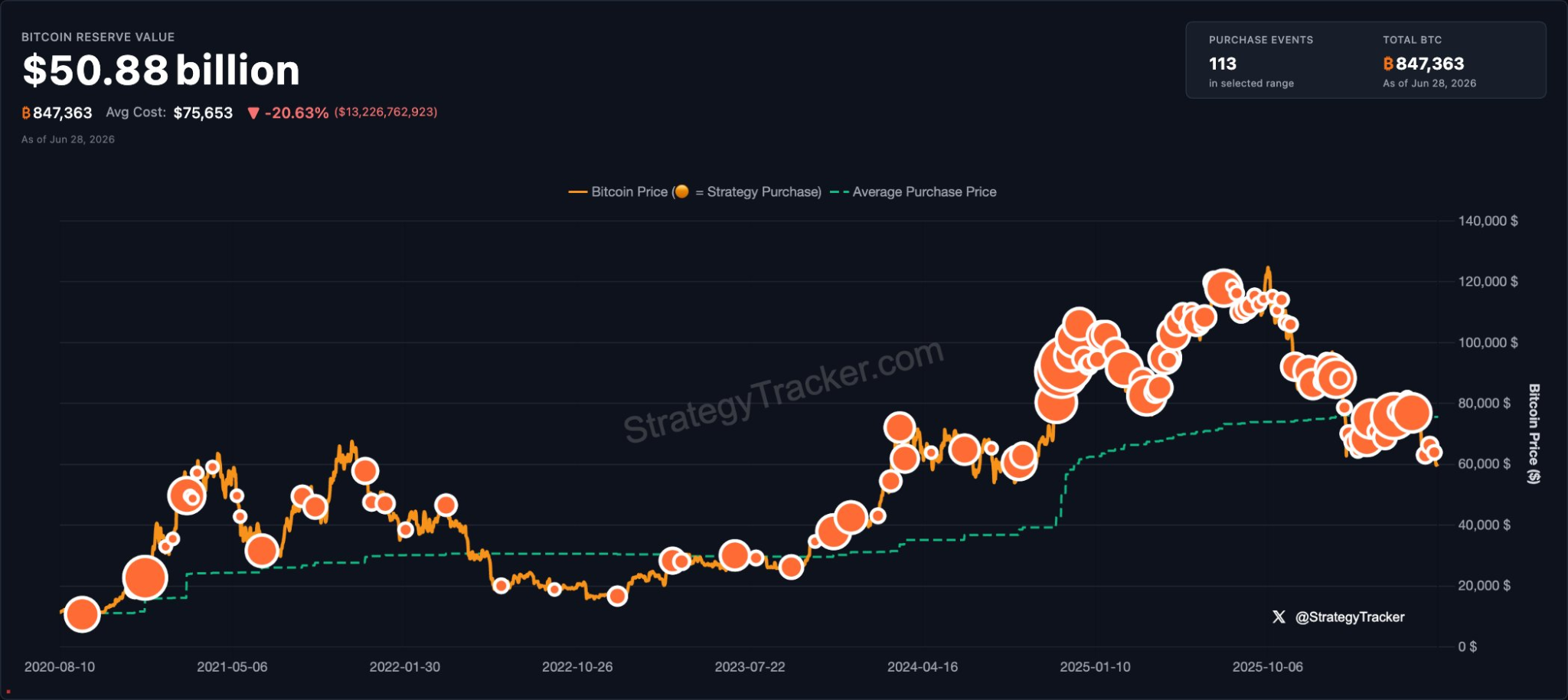
Source: Saylor on X
Analysts Debate the Next Move
Grayscale Head of Research Zach Pandl expects Strategy to increase the dividend on its STRC preferred shares by roughly 50 basis points, adding around $100 million in liabilities over the next two years.
However, he argued that selling at least $3 billion worth of Bitcoin would cover nearly all cash obligations over that period and could restore market confidence.
CryptoQuant CEO Julio Moreno warned that if Strategy begins selling Bitcoin to support STRC, the market could identify the price level where the company is defending the preferred shares and trade against it.
Market participant Fernando Servin disagreed, suggesting that a structured buyback program combined with higher dividends could reduce the impact of short sellers without requiring Bitcoin sales.
Bitcoin advocate Giovanni Incasa criticized Strategy’s continued share issuance, arguing that shareholder dilution has increased while the company’s mNAV has dropped to 0.99.
Peter Schiff also argued that the valuation remains problematic, saying Strategy’s market capitalization is about $30 billion compared with roughly $50 billion worth of Bitcoin on its balance sheet.
According to Schiff, issuing additional shares to purchase Bitcoin creates negative Bitcoin yield until the company’s market value once again exceeds the value of its holdings.
On the other hand, Strategy CEO Phong Le said the company has survived multiple market cycles since its founding in 1989 and compared its experience with companies such as Amazon and Tesla, which also endured periods of severe financial stress before recovering.
He said the 2022 bear market strengthened the company’s resilience and that his confidence remains rooted in Bitcoin’s long-term outlook rather than short-term paper losses.
Related: Stress Test Sees Strategy’s Bitcoin Per Share Falling 94%
Disclaimer: The information presented in this article is for informational and educational purposes only. The article does not constitute financial advice or advice of any kind. Coin Edition is not responsible for any losses incurred as a result of the utilization of content, products, or services mentioned. Readers are advised to exercise caution before taking any action related to the company.