
For years, crypto traders have believed that decentralized exchanges were one of the places where retail investors could still outsmart the crowd. However, unlike centralized exchanges crowded with professional firms and sophisticated algorithms, DEX markets are fragmented, chaotic, and dominated by smaller traders.
But a new study suggests that belief may be wrong.
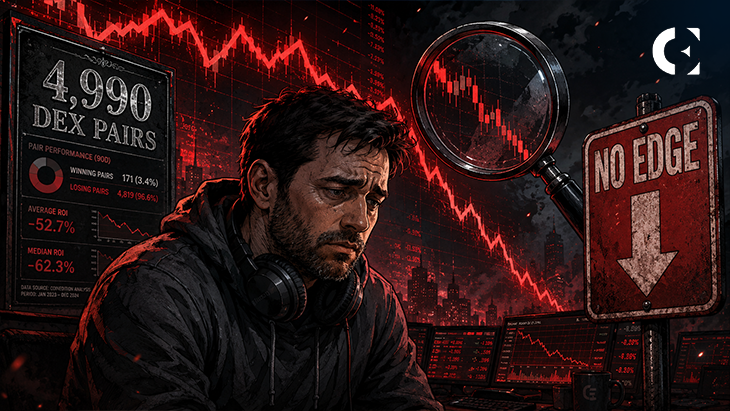
After testing 15 trading strategies across 4,990 DEX pairs spanning 27 blockchains, researcher Daniel Gatto found little evidence that historical price data alone can provide a consistent trading edge. The paper’s conclusion is captured in a simple phrase repeated throughout the research: “No edge without information.”
In other words, price charts by themselves may not be enough to generate profits, even in the supposedly inefficient world of memecoins and micro-cap tokens.
Why DEX Tokens Looked Like a Trader’s Dream
The appeal of DEX markets has always been easy to understand. Thousands of new tokens launch every week across Ethereum, Solana, Base, BNB Chain, Arbitrum, Polygon, Avalanche, and dozens of other networks. Here, liquidity is fragmented as market participation is largely retail-driven, and institutional competition remains limited compared with major centralized exchanges.
The whole idea is that if competition removes profitable opportunities from mature markets, then the chaotic long tail of DEX tokens should be one of the few places where traders can still uncover mispriced assets and exploitable patterns.
Gatto’s study set out to test that assumption using one of the largest datasets assembled on the topic. The research examined 4,990 DEX-only trading pairs, combining roughly six months of daily trading data with six weeks of hourly observations. Every token pair met minimum liquidity requirements, while all strategies accounted for real-world trading costs, including gas fees, swap fees, and AMM slippage.
The results challenged many of crypto’s most widely held assumptions.
Most Tokens Were Already Losing
Even before a single strategy was tested, the data painted a bleak picture.
Nearly three-quarters of all tokens posted negative returns during the sample period, while the median token lost approximately 18.5% of its value. The typical token finished roughly 38% below its peak price, and nearly one-third ended the study more than 50% beneath their highs.
Meanwhile, the average return across the dataset remained positive, but only because a small number of exceptional winners skewed the results. Thus, most tokens steadily lost value.
It’s a dynamic familiar to anyone who spends time on Crypto Twitter. The rare 50x winner gets celebrated and shared endlessly, while the far larger number of failed bets quietly disappear from timelines and Discord channels.
Interestingly, the study also found that DEX tokens behaved differently from what many momentum traders expect. Rather than sustaining trends, prices frequently reverted after moving sharply in either direction. In practical terms, traders attempting to buy strength were often betting against the market’s underlying structure.
Why Even Profitable Signals Failed
To achieve why profitable signals end up failing, the study tested eight popular intraday trading approaches, including breakout strategies, RSI signals, momentum setups, and volume-based entries.
At first glance, some of these strategies appeared promising. The strongest generated a gross edge of roughly 6.5 basis points per trade before costs were applied. However, the problem was scale.
Across the DEX pools studied, round-trip trading costs averaged roughly 230 to 240 basis points once gas fees, slippage, and swap fees were included. The strongest signals simply weren’t large enough to overcome the cost of executing them.
The result was a mismatch of nearly 40-to-1 between signal strength and trading expenses.
After costs, the average scalping strategy lost approximately 2.5% per trade, and fewer than 1% of tested configurations produced positive returns over their full sample period.
More importantly, the study found that costs were not the real culprit.
Gatto stress-tested different assumptions around liquidity, execution quality, and fee structures. The conclusion remained unchanged. Even before fees were fully applied, most signals were already too weak to generate meaningful profits.
Even Sophisticated Strategies Couldn’t Beat the Market
The research extended far beyond traditional chart analysis.
Gatto evaluated several approaches commonly used by professional traders, including market-neutral hedging, token launch timing, liquidity provision, cross-pool arbitrage, Bitcoin trend filters, portfolio diversification, and order-flow analysis.
It is astonishing that none produced statistically significant outperformance.
Liquidity provision initially appeared attractive, generating modest yields before accounting for impermanent loss. Once impermanent loss was included, returns largely disappeared.
Also, cross-pool arbitrage opportunities existed, but most were too small to overcome transaction costs.
A market-neutral strategy that hedged exposure using centralized exchange perpetuals initially produced encouraging risk-adjusted returns. However, those results failed to survive more rigorous statistical testing. Across the board, more complex approaches fared little better than simple chart-based strategies.
When Random Noise Looks Better Than the Market
One of the study’s most surprising findings came from its use of randomized control tests.
Researchers shuffled the sequence of price movements while preserving each token’s overall statistical characteristics. They then reran the same trading strategies on the randomized dataset.
Unexpectedly, the shuffled market often looked more profitable than the real one.
The explanation is not that randomness creates profits. Rather, real DEX markets contain clusters of sharp drawdowns that repeatedly hurt long-only traders. Randomization removes those clusters while preserving other statistical features, making strategies appear more effective.
The conclusion here is that some of the patterns traders believe they are exploiting may actually be structural disadvantages embedded within the market itself.
The Only Signal That Actually Worked
In the end, after fourteen strategies failed, Gatto finally found one approach that showed statistically significant predictive power.
Researchers built a machine-learning model using factors such as recent returns, volatility, turnover, liquidity conditions, and token age. Unlike the other strategies, the model successfully outperformed its statistical baseline.
However, the success is not absolute as the model wasn’t particularly good at identifying future winners. Instead, it excelled at identifying future losers.
When researchers sorted tokens by predicted performance, every group still produced negative median returns. The highest-ranked tokens weren’t strong performers; they simply lost less than the worst-ranked tokens.
That finding may be the study’s most important insight.
In DEX markets, predictive models may be more useful for avoiding catastrophic losses than for discovering the next breakout opportunity. The edge appears to lie in identifying what not to own rather than identifying what to buy.
The Survivorship Problem
The study also highlights a major weakness found in many crypto backtests: survivorship bias.
Because the dataset was built from active liquidity pools, tokens that had already collapsed and disappeared were underrepresented. Researchers estimated that at least 9.2% of still-active pools were already functionally dead based on trading activity, and the true number is likely higher once fully abandoned projects are considered.
This means historical returns may actually look better than reality.
Importantly, survivorship bias did not create a false trading edge in the study. Active strategies still underperformed even among surviving tokens. However, it does suggest that many publicly shared backtests may present a more optimistic picture than traders would have experienced in real time.
What the Study Means for Traders
The practical takeaway is not that profitable trading is impossible. The takeaway is that price charts alone are unlikely to provide a sustainable advantage.
Across thousands of tests, RSI signals, moving averages, breakout strategies, momentum indicators, and several more sophisticated approaches failed to produce durable profits. The one model that showed predictive power relied on information beyond simple price action, including token age and liquidity characteristics.
For traders, this means any strategy should be tested not only against historical performance but also against randomness and a simple buy-and-hold baseline. In this study, many strategies that initially appeared promising failed that test.
More broadly, the findings challenge one of crypto’s most persistent narratives that retail traders can consistently uncover alpha in DEX markets simply by reading charts.
Nonetheless, the study leaves one possibility open. Because the dataset required tokens to survive long enough to generate meaningful trading histories, it could not evaluate ultra-short-term launch strategies that operate within the first moments of a token’s existence.
That edge remains untested.
Everything else, however, points in the same direction. After examining nearly 5,000 DEX tokens and 15 separate trading approaches, the study arrives at a conclusion many traders will find uncomfortable, which is that the chart is not the edge. If profitable opportunities still exist in DEX markets, they are more likely to come from information the market has not yet absorbed than from patterns already visible on a price chart.
Disclaimer: The information presented in this article is for informational and educational purposes only. The article does not constitute financial advice or advice of any kind. Coin Edition is not responsible for any losses incurred as a result of the utilization of content, products, or services mentioned. Readers are advised to exercise caution before taking any action related to the company.