
- Tether froze $344M USDT across two Tron addresses linked to Iran’s Central Bank.
- OFAC and U.S. law enforcement evidence of sanctions evasion via Iranian exchanges triggered the freeze.
- This intensifies U.S. pressure on Tehran’s crypto networks and may raise major compliance concerns ahead.
On April 23, 2026, Tether froze $344 million in USDT across two Tron addresses directly linked to Iran’s Central Bank. Acting on the U.S. Office of Foreign Assets Control (OFAC)
and law enforcement intelligence, the stablecoin issuer blacklisted the wallets over sanctions evasion tied to Iranian exchanges and regime-linked operations. The freeze followed on-chain evidence of transactions involving Iranian exchanges and Central Bank-associated wallets.
Tether Freezes $344M USDT Linked to Iran Central Bank
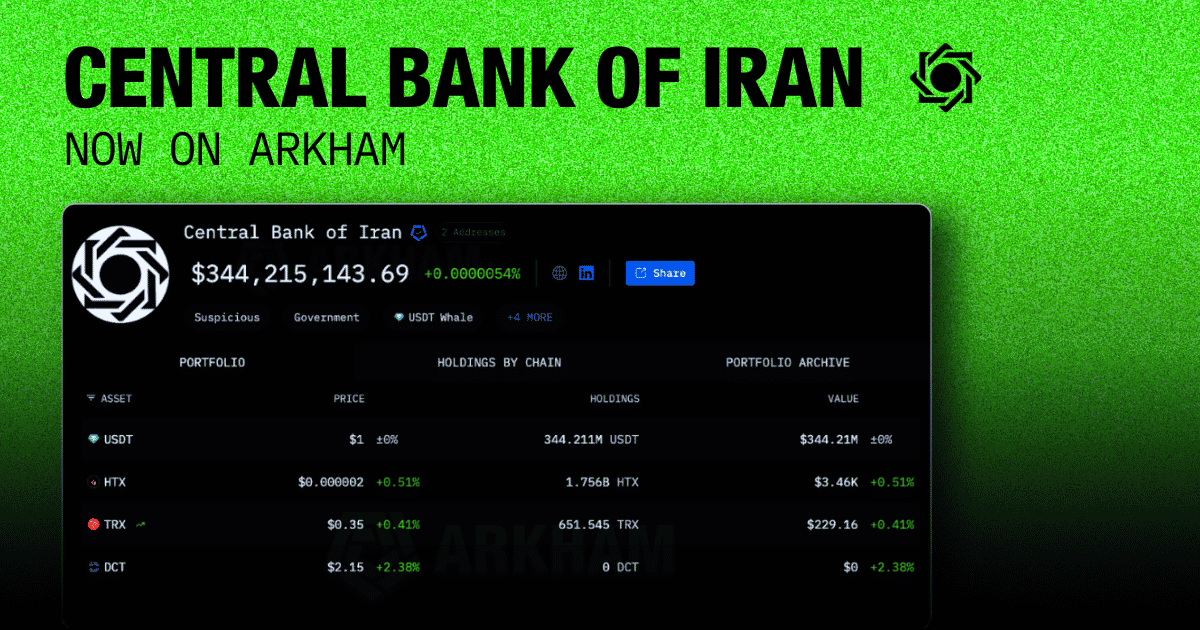
On May 13, 2026, Arkham Intelligence identified two Tron wallets belonging to Iran’s Central Bank after Tether froze $344M USDT in April 2026 for sanctions evasion, labeling them on-platform with nearly all funds frozen.
Source: X
The exposed portfolio holds primarily 344.21M USDT plus minor TRX, HTX, and DCT, showcasing Iran’s reliance on stablecoins and blockchain to route capital outside traditional banking channels.
OFAC Evidence Triggers the Freeze Over Iran Sanctions Evasion
The freeze was triggered by intelligence and on-chain evidence provided by OFAC. OFAC had determined that the two Tron addresses were controlled by the Central Bank of Iran and formed part of a sanctions-evasion network used to receive and move USDT proceeds from illicit oil sales and other prohibited activities.
Furthermore, U.S. officials cited specific transaction patterns showing direct flows through Iranian exchanges and intermediary wallets previously linked to Central Bank operations, as well as connections to the Islamic Revolutionary Guard Corps (IRGC) and Hezbollah financing channels.
Broader Impact on Crypto Sanctions Enforcement
Notably, this freeze marks a turning point in crypto sanctions enforcement, showing that even sophisticated state-linked evasion networks can be rapidly identified and immobilized on-chain. Tether’s swift compliance sets a new benchmark for stablecoin issuers, pushing tighter transaction screening and closer coordination with OFAC and global enforcement agencies.
Meanwhile, sanctioned entities, including Iran’s financial institutions, now face growing restrictions on USDT usage and may shift toward higher-risk alternatives such as privacy coins or offshore decentralized exchanges. This reflects increasing pressure on crypto-based sanctions evasion channels tied to Iranian exchanges and intermediary wallets.
Regulators and blockchain analytics firms are expected to expand real-time stablecoin flow monitoring, enabling faster wallet detection and more frequent asset freezes linked to illicit activity. In response, crypto exchanges and custodial wallets may respond by strengthening preemptive KYC/AML screening, while users diversify away from dominant stablecoins.
Over time, this accelerates demand for standardized global compliance frameworks for stablecoin issuers and digital asset platforms. It may also drive greater adoption of self-custody wallets and privacy-enhancing tools in higher-risk jurisdictions.
Overall, the incident reflects a broader U.S. Treasury sanctions strategy targeting digital asset flows linked to Iran. It reinforces how public blockchains are becoming enforcement infrastructure, likely leading to more frequent OFAC wallet designations, deeper issuer–law enforcement coordination, and stricter compliance standards across the stablecoin sector.
Related: Iranians Move $10.3 Million in Bitcoin to Safety Amid U.S.-Israel Strikes
Disclaimer: The information presented in this article is for informational and educational purposes only. The article does not constitute financial advice or advice of any kind. Coin Edition is not responsible for any losses incurred as a result of the utilization of content, products, or services mentioned. Readers are advised to exercise caution before taking any action related to the company.