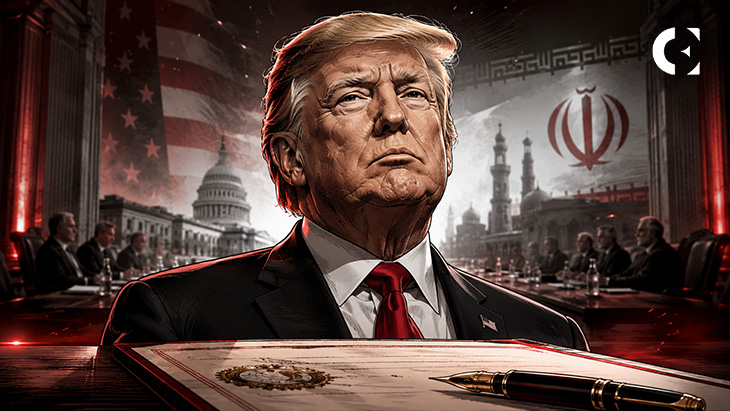

- President Trump and President Pezeshkian signed the Iran MoU at Versailles.
- The deal starts a 60-day negotiation period and reopens the Strait of Hormuz.
- Washington agreed to issue oil export waivers and remove restrictions on Iranian ports.
President Donald Trump formally signed the United States-Iran Memorandum of Understanding (MoU) at the Palace of Versailles in France on June 17 during a dinner hosted by French President Emmanuel Macron after the G7 summit.
Iranian President Masoud Pezeshkian also signed the agreement, putting the deal into effect immediately and starting a 60-day period for both sides to negotiate a broader settlement.
Earlier, Vice President JD Vance and Iranian parliamentary speaker Mohammad Bagher Ghalibaf had electronically signed the agreement on June 14.
Deal Takes Effect as War Ends
The agreement aims to end nearly four months of conflict between the United States and Iran. Pakistani Prime Minister Shehbaz Sharif, who acted as a mediator, said the accord entered into force immediately after the signatures were completed.
Under the MoU, both sides agreed to stop military operations and begin negotiations for a permanent arrangement. The framework also covers Lebanon, with commitments to respect its territorial integrity, although Israel has not agreed to withdraw its forces from the country.
Trump described the agreement as strong but warned that military action could resume if Iran fails to honor its commitments.
During a press conference in France, he said the United States would strike Iran again if the agreement is violated. Iranian negotiator Mohammad Bagher Ghalibaf also maintained that Tehran remains prepared to respond if tensions return.
Oil Sales Resume and Strait of Hormuz Reopens
One of the biggest changes in the agreement is the immediate easing of restrictions on Iranian oil exports. Washington will issue waivers allowing Tehran to sell oil during the 60-day negotiation period while discussions continue on a broader removal of sanctions.
The agreement calls for the reopening of the Strait of Hormuz, through which roughly 20% of global oil and liquefied natural gas trade normally passes.
Commercial shipping is set to resume immediately, although demining operations and technical work may delay a complete return to prewar traffic levels. The passage will remain toll-free for at least 60 days.
The United States also agreed to remove its naval blockade and lift restrictions affecting Iranian ports. The blockade is expected to end completely within 30 days.
Nuclear Talks Enter a New Phase
The memorandum commits Iran to never pursuing nuclear weapons. Tehran’s stockpile of highly enriched uranium will remain inside the country and is expected to be diluted under the supervision of the International Atomic Energy Agency.
Until a final agreement is reached, Iran’s nuclear activities will remain under a temporary status quo. The United States agreed not to impose new sanctions during this period and will permit oil-related banking and transportation services.
A final agreement is targeted within 60 days, although both sides can extend the talks by mutual consent. Any permanent settlement would eventually be backed by a United Nations Security Council resolution.
Related: Santiment: Iran, Oil, AI, and Stablecoins Rise in Sentiment
Disclaimer: The information presented in this article is for informational and educational purposes only. The article does not constitute financial advice or advice of any kind. Coin Edition is not responsible for any losses incurred as a result of the utilization of content, products, or services mentioned. Readers are advised to exercise caution before taking any action related to the company.