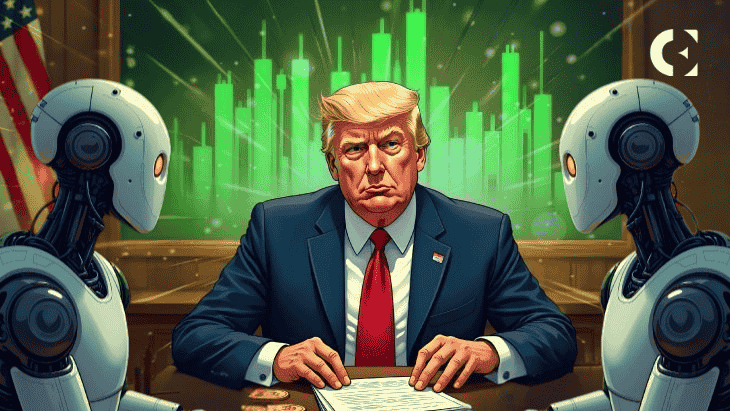

- Trump defends US data centers as the “Golden Goose,” warning communities opposing them could end up poor.
- The backlash is driven by high energy and water demand, electricity bill spikes, pollution, and grid strain.
- US data centers face delays or cancellations amid local protests, political pressure and midterm elections.
On August 31, 2026, President Donald J. Trump condemned the growing backlash against US AI data centers, warning that restricting their construction could threaten economic growth, leave communities “backwards and poor,” and benefit China in the AI race. The backlash has grown bipartisan amid concerns over energy and water demands, electricity bills, noise pollution, and grid strain.
Trump Condemns Growing US Data Center Backlash
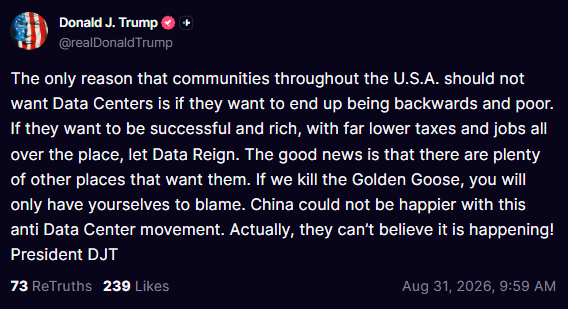
President Trump has issued a forceful statement on Truth Social condemning rising local opposition to data centers across the United States. He explained that the facilities are vital economic factors and that refusal would see communities left behind. “The only reason that communities throughout the U.S.A. should not want Data Centers is if they want to end up being backwards and poor,” Trump wrote.
“If they want to be successful and rich, with far lower taxes and jobs all over the place, let Data Reign. The good news is that there are plenty of other places that want them. If we kill the Golden Goose, you will only have yourselves to blame. China could not be happier with this anti Data Center movement. Actually, they can’t believe it is happening!”
The comments come as community opposition has become a national political issue, transcending party lines and affecting midterm dynamics. According to a March 2026 Gallup survey, 71% of Americans are against building AI data centers in their community, with 48% strongly opposing. Other recent polls have shown opposition in the 61% to 75% range.
Related: Trump Warns US Cannot Lose Crypto and AI Race to China
Energy, Water, and Bill Spikes Fuel Data Center Backlash
The local opposition against data centers has grown, largely due to their power needs, water use for cooling, and impact on energy costs. In 2025, U.S. data centers accounted for about 312.6 TWh, nearly 40% of the global electricity for data centers, and could consume as much as 11.8% of U.S. electricity by 2030. Water consumption is also increasing, with direct on-site water use for cooling around 17.4 billion gallons per year in 2023 and 38-73 billion gallons per year by 2028. Google’s data centers and related operations consumed about 10.9 billion gallons in 2025, a 34% year-over-year increase.
These resource requirements have a direct impact on bills for many households. In the PJM region, independent market monitors attributed roughly 63% of a major capacity-price jump in the 2025–2026 auction to data-center demand, adding billions in costs recovered from customers. Gallup discovered that half of opponents point to excessive resource consumption as a reason, with water and energy each mentioned by about 18%, and roughly one in five cite economic impacts like higher bills or taxpayer costs.
What’s Next for US Data Centers and Crypto Miners
The backlash against the US data center landscape is changing timelines, locations and business models for AI infrastructure and cryptocurrency mining, with 30-50% of planned near-term capacity at risk of delay or cancellation. Bitcoin mining consumes approximately 1% of national electricity, and AI and high-performance computing could generate up to 70% of listed Bitcoin miners’ revenue by the end of 2026.
Related: Trump Pushes AI Growth, Tech Stocks Surge as Anthropic Calls for Pause
Disclaimer: The information presented in this article is for informational and educational purposes only. The article does not constitute financial advice or advice of any kind. Coin Edition is not responsible for any losses incurred as a result of the utilization of content, products, or services mentioned. Readers are advised to exercise caution before taking any action related to the company.