
- The US Dollar Index hit an 18-month high at 102.551 as geopolitical risks boosted demand.
- Beth Hammack urged the Fed to move quickly toward restrictive policy amid persistent inflation.
- A stronger dollar and higher rates could pressure commodities, equities, emerging markets, and crypto.
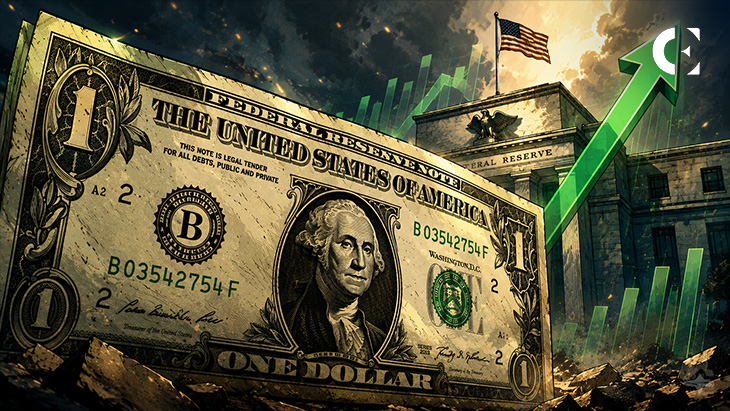
The US dollar has climbed to its highest level since April 2025, with investors weighing geopolitical risks and the possibility of tighter Federal Reserve policy. The Dollar Index (DXY) reached 102.551, up 0.31% on October 12. Meanwhile, Cleveland Federal Reserve President Beth Hammack called for a relatively quick move toward restrictive monetary policy, warning that inflation pressures are spreading across the economy.
Together, they put the dollar and interest-rate expectations at the center of market attention. A stronger greenback can change the cost of commodities, influence international capital flows, and tighten financial conditions for borrowers outside the United States. However, its direction will also depend on upcoming inflation data and how other central banks respond to their own economic conditions.
Dollar Demand Builds as Investors Weigh Global Risks
The dollar’s advance reflects demand for liquid assets as investors assess escalating tensions in the Middle East and uncertainty surrounding energy supplies. Attacks on Saudi Arabian targets and two tankers over the weekend added to concerns about regional security and oil-market disruption. These developments have kept investors cautious ahead of key US inflation data. Sources reported that the dollar index traded near an 18-month high on October 12.
Positioning data also points to stronger demand. According to weekly figures cited by sources, bullish dollar positions rose to around $36 billion in the week ending October 7, compared with $8.4 billion three weeks earlier. Much of that shift came at the euro’s expense. The increase suggests investors have been adding exposure to the US currency as uncertainty grows, although positioning can change quickly when new economic data alters expectations.
Oil prices add another layer to the outlook. Higher energy costs can feed into inflation, complicating the Federal Reserve’s efforts to bring price growth back to its 2% target. If inflation remains persistent, markets may reassess how long US interest rates need to stay elevated. Expectations of higher US yields can support dollar demand by making dollar-denominated assets more attractive relative to investments offering lower returns.
Still, interest rates alone do not drive the dollar’s rise. Geopolitical uncertainty, liquidity demand, and developments in other major economies can all influence currency movements. The current rally therefore reflects several overlapping forces rather than a single trigger.
Hammack Calls for Faster Action on Inflation
Cleveland Fed President Beth Hammack added to the debate over US monetary policy on October 12, saying the central bank should move “relatively quickly” toward a restrictive stance. In prepared remarks for a National Association for Business Economics conference, she said inflation pressures had become broad-based rather than concentrated in a few categories.
Hammack said underlying inflation remained in the mid-to-high 2% range, above the Fed’s 2% target. She also cited conversations with businesses in her district, where some firms planned to raise prices faster than their input costs were increasing. In her view, smaller policy adjustments made sooner could reduce the risk of requiring a larger correction later if inflation becomes more persistent.
Energy remains part of the concern, but Hammack also pointed to demand from artificial-intelligence infrastructure projects. She said the AI buildout was lifting prices for computers, electronics, and other high-tech components. Those cost pressures can extend beyond data centers to projects in aviation, electricity generation, and construction.
Her remarks matter for markets since they reinforce the possibility that the Fed may need to maintain a restrictive approach for longer. Hammack is a voting member of the Federal Open Market Committee and has previously supported raising rates. Nevertheless, her comments do not establish that the committee has decided on another increase. Investors are expecting the Fed to keep its policy rate within the 3.75%–4.00% range at its October 27–28 meeting.
How a Stronger Dollar Can Affect Financial Markets
A stronger dollar can make dollar-priced commodities more expensive for foreign buyers, potentially weighing on demand and prices. However, geopolitical disruptions can offset that pressure by restricting supply. Gold could also face headwinds from dollar strength and higher interest rates, which increase its cost for foreign buyers and raise the opportunity cost of holding a non-yielding asset. Geopolitical uncertainty can nevertheless support gold as a safe-haven investment.
In equities, the impact depends on companies’ international exposure and financing needs. A stronger dollar can reduce the value of foreign earnings when US multinationals convert them into dollars. Meanwhile, higher interest rates can increase borrowing costs and the discount rates used to value future earnings, putting pressure on equity valuations, particularly for companies whose profits are expected further in the future. Earnings performance and sector-specific demand can offset some of that pressure.
Emerging-market economies face another challenge. When their currencies weaken against the dollar, servicing dollar-denominated debt generally becomes more expensive in local-currency terms. Dollar-priced imports, including oil and equipment, can also become costlier. Countries heavily dependent on external funding or energy imports may therefore face greater currency and inflation pressures.
Changes in dollar liquidity and interest-rate expectations could also influence cryptocurrencies. A stronger dollar and tighter financial conditions can reduce investors’ appetite for speculative positions, but they do not guarantee that Bitcoin or other digital assets will fall. Fund flows, leverage, market positioning, and network-specific developments also influence crypto prices.
Inflation Data Becomes the Next Market Test
Investors are now looking toward the upcoming US inflation report for evidence of whether price pressures are easing or remaining stubborn. The data could influence expectations for the Fed’s late-October meeting and shape the outlook for Treasury yields and the dollar. Further comments from Hammack and other policymakers may also help markets assess how officials would respond to different inflation readings.
For now, the dollar’s move toward a multi-month high coincides with renewed concern about inflation and the potential for restrictive monetary policy. If incoming data reinforces expectations for higher US rates, dollar demand may remain supported. If inflation readings fall short of expectations, investors may re-evaluate their expectations. The outcome will vary by currency, commodity, equity, and cryptocurrency depending on how the new evidence impacts the policy and risk appetite outlook for the United States.
Related: Bitcoin Price Faces Volatility as US CPI, PPI Data and Fed Chair Warsh Speech Loom
Disclaimer: The information presented in this article is for informational and educational purposes only. The article does not constitute financial advice or advice of any kind. Coin Edition is not responsible for any losses incurred as a result of the utilization of content, products, or services mentioned. Readers are advised to exercise caution before taking any action related to the company.