
- Deposits into RWAs more than tripled from last year, hitting $7.4 billion in Q2.
- As of August 2026, tokenized RWAs are nearing $38 billion in total on-chain value.
- Tokenized credit is the largest RWA category, while Treasury bills are fastest-growing.
In 2026, one of the fastest-growing crypto areas is tokenized real-world assets (RWAs), where government bonds, private credit, commodities, and even property are moving onto blockchains.
The primary reason is likely that investors are seeking consistent returns. After several crypto ups and downs, big investors are leaning toward assets that steadily produce cash flow. Examples include tokenized Treasury bills that pay interest, tokenized money market funds, tokenized private credit, real estate income, and commodity-backed tokens.
Recent data even suggests investors are favoring transparency and regulated products, rather than purely speculative opportunities.
For instance, deposits into RWAs more than tripled from last year, hitting $7.4 billion in Q2, while spot trading activity experienced a 220% rise during the same period.
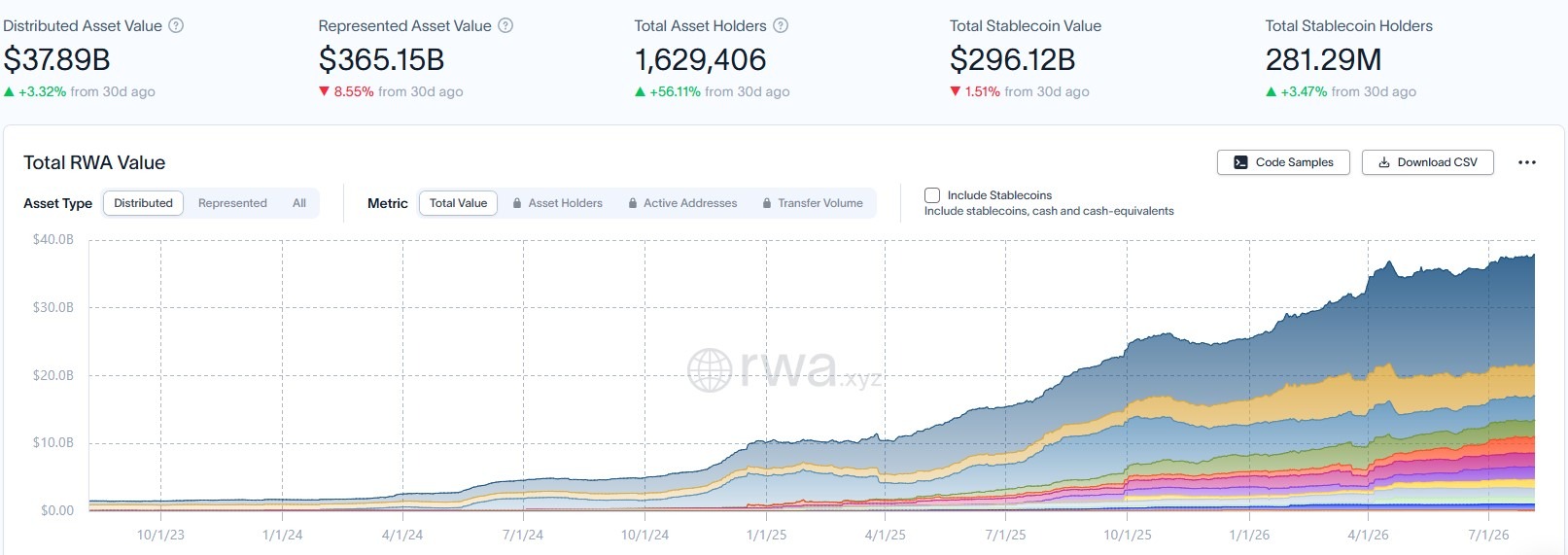
Additionally, according to RWA.xyz (a platform that tracks everything from tokenized Treasuries and private credit to commodities and institutional funds), tokenized RWAs topped $30 billion on-chain in 2026, which is more than double the previous year.
As of August 2026, tokenized RWAs are nearing $38 billion in total on-chain value.
RWAs are Becoming the Bridge Between TradFi and DeFi
Instead of replacing traditional finance, RWAs are acting more like a link between it and the blockchain world. Banks and asset managers can now launch regulated products on public blockchains without stepping outside securities laws.
Meanwhile, DeFi users gain access to assets previously unavailable on-chain.
This means that traditional finance brings capital, regulation, and proven products, while blockchain delivers 24/7 settlement, transparency, programmability, global access, and lower fees.
Many are starting to see tokenization as infrastructure, as opposed to just another crypto application.
Which Sectors are Growing Fastest?
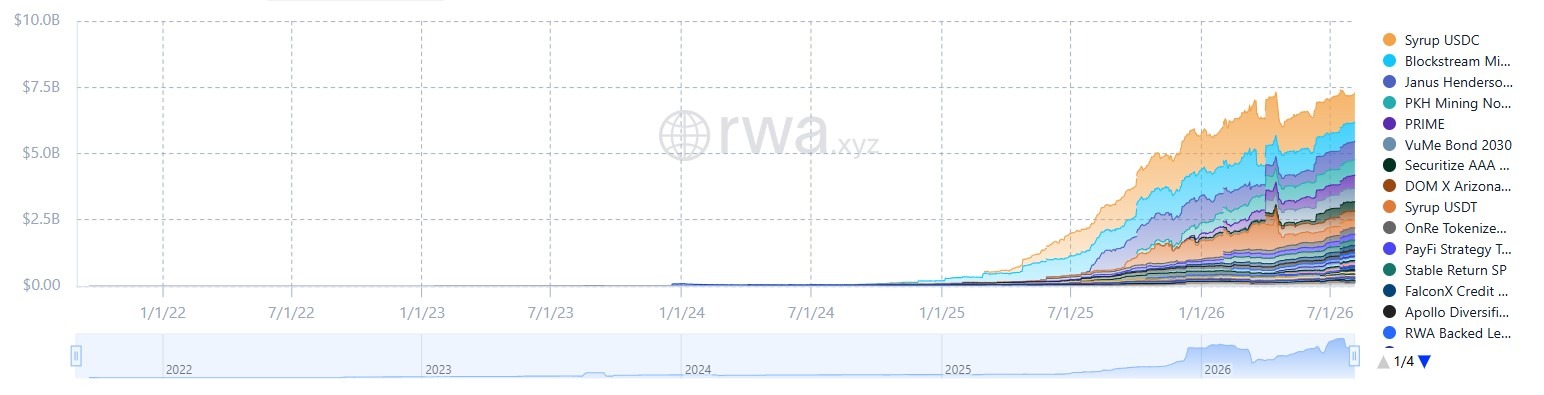
Tokenized credit remains the largest RWA category, with blockchain cutting costs and giving investors better visibility. RWA.xyz data shows that its total on-chain value surpassed $7 billion.
That said, Treasury bills represent the fastest-growing institutional segment, driven by higher rates and demand for safer yields.
Moreover, commodities (especially gold-backed tokens) are expanding as they combine the safety of gold with the ease of blockchain trading, often attracting more money during times of global uncertainty.
There’s real estate too, which is small compared to the credit market, but is growing steadily.
Biggest Challenges Remaining
Even with all that growth, tokenized RWAs still have a few obstacles to clear before they become mainstream.
Regulations are tricky and complex, as assets need to comply with different securities, tax, and AML laws across borders. Also, liquidity can be thin, since many of these assets trade on much smaller markets than traditional ones.
Interoperability is another issue, with different blockchains and token standards not always having seamless transfers between ecosystems.
A blockchain token needs to clearly represent an enforceable right to whatever asset it’s tied to, which means solid legal backing and trustworthy custodians are required as well.
Related: HTX Research Says RWA Market Is Shifting From Asset Tokenisation to Cash-Flow Finance
Disclaimer: The information presented in this article is for informational and educational purposes only. The article does not constitute financial advice or advice of any kind. Coin Edition is not responsible for any losses incurred as a result of the utilization of content, products, or services mentioned. Readers are advised to exercise caution before taking any action related to the company.