
- The Indian rupee is now trading around a record low of 97 against the US dollar.
- This fall is due to the US-Iran war, oil price surge, and foreign investor outflow.
- As the RBI has intervened multiple times, the rupee has slightly surged on Friday.
The Indian rupee continues to trade near the record low of 97 against the US dollar. Although it recovered slightly on Friday, the broader sentiment remains concerning. The fiat currency is under rising pressure due to increasing crude oil prices, foreign investor outflow, and heightened geopolitical tensions.
Why is the Indian Rupee Falling?
The month of July this year is defined by global financial instability. In line with this larger trend, the Indian rupee is also experiencing huge pressure. It has fallen by around 2% against the US dollar, and is now trading near a record low of 97. While it recently reached 96.8 per dollar, it is now one of the weakest-performing currencies in Asia.
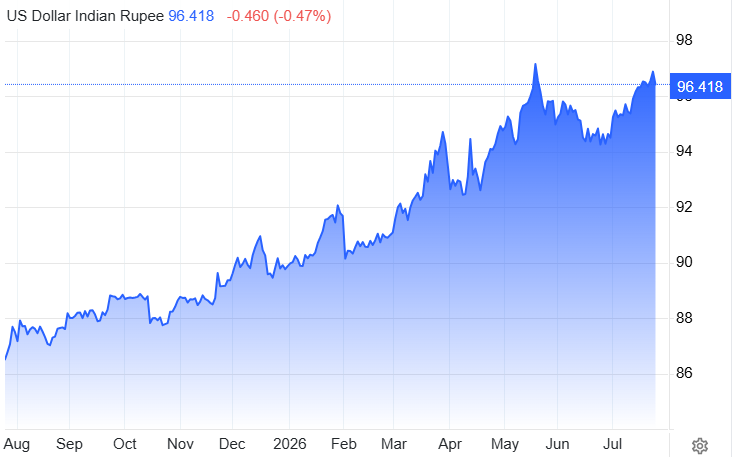
Source: Trading Economics
This sharp decline in the Indian rupee is the result of a combination of reasons, including global and domestic factors. One of the main reasons is the ongoing US-Iran war and its related consequences. The rising geopolitical issues have pushed back risk assets and many fiat currencies, including the rupee, while the US dollar stays strong.
The surging oil prices have also been a major issue as it has increased India’s import bills. The country imports about 90% of its crude oil, which makes it highly vulnerable to rising oil prices. When oil prices surge, India is forced to spend more dollars on imports. This puts extra pressure on the rupee. In addition, foreign investors have pulled their money out of Indian stocks and bonds, significantly impacting the rupee.
Is the RBI Stopping the Currency from Falling?
It is worth noting that the Reserve Bank of India (RBI) has intervened multiple times to support the Indian rupee. With the intention of helping the falling fiat, the bank sold billions of dollars from its foreign exchange reserves. It has also introduced measures such as forex swaps and tighter market rules.
However, according to experts, RBI’s efforts help only to reduce volatility and not to stop the fall. JB Drax Honore’s Vivek Rajpal stated, “The RBI’s softer approach towards intervention has been difficult to understand.”
Indian Rupee Recovers after RBI Intervention
Impressively, the Indian rupee has exhibited a marginal recovery following the reported intervention of the RBI. The fiat price surged by 18 paise to close at around 96.55 against the US dollar on Friday. V K Vijayakumar, the Chief Investment Strategist at Geojit Investments Ltd., stated
“Rupee has been stable on Friday, trading around 96.55 to the dollar at 3.30 pm. There are reports of RBI intervention to prevent further depreciation of the rupee. Some PSU banks are also reported to have sold dollars to stabilise the rupee. If crude declines next week, it can further help the rupee to stabilise.”
However, if global tensions continue to rise, the Indian rupee is expected to stay in the red zone. The higher the crude oil prices rise, the weaker the rupee could become. Anuj Choudhary, Research Analyst at Mirae Asset Sharekhan, noted, “We expect the rupee to trade with a negative bias as on further escalation in tensions between the US and Iran. Elevated crude oil prices may also pressure the rupee.”
How a Weaker Rupee Could Help Crypto?
Interestingly, as the Indian rupee weakens, cryptocurrencies like Bitcoin become more powerful in the country. As cryptocurrencies are priced globally in dollars, a falling rupee can be a positive development for BTC and altcoins. This is because their Indian values can surge even if the dollar price remains unchanged. Thus, cryptocurrencies are facing higher demand as the fiat price falls.
Also, dollar-pegged stablecoins are seeing rising demand. As tokens like USDT and USDC allow investors to hold US dollars indirectly, Indians are choosing them over the rupee.
Related: Why the Indian Rupee Is Falling and What It Means for Bitcoin
Disclaimer: The information presented in this article is for informational and educational purposes only. The article does not constitute financial advice or advice of any kind. Coin Edition is not responsible for any losses incurred as a result of the utilization of content, products, or services mentioned. Readers are advised to exercise caution before taking any action related to the company.