
- Bullish ZEC price prediction for 2026 ranges from $900 to $1,200.
- ZEC could hit $1,000 before end of 2026 if NU7 mainnet delivers and the Grayscale ETF gets approved.
- The bearish ZEC price prediction for 2026 is $400.
Zcash trades at $614 in June 2026, up over 1,000% in the past year and backed by some of the most respected names in institutional crypto. Arthur Hayes sold Bitcoin to buy it, Paradigm and a16z seeded its developer ecosystem, and the SEC just closed its multi-year investigation without taking action. This ZEC price prediction breaks down where Zcash goes from here, covering technical analysis for 2026 and forecasts through 2050.
Table of contents
- What Is Zcash (ZEC)?
- Zcash (ZEC) Price Prediction Overview
- ZEC Price Prediction 2026
- Zcash (ZEC) Price Prediction 2027
- Zcash (ZEC) Price Prediction 2028
- Zcash (ZEC) Price Prediction 2030
- Zcash (ZEC) Price Prediction 2031
- Zcash (ZEC) Price Prediction 2040
- Zcash (ZEC) Price Prediction 2050
- What Major Analysts and Institutions Say About ZEC
- Conclusion
- Frequently Asked Questions (FAQs)
What Is Zcash (ZEC)?
Zcash is a proof-of-work cryptocurrency launched in October 2016 by the Electric Coin Company. It was built using zk-SNARKs, a form of zero-knowledge proof that allows transactions to be verified without revealing the sender, receiver, or amount. Users choose between transparent addresses, publicly visible like Bitcoin, and shielded addresses where all transaction data is encrypted.
The NU5 upgrade in 2022 introduced Halo 2, removing the trusted setup requirement and making Zcash’s privacy model mathematically stronger than any prior iteration. Shielded adoption has climbed steadily since, reaching 59.3% by February 2026 with 20 to 25% of circulating ZEC held in encrypted addresses.
ZEC has a fixed supply of 21 million coins and undergoes halvings approximately every four years, mirroring Bitcoin’s monetary policy. The most recent halving has reduced new supply issuance at precisely the moment institutional demand is building. ZEC trades on Binance, Coinbase, OKX, Kraken, and most tier-1 exchanges globally.
Zcash (ZEC) Price Prediction Overview
| Year | Minimum | Average | Maximum |
| 2026 | $400 | $750 | $1,200 |
| 2027 | $600 | $1,500 | $3,000 |
| 2028 | $1,000 | $2,500 | $5,000 |
| 2030 | $2,000 | $5,000 | $10,000 |
| 2031 | $1,500 | $3,500 | $6,000 |
| 2040 | $5,000 | $15,000 | $30,000 |
| 2050 | $10,000 | $30,000 | $80,000 |
ZEC Price Prediction 2026
Fibonacci Levels: $806 Extension in Sight After 0.618 Holds
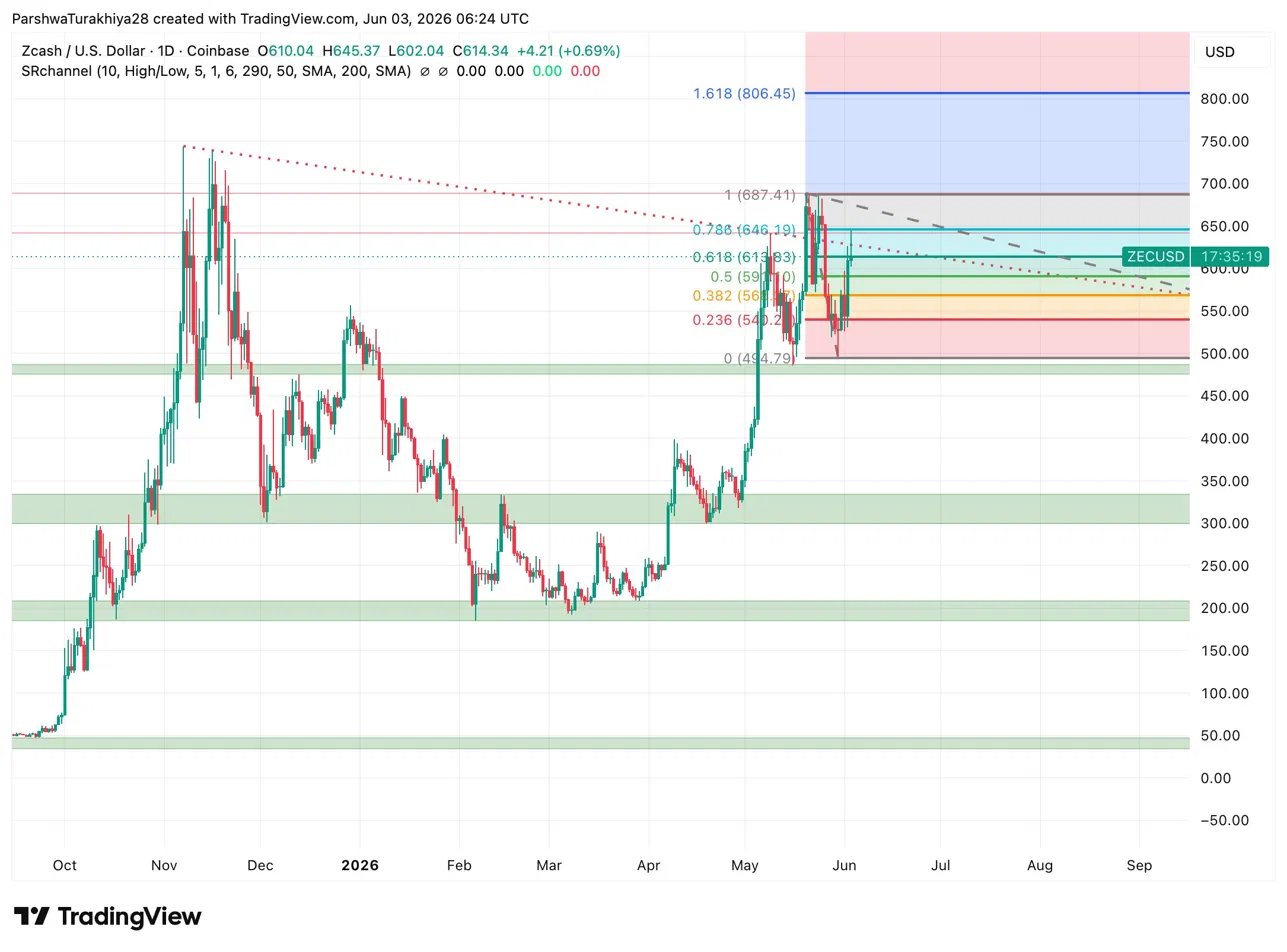
ZEC trades at $614.34 on June 3, sitting right at the 0.618 Fibonacci retracement level at $613.83 after a sharp rally from the March swing low at $494.79 through the swing high at $687.41. This is a critical location. The 0.618 is the deepest retracement most trending assets pull back to before resuming. A hold here keeps the 0.786 Fib at $646.19 and the full retracement at $687.41 as the next resistance levels, with the 1.618 extension at $806.45 as the bullish projection target sitting inside the blue channel zone visible on the chart.
A breakdown below the 0.5 Fib at $595.10 weakens the immediate case. Losing $567.67, where the 20 EMA sits, would shift the short-term bias bearish and open a retest of the 0.236 level at $540.20.
Key ZEC levels for 2026:
- Resistance: $646 (0.786 Fib), $687 (swing high), $806 (1.618 extension)
- Support: $595 (0.5 Fib), $567 (20 EMA), $540 (0.236 Fib), $494 (range low)
Bollinger Bands and EMAs: Cleanest Bullish Structure Since 2021
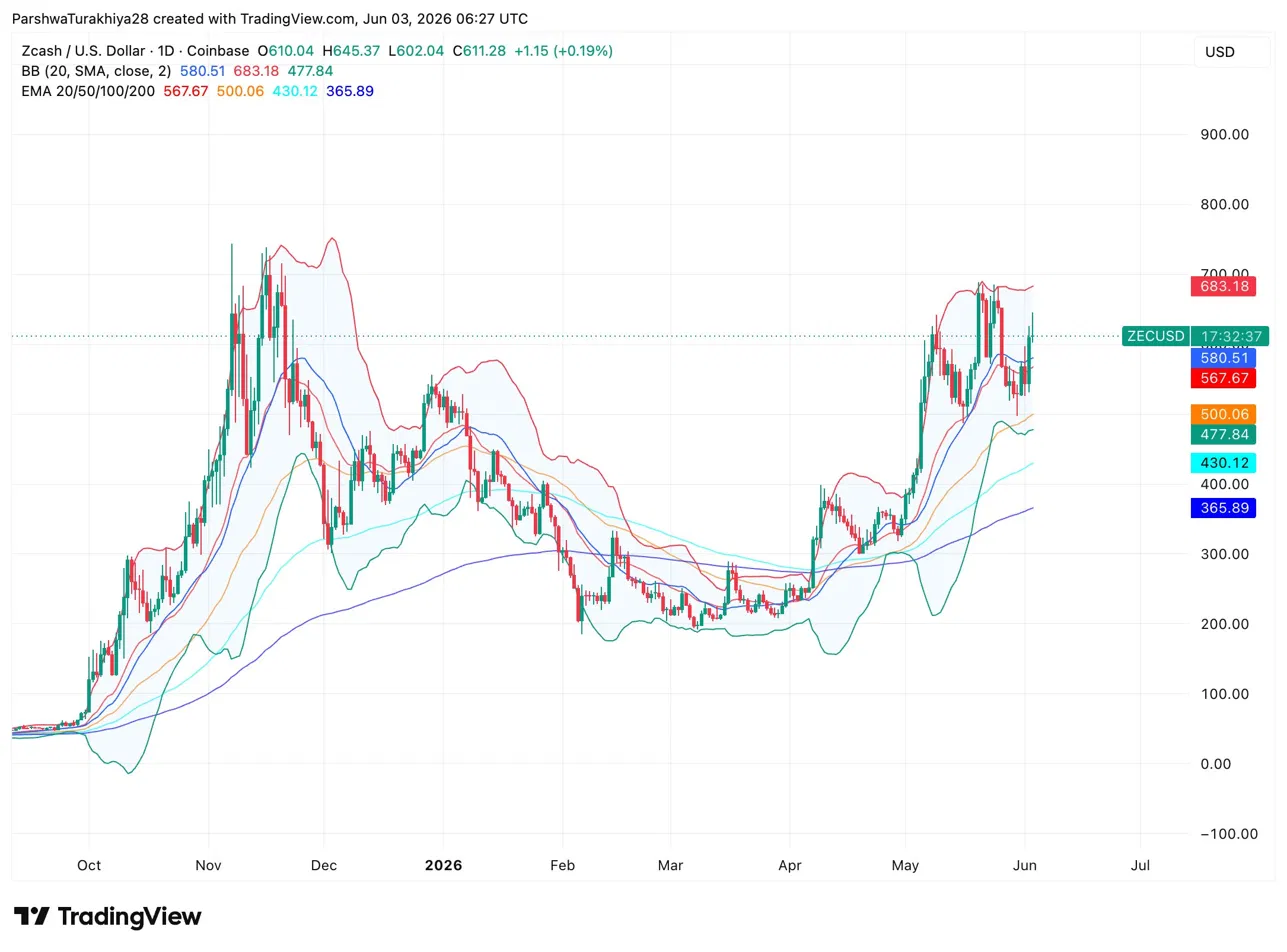
All four daily EMAs are stacked below price in ascending order. The 20 EMA sits at $567.67, the 50 EMA at $500.06, the 100 EMA at $430.12, and the 200 EMA at $365.89. When the full EMA stack confirms below price like this, it is one of the strongest trend continuation signals on the daily chart.
The Bollinger Band upper boundary at $683.18 roughly coincides with the swing high resistance at $687.41, making that zone a double ceiling on any push higher. The midline at $580.51 is the first pullback support, with the lower band at $477.84 aligning with prior structure near the $494 swing low.
RSI Divergence: Bullish Signal Already Played Out, Bear Tag at the Top
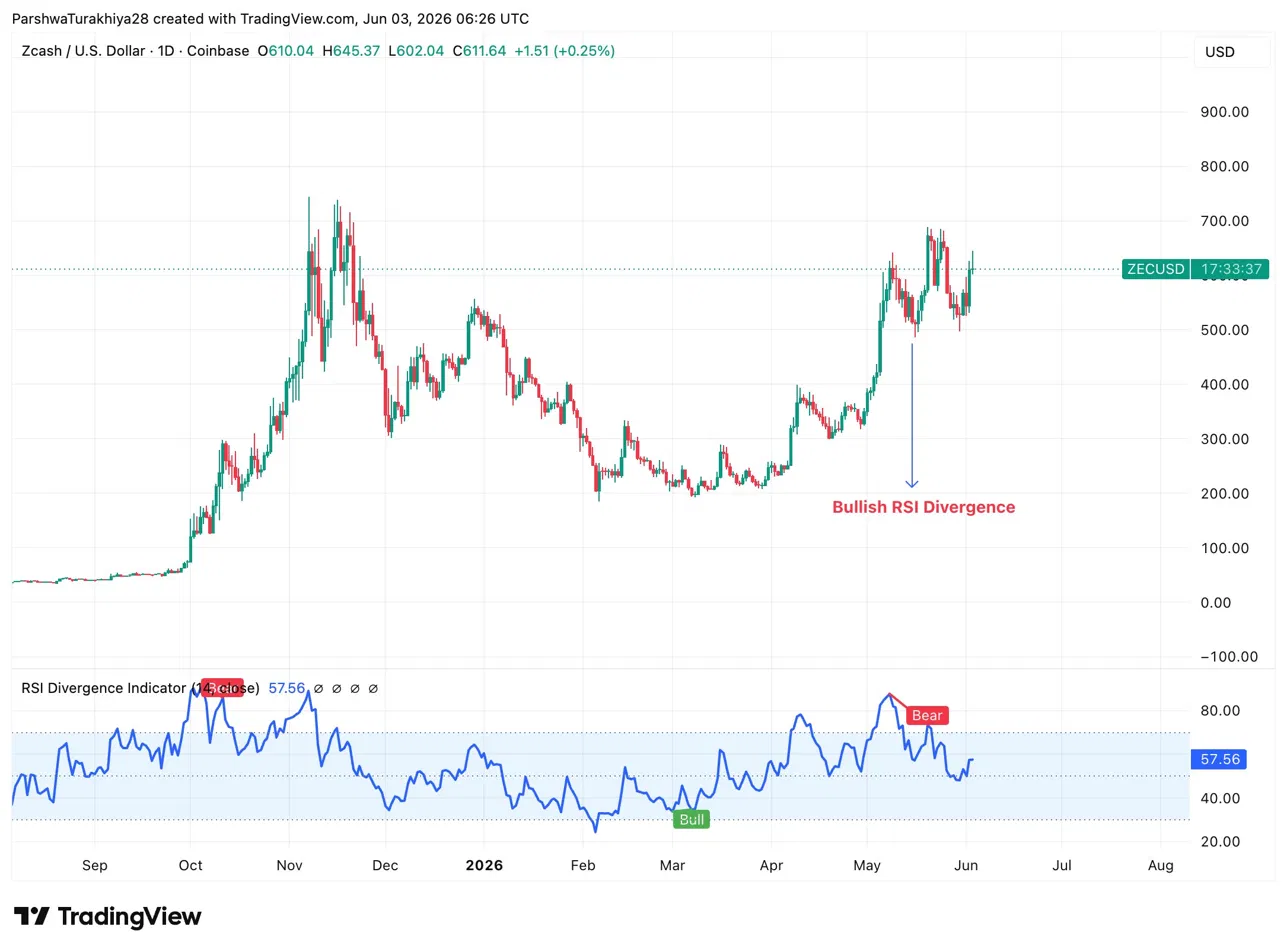
The RSI divergence chart confirmed a textbook bullish divergence earlier in the cycle when price printed lower lows while RSI made higher lows. That signal preceded the entire rally from $200 to $700. The RSI currently sits at 57.56, mid-range with room to push toward 70 before reaching overbought territory.
A bear divergence was flagged at the May peak, which explains the current pullback. As long as RSI holds above 50, the primary daily trend remains intact. A drop below 50 would signal momentum has genuinely shifted rather than simply consolidating.
Zcash (ZEC) 2026 Fundamental Catalysts
The SEC closing its Zcash investigation on June 2, 2026 without enforcement action was the regulatory clearance event the market had been waiting on since 2023. Exchanges and institutional funds that held back on ZEC exposure due to legal uncertainty now have a clean path to build positions.
NU7 launched on testnet in May 2026, reducing block times from 75 seconds to 25 seconds and tripling network throughput. The first coinholder governance poll for NU7 happens in June 2026, with mainnet activation targeted for late 2026. The upgrade also introduces a Network Sustainability Mechanism that realigns miner incentives and lays the groundwork for Zcash Shielded Assets, private user-defined tokens within the shielded pool.
https://twitter.com/search?q=grayscale%20zcash%20etf&src=typed_query
The Grayscale spot ZEC ETF filing remains the single most powerful pending catalyst. Approval would direct institutional capital from traditional accounts into a $10.24B asset with constrained circulating supply. The supply shock math is straightforward and the setup for a significant repricing is in place.
ZEC 2026 Forecast Table
| Scenario | Price Range |
| Bullish | $900 to $1,200 |
| Average | $700 to $900 |
| Bearish | $400 to $600 |
Zcash (ZEC) Price Prediction 2027
By 2027 the NU7 mainnet upgrade will be live and its real-world performance will be the central narrative driving ZEC sentiment. Shielded Assets, the feature delayed from NU7’s initial scope due to compatibility issues, is expected to roll out in 2027. This functionality allows user-defined private tokens inside Zcash’s shielded pool, which means stablecoins, tokenized securities, and corporate payment instruments can all operate with Zcash-grade privacy. The addressable market that unlocks is fundamentally different from privacy coin speculation.
Full post-quantum security is the Zcash Foundation’s formal 2027 target. This matters for institutional treasury allocation at the sovereign wealth fund and central bank level, where 10-year cryptographic durability is a requirement. No other major privacy protocol is actively building quantum resistance into its base layer on this timeline.
The 2027 crypto market sits approximately 12 to 18 months after the April 2028 Bitcoin halving on the post-halving alt-season runway. If BTC approaches $150,000 to $200,000 during this window, ZEC at $3,000 would still represent only 2% of Bitcoin’s price, well below Hayes’ 10% framework target. The downside risk centers on Shielded Assets execution delays and competition from newer zero-knowledge privacy protocols building since 2022.
ZEC 2027 Forecast Table
| Scenario | Price Range |
| Bullish | $2,000 to $3,000 |
| Average | $1,200 to $2,000 |
| Bearish | $600 to $900 |
Zcash (ZEC) Price Prediction 2028
The April 2028 Bitcoin halving reduces BTC block rewards from 3.125 to 1.5625 BTC. Every prior halving has produced a new all-time high within 12 to 18 months, with altcoins following with amplified moves. ZEC has historically delivered 3x to 5x multipliers on BTC’s percentage gains during alt-season periods.
By 2028, institutional infrastructure will have had two full years to mature. If Grayscale’s ZEC ETF is running, Cypherpunk Technologies’ stated goal of owning 5% of the network will have been partially or fully executed, and Maelstrom’s ZEC position will be well in profit. Corporate treasury buyers holding at cost basis significantly below market do not generate selling pressure. They hold through volatility and reinforce the floor.
Zcash Shielded Assets in production would shift ZEC from a privacy coin into a privacy infrastructure layer, a fundamentally different category for institutional valuation models. The bearish case in 2028 assumes regulatory pressure on privacy protocols in key markets and execution failure on the Shielded Assets roadmap.
ZEC 2028 Forecast Table
| Scenario | Price Range |
| Bullish | $3,500 to $5,000 |
| Average | $2,000 to $3,500 |
| Bearish | $1,000 to $1,500 |
Zcash (ZEC) Price Prediction 2030
Two converging institutional frameworks point to the same 2030 price zone. Hayes’ model of ZEC at 10% of Bitcoin’s price implies $10,000 to $20,000 if BTC reaches $100,000 to $200,000. Winklevoss’ $9,700 target, derived from ZEC capturing 1% of global offshore wealth, arrives at a similar number through a completely different methodology. When independent valuation frameworks from sophisticated buyers converge, the signal is worth taking seriously.
The supply side reinforces the bullish case. Four years of post-halving issuance will have reduced new ZEC supply materially. Combined with institutional accumulation already underway, the circulating float available for market trading will be increasingly constrained. The bearish scenario at $2,000 to $3,000 assumes ZEC retains its existing niche but fails to achieve mainstream institutional integration as a compliant settlement layer.
ZEC 2030 Forecast Table
| Scenario | Price Range |
| Bullish | $7,000 to $10,000 |
| Average | $4,000 to $7,000 |
| Bearish | $2,000 to $3,000 |
Zcash (ZEC) Price Prediction 2031
Post-cycle consolidation follows every crypto bull run. After a 2030 peak, ZEC will likely enter a range-bound phase before the next halving cycle builds in 2032. Historical altcoin behavior shows drawdowns of 40% to 60% from cycle highs during consolidation periods, which would place 2031 between $3,500 and $6,000 assuming a $7,000 to $10,000 2030 peak. The key question by 2031 is whether ZEC has defended its position as the leading privacy settlement layer against younger zero-knowledge competitors that will have had several more years to build institutional relationships and developer ecosystems.
ZEC 2031 Forecast Table
| Scenario | Price Range |
| Bullish | $5,000 to $6,000 |
| Average | $3,000 to $5,000 |
| Bearish | $1,500 to $2,500 |
Zcash (ZEC) Price Prediction 2040
By 2040, the assets that survived will be those with genuine utility, institutional integration, and cryptographic security that holds up against post-quantum threats. Zcash is one of the very few cryptocurrencies actively building quantum resistance into its base protocol. That is not a marketing claim. It is a technical roadmap with a 2027 initial target and ongoing development through the 2030s.
If financial privacy becomes a regulated compliance feature globally by the 2030s, Zcash’s architecture, which allows selective transparency through view keys, positions it as the only privacy protocol built for a world where institutions need both privacy and auditability. The market for that tool runs into trillions of dollars annually. Under Hayes’ 10% of BTC framework with Bitcoin at $500,000 to $1,000,000 by 2040, ZEC targets $50,000 to $100,000. A more conservative Winklevoss-style model adjusted for a decade of offshore wealth growth points to $15,000 to $30,000.
ZEC 2040 Forecast Table
| Scenario | Price Range |
| Bullish | $20,000 to $30,000 |
| Average | $12,000 to $20,000 |
| Bearish | $5,000 to $8,000 |
Zcash (ZEC) Price Prediction 2050
By 2050, Bitcoin will have completed its final halving with block rewards effectively at zero. Zcash, built on the same monetary architecture, faces the same long-term security model question, but its shielded transaction fee structure generates more consistent per-transaction revenue. If financial privacy is embedded in mainstream institutional digital infrastructure by the 2050s, a scenario that current regulatory and technological trajectories support, ZEC’s position as the oldest, most audited, most institutionally-held privacy protocol gives it a durable claim on a share of that market.
ZEC 2050 Forecast Table
| Scenario | Price Range |
| Bullish | $50,000 to $80,000 |
| Average | $25,000 to $50,000 |
| Bearish | $10,000 to $15,000 |
What Major Analysts and Institutions Say About ZEC
Arthur Hayes, Maelstrom Fund: Hayes’ ZEC target is 10% of Bitcoin’s price, implying $8,200 at current BTC levels and $10,000 or more if BTC reaches six figures. He sold Bitcoin specifically to buy Zcash and Hyperliquid, confirmed Maelstrom holds ZEC as a core position, named it part of his “holy trinity” alongside HYPE and NEAR on May 22, and most recently predicted a fivefold ZEC move within 12 months tied to geopolitical tensions and AI-driven surveillance narratives.
Tushar Jain, Multicoin Capital: Multicoin built a significant ZEC position starting in February 2026. Jain described it publicly as a return to the cypherpunk ideals that motivated crypto’s founding, framing ZEC as the leading public-market bet on censorship-resistant private money in an era of growing on-chain surveillance.
Tyler Winklevoss, Cypherpunk Technologies: The firm holds 303,906 ZEC at an average cost of $332.83 and has set a $9,700 target based on ZEC capturing 1% of global offshore wealth or 10% of Bitcoin’s market cap. CIO Will McEvoy stated the firm intends to own at least 5% of the entire Zcash network.
Balaji Srinivasan: After the ECC developer team departed in March 2026, Balaji posted “Zcash can scale. Zcash must scale. Zcash will scale” before backing those words with capital, joining the $25M ZODL seed round alongside Paradigm, a16z, and Coinbase Ventures.
Conclusion
Zcash enters H2 2026 with a cleaner setup than at any point in its history. The regulatory overhang is gone, the institutional capital is committed and on record, and the protocol roadmap has its most ambitious upgrade since Halo 2 on testnet and heading to mainnet before year end. All four daily EMAs sit below price in an ascending stack, the 0.618 Fibonacci level is holding as support, and the 1.618 extension at $806.45 is the next technical target before $1,000 becomes the conversation.
The question of whether ZEC hits $1,000 soon is no longer primarily a technical question. It is a question of whether NU7 delivers on mainnet, whether Grayscale’s ETF gets approved, and whether the privacy narrative continues attracting the caliber of institutional conviction it has in the first half of 2026. All three conditions are trending in the same direction.
Frequently Asked Questions (FAQs)
Based on the Fibonacci extension target at $806.45, the NU7 mainnet catalyst expected in late 2026, and the SEC investigation now closed, ZEC reaching $1,000 this year is achievable. A Grayscale ETF approval or shielded pool adoption surpassing 70% would be the trigger for a clean break above $1,000. The bearish case keeps ZEC between $400 and $700 if NU7 experiences further delays or macro conditions deteriorate.
ZEC enters 2026 with the SEC probe closed, capital from Paradigm, a16z, Multicoin, Maelstrom, and Cypherpunk Technologies actively accumulating, a protocol upgrade that triples transaction speed on testnet, and a 21 million supply cap with reduced post-halving issuance. The risks are NU7 execution delays and privacy coin regulatory pressure in EU markets. For investors who understand the volatility, the fundamental setup is among the strongest ZEC has seen in its 10-year history.
Our 2030 average target sits between $4,000 and $7,000, with the bullish scenario reaching $10,000 if Zcash achieves institutional adoption as a compliant privacy settlement layer. Hayes’ 10% of BTC model and Winklevoss’ offshore wealth framework both point toward this range independently. The bearish case at $2,000 to $3,000 assumes ZEC retains its niche without achieving broader financial infrastructure integration.
The 2026 rally reflects several simultaneous catalysts. The SEC closed its multi-year investigation without enforcement action. Paradigm and a16z co-led a $25 million seed round into the ZODL ecosystem. Arthur Hayes, Multicoin, and Cypherpunk Technologies all disclosed public ZEC positions. NU7 launched on testnet tripling transaction speeds. These events arrived within weeks of each other, creating a rare convergence of institutional capital and technical development that the market repriced sharply.
Our 2028 ZEC prediction ranges from $1,000 on the bearish side to $5,000 on the bullish side with an average of $2,000 to $3,500. The April 2028 Bitcoin halving is the primary macro catalyst, with historical alt-season dynamics generating amplified ZEC moves 12 to 18 months post-halving. Full institutional infrastructure through a ZEC ETF and live Shielded Assets functionality would support the upper end of that range.
Disclaimer: The information presented in this article is for informational and educational purposes only. The article does not constitute financial advice or advice of any kind. Coin Edition is not responsible for any losses incurred as a result of the utilization of content, products, or services mentioned. Readers are advised to exercise caution before taking any action related to the company.