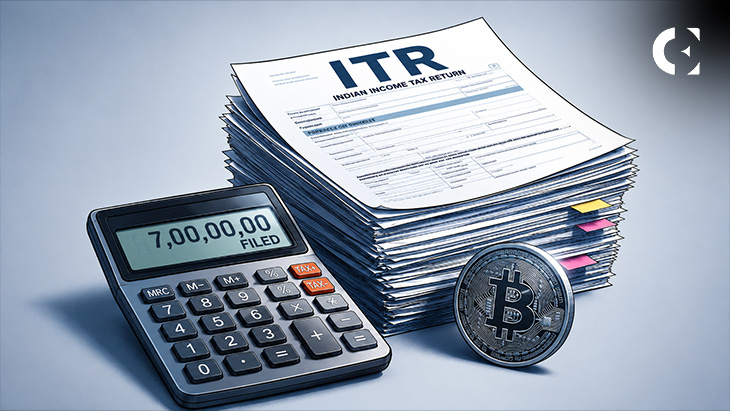

- Over 7 Crore ITRs have already been filed for A.Y. 2026-27, with August 31, 2026, as the due date.
- The new Schedule VDA requires crypto acquisition date, transfer date, cost and consideration received.
- Failing to file ITR correctly or missing the relevant window could trigger severe financial penalties.
The Income Tax Department has announced that over 7 crore Income Tax Returns (ITRs) have already been filed for the Assessment Year (AY) 2026-27. While individual taxpayers filing ITR-1 and ITR-2 faced a July 31, 2026 deadline, August 31, 2026, is the critical deadline for non-audit business entities, professionals and crypto traders filing ITR-3 or ITR-4.
7 Crore ITRs Filed: Why August 31 Matters as New VDA Rules Change Crypto Tax Filing
On 28 August 2026, the Income Tax Department announced that over 7 crore ITRs have already been filed for AY 2026-27. The same official update also reminded taxpayers that 31 August 2026 is the due date for non-audit cases involving business or professional income, primarily ITR-3, ITR-4, ITR-5 and ITR-7.
However, for Indian crypto investors and traders, this is not just another tax deadline, as crypto activity may be considered as business income if the trading is frequent, large scale or with an intention to earn profits. In such cases the correct ITR would be ITR-3, and ITR-4 may apply to taxpayers who choose to opt for the presumptive taxation scheme.
In addition, the filing process has undergone changes with the Schedule VDA disclosure requirement, requiring for transaction-level details of all VDA transfers in FY 2025-26, such as acquisition date, transfer date, income head, cost of acquisition, and consideration received. Crypto investors cannot simply report a net profit on their exchange dashboard. Each transaction must be reconciled with taxpayer records and information in AIS and Form 26AS.
What Crypto Traders Must Reconcile Before Filing: Why Exchange Records and ITRs Can Differ
Before filing an ITR with Virtual Digital Asset (VDA) income for AY 2026-27, crypto traders must actively reconcile exchange and wallet transaction histories, AIS and Form 26AS data, and the transaction-wise entries required in Schedule VDA. A simple download of an exchange’s annual P&L or tax report and input of a net figure is no longer enough. Crypto traders must match every buy, sell, crypto-to-crypto swap, transfer, staking reward, airdrop and disposal across platforms and wallets.
Exchange records and ITRs can differ because of gross volume versus taxable income, treatment of losses, crypto-to-crypto swaps, cost basis and fees, foreign exchanges, self-custody and P2P activity, reporting quirks by exchanges, and timing and INR conversion. It is advised to verify 1% TDS in Form 26AS under Section 194S and verify bank statements and P2P trails against the corresponding VDA movements.
Related: India’s Crypto Tax Regime Could Face a Shake-Up: Could Modi Cut the 30% Tax and 1% TDS?
30% Crypto Tax Is Only Part of the Calculation: What Happens If You Miss the August 31 Deadline
While the headline 30% rate under Section 115BBH is the starting point for taxing gains from VDAs, it is not the final figure that a crypto trader pays. Income from VDA transfers is taxed at a flat 30% on the difference between consideration received and cost of acquisition. There are no selling fees, gas fees or platform charges, and VDA losses cannot be offset. Surcharge and 4% cess can further increase the tax burden.
For taxpayers whose due date is 31 August 2026, missing the deadline has clear consequences. A belated return can still be filed under section 139(4) till 31 December 2026 or before the assessment is completed, whichever is earlier. A late-filing fee under Section 234F is ₹1,000 when total income does not exceed ₹5 lakh and ₹5,000 otherwise. Advance-tax shortfalls or deferment may also be charged interest under Sections 234A, 234B and 234C.
What Indian Crypto Investors Must Check Before Filing Their ITR
Indian crypto investors and traders should ensure that they have the correct ITR form to complete, review AIS and Form 26AS, maintain thorough transaction records, ensure accurate Schedule VDA data entry, reconcile the three data sources, and verify Section 194S TDS credits before filing the return for AY 2026-27. They should also review cost of acquisition, INR conversion, foreign holdings and disclosures, and determine the total tax liability, and file early.
Related: India’s ITR Deadline Nears: Crypto Tax Rules You Should Know
Disclaimer: The information presented in this article is for informational and educational purposes only. The article does not constitute financial advice or advice of any kind. Coin Edition is not responsible for any losses incurred as a result of the utilization of content, products, or services mentioned. Readers are advised to exercise caution before taking any action related to the company.