
- AI tokens beat payment tokens like XRP in South Korean won trading by June 2026.
- AI tokens were 0.91% of yen trading in June; the won rate was 19.5 times higher.
- Worldcoin led AI token volume at $7.41 billion, ahead of SAHARA at $3.2 billion.
Korean retail traders are putting more won into AI-linked crypto tokens than into any other thematic category, according to a Chainalysis report. By June 2026, AI tokens led won-denominated trading among defined themes, ahead of payment tokens such as XRP. The pattern echoes the country’s stock market, which leans heavily on a single memory-chip maker that supplies the data center boom.
A Gap No Other Currency Matches
Chainalysis found AI tokens made up 0.91% of yen trading volume in June, and put the won rate at 19.5 times that level. Multiplying the two figures implies roughly 17.7% of won volume, though the report does not publish that share and the number here is a derived estimate.
The other major currencies sit far lower:
- Euro: 1.02%
- Brazilian real: 0.20%
- British pound: 0.03%
However, the thematic categories do not add up to 100% of won volume. About 413 smaller or unclassified symbols make up the remainder, so AI tokens lead among defined themes, not necessarily across every pair.
Names Moving the Money
Five tokens drew the most volume in the period:
- Worldcoin (WLD): $7.41 billion
- SAHARA: $3.2 billion
- VIRTUAL: $2.7 billion
- BIO: $2 billion
- NEAR: $1.7 billion
The leaders changed within a year. VIRTUAL and KAITO topped the 2025 list before Worldcoin and SAHARA took over. Chainalysis says Korean traders rotate through this category faster and more intensely than any market it tracks. FET and TAO do not appear among the named leaders. FET rose 15.09% in 24 hours on Monday according to market listings, but the report does not tie any single token’s move to Korean flows.
Why the Stock Market Matters
Chainalysis said that AI token trading grew in step with the rise of SK Hynix, which dominates Korea’s mainstream equity market. The report links the two to a shared appetite for high-risk, high-reward themes among retail investors. It describes parallel growth, not proven cause and effect.
A Retail Market Still Waiting for Institutions
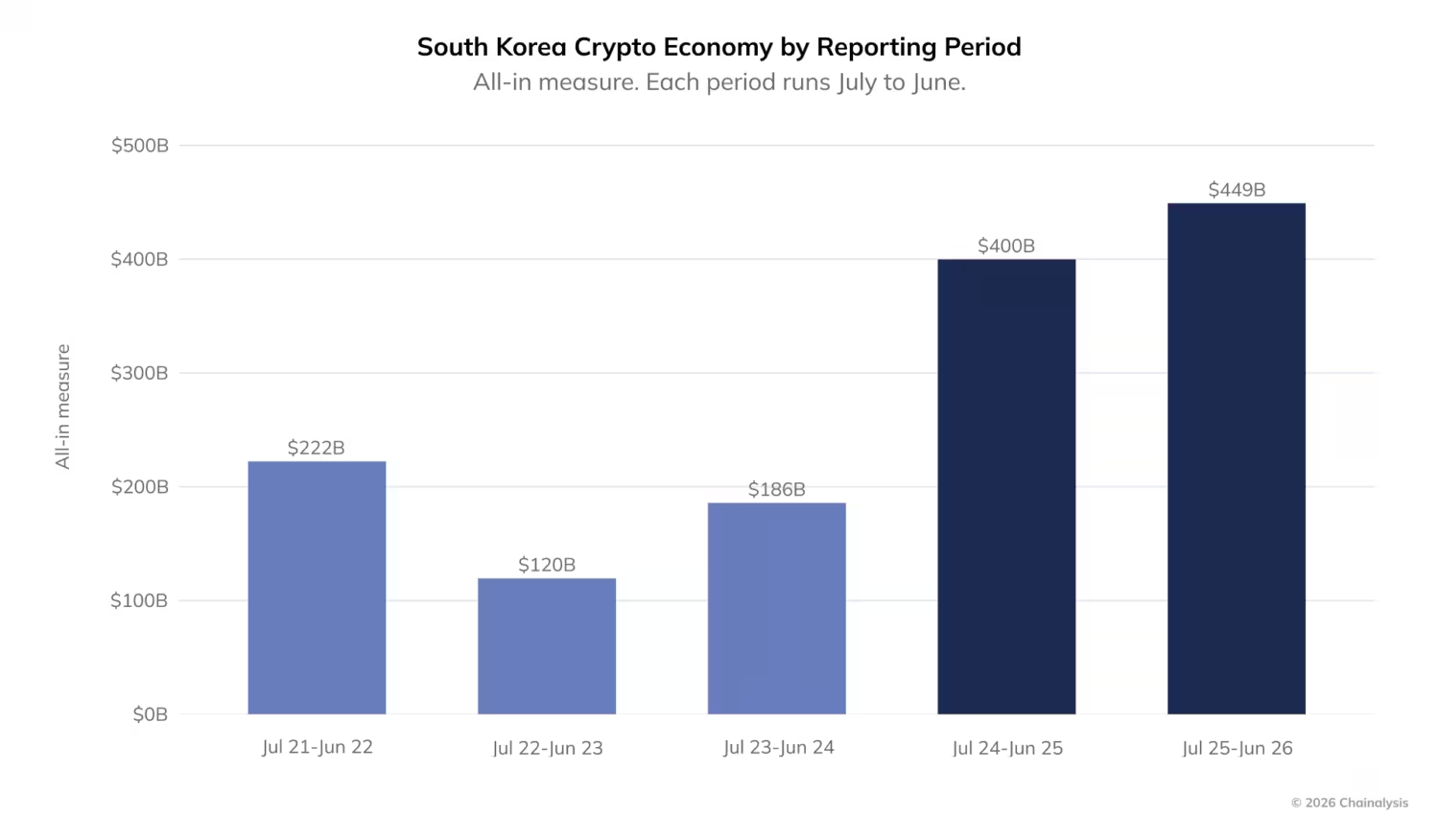
South Korea’s crypto economy reached $449.1 billion in the period, up 12.3%, with an additional $51.1 billion in exchange-related flows. The growth has come largely without major financial institutions.
Francis Kang, executive director of Korea Blockchain Week, described the sector as in “preparatory mode,” with banks and securities firms running stablecoin, tokenisation and custody pilots. The government only began easing its ban on corporate crypto trading in February 2026.
How the Rest of East Asia Compares
- Japan ($228.3 billion): Decentralized exchanges hold 34.5% of the service market, the highest in the region among markets with a mature centralized sector. A July tax reform could cut the top rate from 55% to about 20%.
- Hong Kong ($192.2 billion): Institutional platforms took 16% of service inflows, up from about 9% two years earlier. No other regional market tops 6%.
- China (at least $176.3 billion): Despite the exchange ban, unique wallets sending stablecoin peer-to-peer payments grew 43 times in two years. Chainalysis links the timing to expanded social credit rules but calls that a working hypothesis.
What Changes in 2027
No tax applied to crypto profits during the study period. A 22% tax on gains is scheduled to start in January 2027, though lawmakers have delayed it before and experts told Chainalysis they could again. If it takes effect while corporate access widens, retail activity could cool, and institutions could become a counterweight for the first time. Jinhyeong Jo of Korea’s Financial Intelligence Unit said the National Assembly’s decision could meaningfully affect retail demand.
Related: Securitize, LG CNS Partner to Expand Tokenized Finance in South Korea
Disclaimer: The information presented in this article is for informational and educational purposes only. The article does not constitute financial advice or advice of any kind. Coin Edition is not responsible for any losses incurred as a result of the utilization of content, products, or services mentioned. Readers are advised to exercise caution before taking any action related to the company.