
- Bullish ARB price prediction for 2026 ranges from $0.25 to $0.35.
- ARB could hit $0.20 in 2026 with Robinhood Chain fee-sharing confirmed and March 2027 vesting completion removing monthly unlock pressure.
- The bearish ARB price prediction for 2026 is $0.07.
Arbitrum hit an all-time low of $0.07067 in June 2026, down 97% from its $2.40 peak, while securing $18 billion in TVL across 100+ live Orbit chains including Robinhood’s new Layer 2. On July 9, Offchain Labs co-founder Steven Goldfeder announced 10% of fees from every Orbit chain plus 100% of Arbitrum One fees flow back to ARB tokenholders, sending the token up 13%. That gap between network performance and token price is the entire ARB story, and this price prediction covers whether the fee-sharing model finally closes it through 2050.
Table of contents
- What Is Arbitrum (ARB)?
- Arbitrum (ARB) Tokenomics: The Unlock Schedule Is the Chart
- Arbitrum (ARB) Current Market Status
- Arbitrum (ARB) Price Prediction 2026-2050 Overview
- Arbitrum (ARB) Price Prediction 2026
- ARB 2026 Fundamental Catalysts
- Arbitrum (ARB) Price Prediction 2027
- Arbitrum (ARB) Price Prediction 2028
- Arbitrum (ARB) Price Prediction 2030
- Arbitrum (ARB) Price Prediction 2031
- Arbitrum (ARB) Price Prediction 2040
- Arbitrum (ARB) Price Prediction 2050
- Conclusion
- Frequently Asked Questions (FAQs)
What Is Arbitrum (ARB)?
Arbitrum is Ethereum’s largest Layer-2 scaling solution, built by Offchain Labs and founded by Ed Felten, former US Deputy CTO under Obama, alongside Steven Goldfeder and Harry Kalodner, all Princeton alumni. Live since September 2021, it processes transactions off-chain, bundles them into rollup batches, and settles to Ethereum mainnet, delivering 90 to 95% lower fees while inheriting Ethereum’s security.
Four products make up the ecosystem:
- Arbitrum One: The flagship public L2 with $18B+ in TVS, home to GMX, Aave, Uniswap, Pendle, and dozens of major DeFi protocols
- Arbitrum Nova: AnyTrust-based, lower cost, optimised for gaming and high-frequency applications
- Arbitrum Orbit: Framework for deploying custom L2 and L3 chains, with 100+ already live including Robinhood Chain, Xai, and LG Electronics’ ad infrastructure chain, each paying 10% of fees back to the ecosystem
- Arbitrum Stylus: Launched September 2024, adds WASM support allowing smart contracts in Rust, C, and C++, a first for Ethereum L2s
ARB is the governance token for the Arbitrum DAO. Holders vote on protocol upgrades, treasury allocations, Security Council elections, and grant programmes. ARB does not collect gas fees directly since all Arbitrum transactions pay in ETH. The new fee-sharing model is the first mechanism creating a direct link between Orbit chain growth and ARB tokenholder value.
Arbitrum (ARB) Tokenomics: The Unlock Schedule Is the Chart
Total supply is 10 billion ARB, with approximately 6.36 billion circulating as of July 10, 2026, representing 63.6% of total supply.
The most important tokenomics fact: a $2.4 billion cliff unlock of 1.1 billion ARB hit on March 16, 2026, clearing the largest single batch of early investor and team allocations. Following that, ARB transitioned to a linear monthly cadence of approximately 92.63 million ARB per month through March 2027, when all original vesting schedules conclude.
At current prices that is roughly $7.6 million in new supply entering the market every month. Every rally through March 2027 faces structured selling from vesting holders. The end of that schedule in March 2027 is the single most important bullish structural event on ARB’s calendar, arriving eight months from now.
The new fee-sharing model, 10% of Orbit chain revenue to the treasury and 100% of Arbitrum One revenue to the treasury, is the counter-mechanism. ARB holders govern that treasury but do not automatically receive distributions. A formal value-return mechanism requires a separate DAO vote.
Arbitrum (ARB) Current Market Status
| Metric | Value |
| Price (July 10, 2026) | ~$0.087 to $0.090 |
| All-Time High | $2.40 (January 12, 2024) |
| All-Time Low | $0.07067 (June 25, 2026) |
| Market Capitalization | ~$549M to $575M |
| CMC Rank | ~#74 to #82 |
| TVL / TVS | $18B+ |
| Daily Active Wallets | 140,000+ |
| Orbit Chains Live | 100+ |
| Circulating Supply | ~6.36B ARB |
| Total Supply | 10B ARB |
Arbitrum (ARB) Price Prediction 2026-2050 Overview
| Year | Bearish | Base | Bullish |
| 2026 | $0.07 to $0.10 | $0.10 to $0.20 | $0.25 to $0.35 |
| 2027 | $0.08 to $0.15 | $0.15 to $0.45 | $0.50 to $1 |
| 2028 | $0.10 to $0.25 | $0.30 to $0.70 | $0.80 to $1.50 |
| 2030 | $0.25 to $0.60 | $1 to $3 | $4 to $8 |
| 2031 | $0.20 to $0.50 | $0.60 to $1.50 | $2 to $4 |
| 2040 | $1 to $3 | $5 to $15 | $15 to $30 |
| 2050 | $2 to $6 | $8 to $25 | $30 to $100 |
Arbitrum (ARB) Price Prediction 2026
EMA Stack and RSI: First Sign of Recovery but the Descending Channel Has Rejected Every Rally This Year
The daily EMAs on July 10 show the 20 EMA at $0.0816, 50 EMA at $0.0883, 100 EMA at $0.1010, and 200 EMA at $0.1394. Price at $0.0941 sits above the 20 and 50 EMAs for the first time since the downtrend began, but remains below the 100 EMA at $0.1010 and well below the 200 EMA at $0.1394. Two significant EMA ceilings still sit overhead.
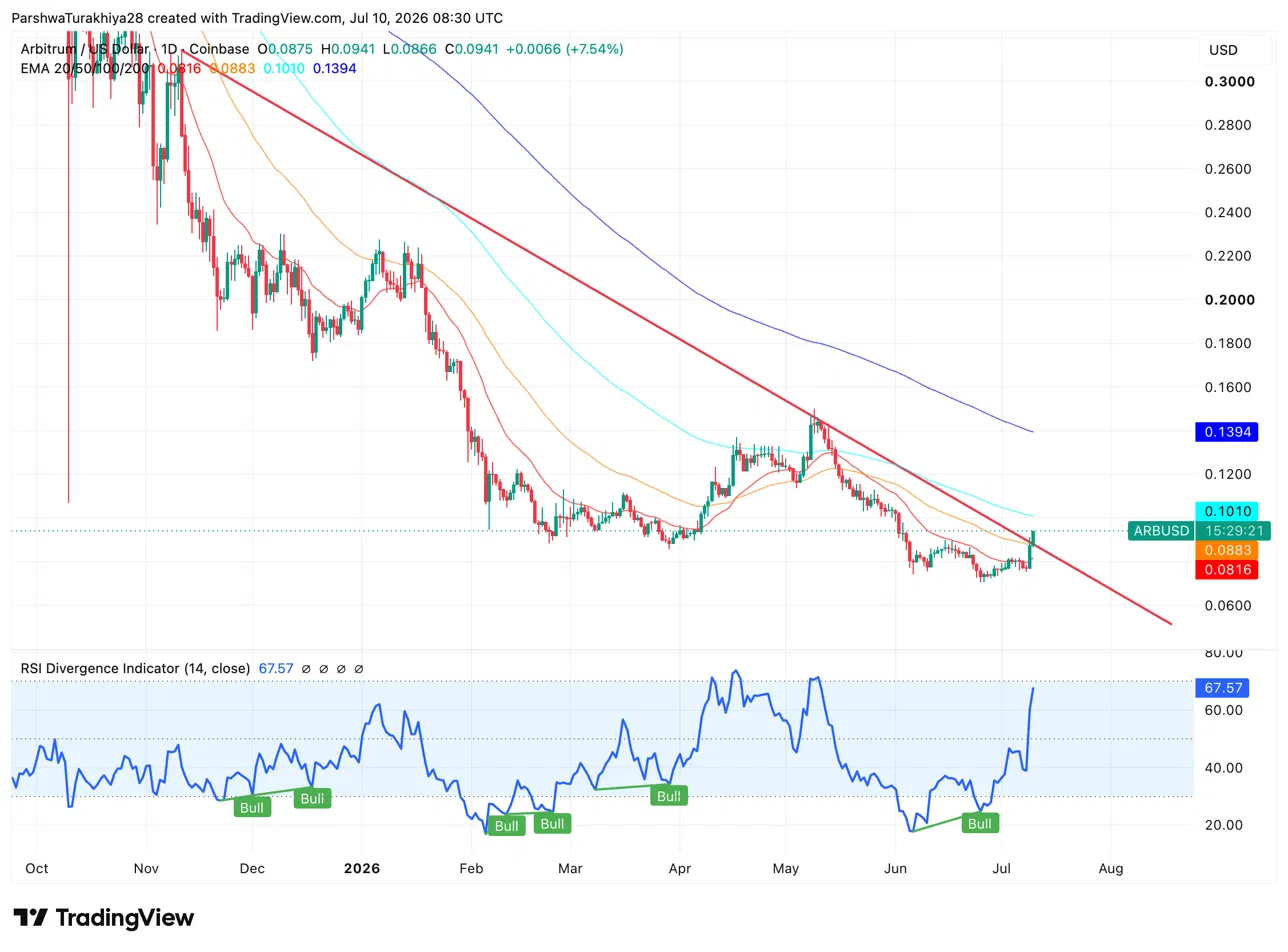
The more important observation is the descending channel. The steep trendlines running from October 2025 through today have rejected every meaningful rally for nine months. Today’s session high of $0.0941 is pressing directly against the descending upper trendline. A confirmed daily close above it would be the first structural break of the downtrend on record. Without that close, it is another test of the same resistance that has held all year.
The RSI divergence indicator reads 67.57, rising sharply from the fifth bull divergence signal fired in late June, the strongest of the five that have printed since October 2025. Each prior signal showed RSI printing a higher low while price printed a lower low, producing a temporary bounce before the downtrend resumed. The difference with this fifth signal is where it fired: at the ATL zone near $0.070, the lowest price ARB has ever traded. Bull divergences at all-time lows carry more structural weight than those mid-trend because there is no prior support below to absorb selling if they fail. RSI at 67.57 has room to push toward 70 before overbought territory begins, and whether it clears that level in conjunction with a close above the descending channel is the dual confirmation bulls need.
Key ARB levels for 2026:
- Resistance: $0.0941 (descending channel upper line), $0.1010 (100 EMA), $0.1394 (200 EMA)
- Support: $0.0883 (50 EMA), $0.0816 (20 EMA), $0.0706 (ATL)
ARB 2026 Fundamental Catalysts
Robinhood Chain Fee-Sharing: The New Fundamental Case
This is the first mechanism in ARB’s history that directly links third-party chain growth to tokenholder value. Ten percent of every Orbit chain’s net revenue goes to the Arbitrum ecosystem, with 8% to the treasury and 2% to development. One hundred percent of Arbitrum One’s own fees go to the treasury. Robinhood Chain reached $2.36M in app fees on July 8 and $2.12M on July 9, driven by $560M in DEX volume and 140,000 new addresses. Goldfeder stated directly: “As enterprise adoption is heating up, Arbitrum is well positioned to capture revenue.”
The critical gap sits between current performance and what is needed. Robinhood Chain generated $57K in week-one protocol revenue, meaningful for the first week of a new chain, but 0.7% of the $8M monthly needed to neutralise unlock pressure. The trajectory matters more than the starting point.
Robinhood’s Addressable User Base
Robinhood has tens of millions of users across 120+ countries with the app already live in Robinhood Wallet. The day-one DeFi infrastructure including Uniswap, Chainlink, and BitGo is already in place. If even a fraction of that retail base begins transacting regularly on-chain, the fee trajectory changes rapidly and Arbitrum captures 10% of every dollar generated.
March 2027 Vesting Completion
Every monthly unlock through March 2027 adds approximately $7.6M in supply pressure. The end of that schedule removes the primary structural ceiling that has capped every ARB rally since launch. This is not a product milestone. It is a mechanical removal of the most persistent bearish force in the token’s history, arriving eight months from now.
LG Electronics and the Enterprise Orbit Pipeline
LG Electronics selecting Arbitrum for a custom L2 validates that enterprise adoption extends beyond crypto-native deployments. Each new enterprise Orbit chain contributes to the 10% fee-share pool. The enterprise pipeline building behind Robinhood and LG is the variable that determines how quickly treasury revenue scales toward the level that changes ARB’s fundamental narrative.
The Risk
ARB holders govern the treasury but do not automatically receive distributions. The fee revenue flowing in requires a separate DAO vote to become a value-return mechanism. Until buybacks, staking rewards, or fee distributions are formally approved, the fee-sharing announcement is a treasury-building event rather than direct token value accrual. Base, built on the OP Stack with no token, continues capturing Ethereum L2 mindshare without any of the unlock pressure ARB carries.
| Scenario | Price Range |
| Bullish | $0.25 to $0.35 |
| Average | $0.10 to $0.20 |
| Bearish | $0.07 to $0.10 |
Arbitrum (ARB) Price Prediction 2027
2027 is the pivotal year for ARB and it comes down to two sequential events. First, the March 2027 vesting completion permanently removes approximately 92 million ARB per month in structured sell pressure, the single biggest structural change in the token’s history. Second, pre-halving capital rotation for April 2028 builds through 2027, and ARB entering that window with a live fee-sharing model, 100+ Orbit chains, and zero unlock overhang is a materially stronger setup than at any prior point in the token’s existence.
Changelly projects $0.0603 to $0.208 for 2027, a pre-Goldfeder model. The base case assumes vesting completion drives a structural re-rating in the second half of 2027 as the unlock ceiling lifts for the first time since launch.
| Scenario | Price Range |
| Bullish | $0.50 to $1 |
| Average | $0.15 to $0.45 |
| Bearish | $0.08 to $0.15 |
Arbitrum (ARB) Price Prediction 2028
With vesting complete and the April 2028 Bitcoin halving creating the post-halving altcoin expansion environment, ARB enters 2028 with both structural headwinds addressed. The question is how much Orbit chain fee revenue has scaled by then. If Robinhood Chain, LG Electronics, and the broader enterprise pipeline are generating combined protocol revenue of $50M+ annually by 2028, the treasury’s fee accrual becomes material at ARB’s current market cap. BoLD’s permissionless validation and sequencer decentralisation, both on the 2026 to 2027 roadmap, would remove the two main institutional objections to ARB as infrastructure.
| Scenario | Price Range |
| Bullish | $0.80 to $1.50 |
| Average | $0.30 to $0.70 |
| Bearish | $0.10 to $0.25 |
Arbitrum (ARB) Price Prediction 2030
The 2030 case is a bet on Ethereum L2s remaining the dominant scaling paradigm for global on-chain finance with Arbitrum maintaining its leadership position against ZK rollup competition. PricePrediction.net projects $4.49 to $5.48 for 2030, CoinLore’s base sits at $1.49, and Cryptopolitan targets $1.24 to $1.52. Most models predate the Orbit fee-sharing model. A 2030 base case anchored on Arbitrum One plus 100+ Orbit chains generating combined revenue that the DAO deploys meaningfully produces $1 to $3 as the realistic range. The bull case at $4 to $8 requires both Orbit ecosystem dominance and a DAO-approved value-return mechanism directing treasury revenue to token holders.
| Scenario | Price Range |
| Bullish | $4 to $8 |
| Average | $1 to $3 |
| Bearish | $0.25 to $0.60 |
Arbitrum (ARB) Price Prediction 2031
Post-cycle compression affects every governance token after a major bull run, and ARB has demonstrated this repeatedly with a 97% drawdown from ATH to ATL. The 2031 bear case assumes a partial bull-cycle reversal. The key 2031 differentiator from prior cycles is full vesting completion alongside the fee-sharing model. If the DAO has by then established a formal value-return mechanism, the token carries a price floor tied to protocol revenue rather than pure speculation.
| Scenario | Price Range |
| Bullish | $2 to $4 |
| Average | $0.60 to $1.50 |
| Bearish | $0.20 to $0.50 |
Arbitrum (ARB) Price Prediction 2040
By 2040, whether Ethereum L2s became the dominant global transaction layer or lost to ZK rollups, alt-L1s, or next-generation architectures determines everything. CoinLore’s base sits at $3.3 to $9.1 by 2040 and Coincub’s analysis targets $9 to $20 if Ethereum scaling demand remains strong. Stylus’s multi-language smart contract support and the Orbit enterprise chain pipeline are the two technical moats most likely to remain differentiated by 2040. If Arbitrum is processing a meaningful share of global on-chain financial activity by then, the treasury accumulated across 15 years of 10% fee-sharing becomes the dominant fundamental variable.
| Scenario | Price Range |
| Bullish | $15 to $30 |
| Average | $5 to $15 |
| Bearish | $1 to $3 |
Arbitrum (ARB) Price Prediction 2050
A 2050 ARB price depends on whether Ethereum and its L2 ecosystem became foundational global financial infrastructure or were displaced. PricePrediction.net’s maximum for 2050 is $594, requiring Arbitrum to underpin a multi-trillion dollar on-chain economy with a market cap comparable to today’s major financial institutions. CoinCodex caps its estimate at $1.08 and Changelly’s conservative model averages $0.87. The realistic range splits between L2s as niche and L2s as infrastructure. At 10 billion total supply, $10 per ARB equals a $100 billion market cap, achievable only if Arbitrum becomes a foundational layer of global finance.
| Scenario | Price Range |
| Bullish | $30 to $100 |
| Average | $8 to $25 |
| Bearish | $2 to $6 |
Conclusion
Arbitrum is the clearest example in the 2026 market of a network succeeding while its token failed: $18B in TVS, 140,000 daily wallets, 100+ Orbit chains live including Robinhood’s Layer 2, and a security record good enough for LG Electronics to build on, all sitting behind a token at 96% below ATH. The Goldfeder fee-sharing announcement on July 9 is the first mechanism that actually connects that network success to tokenholder value. Whether it changes the trajectory depends on two sequential events: Robinhood Chain scaling from $57K in week-one protocol revenue toward the $8M monthly needed to offset unlocks, and the March 2027 vesting completion lifting the structural ceiling that has capped every ARB rally since launch. Until then, the token’s near-term story remains the same: real infrastructure underneath, real sell pressure on top, with $0.0852 as the level bulls have to hold through the July 16 unlock to prove this time is different.
Frequently Asked Questions (FAQs)
At $0.087, $0.20 requires a 130% move. The path runs through $0.0897 resistance, then the $0.095 zone, then $0.12 before $0.20 comes into range. Robinhood Chain scaling its fee revenue from $57K in week one toward the $8M monthly needed to offset unlocks is the fundamental catalyst. The March 2027 vesting completion is the structural catalyst. Whether either arrives fast enough to hold price above $0.0852 through July 16’s unlock is the first test.
ARB is one of the more asymmetric infrastructure plays in crypto right now: $18B in TVS, 140,000 daily wallets, 100+ Orbit chains, and a new fee-sharing model, all sitting at 96% below ATH. The counterweight is the $7.6M monthly unlock pressure through March 2027 and the fact that the fee-sharing model benefits the treasury rather than ARB holders automatically, requiring a separate DAO vote on value distribution. It is an infrastructure investment with a real unlock ceiling until March 2027 and a genuine re-rating catalyst once that ceiling lifts.
On July 8 to 9, 2026, Offchain Labs co-founder Steven Goldfeder confirmed that 10% of fees generated on Robinhood Chain and every other Orbit-based Layer 2 flows back to the Arbitrum ecosystem, with 8% to the ARB tokenholder-controlled treasury and 2% to development. Additionally, 100% of Arbitrum One’s own fees go to the treasury. This is the first mechanism directly tying enterprise chain adoption to ARB tokenholder value, positioning Arbitrum as a platform business rather than a single chain.
Average $1 to $3, bullish to $4 to $8 if Arbitrum maintains L2 leadership, the Orbit fee-sharing model generates material treasury revenue, and the DAO approves a formal value-return mechanism directing fees to token holders. Bearish $0.25 to $0.60 if ZK rollups or competing L2s capture market share and Orbit chain adoption plateaus.
The structural answer is the vesting schedule. Since launch, approximately 90 to 100 million ARB per month have unlocked from team, investor, and backer allocations, creating persistent sell pressure regardless of network growth. The network grew while the token suffered dilution. That overhang ends in March 2027. The secondary answer is that ARB has no direct fee accrual mechanism. It is a governance token, and until the DAO votes to distribute treasury revenue to holders, network growth benefits the treasury rather than the token price.
All original team, investor, and backer vesting schedules conclude by March 2027. After that date, the structured monthly sell pressure of approximately 92 million ARB permanently disappears. This is the single most important bullish structural event on ARB’s calendar and has been the most consistent long-term argument from ARB bulls throughout the 2025 to 2026 bear cycle.
Stylus, launched September 2024, added WebAssembly virtual machine support alongside the existing EVM, allowing smart contracts to be written in Rust, C, and C++ for the first time on an Ethereum L2. This unlocks computationally intensive use cases including gaming engines, AI computation, and high-performance cryptography that were previously impractical in Solidity. No other major L2 currently matches this capability, giving Arbitrum a genuine technical advantage in enterprise and high-performance application categories.
Disclaimer: The information presented in this article is for informational and educational purposes only. The article does not constitute financial advice or advice of any kind. Coin Edition is not responsible for any losses incurred as a result of the utilization of content, products, or services mentioned. Readers are advised to exercise caution before taking any action related to the company.