
Crypto APIs are no longer used only by developers writing scripts. Increasingly, they are being accessed directly by AI models that can discover data structures in real time and choose which endpoints to call.
This shift is changing how API products are built. Many providers now offer MCP servers, agent-ready integrations, and even pay-per-request access that removes the need for accounts or API keys. In fact, several APIs today can be used without any signup at all.
As a result, the way APIs are evaluated is also evolving. Coverage and pricing still matter, but so does accessibility, especially whether an AI agent can access and use the data without manual setup or credentials.
This guide looks at five APIs commonly used in crypto trading systems: CoinStats API, altFINS, StealthEX, Codex, and Hyperliquid API. Each serves a different function in the stack, and they are designed to work alongside one another rather than replace each other.
What To Look For in a Crypto API
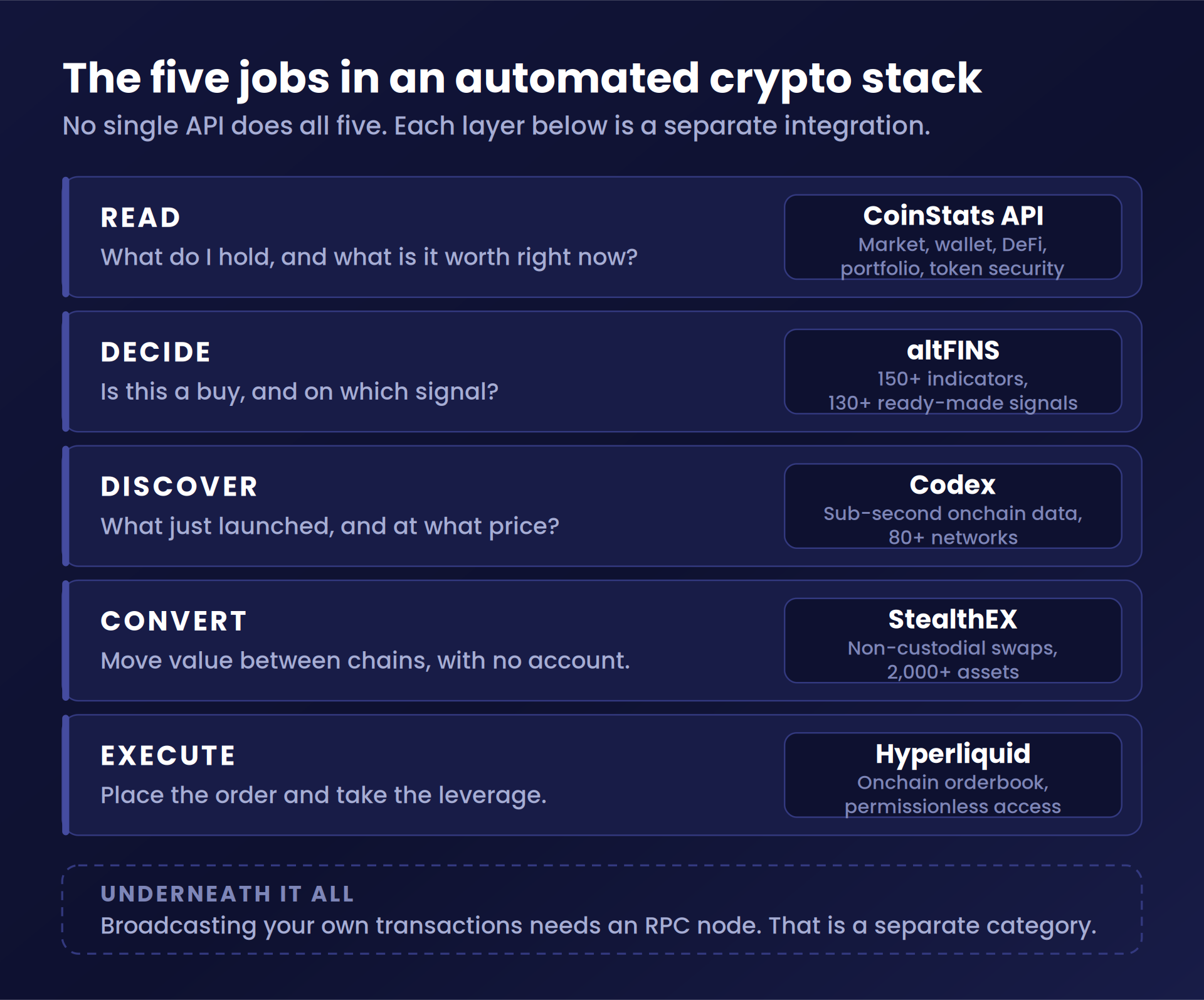
Before comparing vendors, work out which layer the build is missing:
- Aggregated market data. Prices, OHLCV, market caps, and exchange coverage across venues.
- Wallet and portfolio state. Balances, transaction history, DeFi positions, and profit and loss.
- Signals and analytics. Indicators, patterns, and scans, computed for you rather than by you.
- Real-time onchain data. New tokens and pairs, indexed the second they exist.
- Execution. Swap rails and orderbooks that actually move the position.
- Agent access. MCP support, machine payments, and documentation an LLM can read.
Most products need at least three of these. Chain focus narrows it further. A multi-chain tracker and a Solana-only API have different shopping lists.
Quick Comparison
| Provider | Layer | Best for | Free tier | Entry paid plan |
| CoinStats API | Unified data | Market, wallet, DeFi, portfolio, and token security | 20,000 credits/mo | $49/mo |
| altFINS | Signals | Pre-computed indicators and trading signals | 1,000 credits/mo | $39/mo |
| StealthEX | Swap execution | Non-custodial cross-chain conversion | Free integration | Revenue share |
| Codex | Onchain data | Sub-second token, pair, and prediction market data | 10,000 requests/mo | $350/mo |
| Hyperliquid API | Venue execution | Onchain perpetuals and spot orderbooks | Permissionless | None |
The Layer Underneath: RPC and Node Access
None of the five APIs below is a node. They read blockchains, normalize the result, and hand back JSON. That is a different job from connecting to a chain yourself.
That distinction matters when a system needs to interact with the blockchain directly. Tasks like sending transactions, reading contract state, or accessing real-time network activity require an RPC endpoint, a direct connection to a node.
Data APIs do not handle these functions. They are designed to simplify access to structured data, not to execute transactions or interact with the network at a low level.
Because of this, most production systems use both layers together: a data API for processed information and an RPC provider for direct blockchain access. For teams evaluating that second layer, factors like latency, coverage, and cost become key considerations.
The 5 Best Crypto APIs for Trading and AI Agents
1. CoinStats API
CoinStats Crypto API covers the read half of an automated system. One key feature returns market data, wallet balances, DeFi positions, portfolio analytics, and token security. That combination is the unusual part. Most providers sell prices or onchain state, rarely both from one schema.
Coverage runs to 100,000+ coins aggregated from 200+ exchanges. Wallet and DeFi data spans 120+ blockchains and 10,000+ protocols. Positions resolve per address automatically, with no protocol-by-protocol integration. Historical pricing reaches back roughly ten years, which is enough for most backtests. Portfolio endpoints return profit and loss directly. A rebalancing bot reads its input instead of computing it.
Two features matter specifically for automation. Token Risks screens an EVM contract before a bot routes into it. It flags honeypots, hidden fees, mint and blacklist authority, pausable transfers, and upgradeable proxies. Separately, CoinStats MCP Server exposes the same data as callable tools. Claude, Cursor, and VS Code connect over one OAuth URL, with no custom middleware. An x402 endpoint also lets an agent pay per request in USDC on Base. No account, no key.
Pricing is credit-based rather than per call. The free tier gives 20,000 credits per month at 2 requests per second. It permits commercial use, which most free tiers do not. Starter is $49 per month for 1,000,000 credits at 30 requests per second. Basic market calls cost 1 to 2 credits. Wallet calls cost 40 to 50 credits, and full DeFi calls cost 400 credits. Lower-cost endpoints are better suited for frequent polling, while higher-cost queries are typically handled less frequently to optimize usage. Developers should compare integration effort, pricing, and coverage across APIs when choosing between providers.
Strengths
- Market data, wallet, DeFi, portfolio analytics, and token security behind one key
- 120+ blockchains, 200+ exchanges, 10,000+ DeFi protocols, 100,000+ coins
- MCP Server plus x402 pay-per-request access for AI agents
- Free tier allows commercial use, not just prototyping
- Cheap per call on market data, so continuous polling stays affordable
Tradeoffs
- REST only, so latency-critical strategies need a streaming source alongside it
- Wallet and DeFi endpoints are credit-heavy and reward scheduling over looping
- A data API, not an execution API, so orders still route through a venue
- Token risk screening covers EVM chains
Best for: trading bots, portfolio trackers, tax tools, and AI agents. Anything that needs market and position context from one integration.
2. altFINS
altFINS Crypto API sells the layer most teams build themselves and regret. Rather than shipping raw candles, it returns indicators and signals already computed. A bot moves from data straight to decision, and the indicator engine never gets written.
The catalog is deep. It covers 150+ pre-calculated technical indicators. MACD, RSI, SMA, EMA, Bollinger Bands, Stochastic, ADX, and Williams %R are all included. These run across 2,000+ crypto assets, with prices aggregated from 30 exchanges. On top sit 130+ ready-to-use bullish and bearish signals. The platform detects 35 candlestick patterns, from single-candle shapes to three-candle formations. Crossover analytics highlight when one indicator line moves above or below another.
History and cadence suit backtesting. Five intervals run from 15m through 1d. Historical depth scales with the plan, from one month at entry to five years and beyond. Fundamental data comes bundled, covering token revenue, TVL, and valuation ratios. For agents, there is a native MCP server, included on every tier. It gives AI tools read-only access to indicators and signals without requiring custom integration. Research bots and portfolio copilots are explicit design targets, not an afterthought.
Pricing has five steps rather than the usual two. Basic is free with 1,000 monthly credits, 30 requests per minute, and one month of history. It is licensed for personal use only. Hobbyist at $39 raises that to 100,000 credits and twelve months, still for personal use. Startup at $99 is the first commercial license, with 300,000 credits and 50 requests per minute. Standard at $299 is the recommended plan, and Professional at $699 tops out at 3M credits. Each credit returns up to 100 values, making the overall allowance more efficient in practice.
Strengths
- 150+ pre-computed indicators across 2,000+ crypto assets
- 130+ bullish and bearish signals, plus 35 detected candlestick patterns
- Prices aggregated from 30 exchanges across five intervals
- Native MCP server on every tier, including the free one
- One credit covers 100 returned values, so allowances stretch
Tradeoffs
- Free and $39 tiers are licensed for personal use only
- Commercial use starts at $99 per month
- No wallet, DeFi, or portfolio endpoints
- History depth is gated by plan, from one month upward
Best for: quants, algorithmic traders, and AI teams. Anyone who wants strategy-level analytics without building the signal engine.
3. StealthEX
StealthEX handles the step data APIs deliberately leave alone: moving value. It is a non-custodial instant exchange covering 2,000+ coins and tokens. End users never create an account to complete a swap. Standard crypto-to-crypto volumes carry no mandatory verification. Risk-based screening applies to flagged transactions only.
Removing the account step removes a whole class of failure from automation. A bot never handles a signup flow. It never stores user credentials, and never stalls mid-strategy waiting on approval. That is why the API turns up behind Telegram bots and in-wallet swap features. It also sits behind treasury scripts that convert revenue to stablecoins on a schedule.
The REST API exposes fixed and floating rates through separate endpoints. The choice has real implications for how a bot operates. Floating rates settle at market on execution and can drift. Fixed rates lock the receive amount in advance. This is a safer default when one step’s output feeds into the next. Settlement typically completes in 5 to 30 minutes. It is better suited for scheduled conversions rather than latency-sensitive arbitrage.
The commercial model inverts the usual one. Integration is free with no monthly commitment. Partners earn revenue share instead of paying a subscription. The standard partner fee is 0.4%, configurable from the partner dashboard. Commissions can be tuned by asset, pair, or swap size. Swap volume becomes a revenue line rather than a cost line. That changes the math for any product routing user flow through it.
Strengths
- Non-custodial swaps across 2,000+ coins and tokens
- No account and no mandatory verification for standard swaps
- Fixed-rate endpoint locks the receive amount before execution
- Free to integrate, with 0.4% revenue share configurable per partner
- Removes signup and credential storage from the automation path
Tradeoffs
- No market data, wallet, or analytics endpoints of any kind
- Settlement in 5 to 30 minutes rules out latency-sensitive strategies
- Floating rates can drift between quote and settlement
- Functions only as the execution half of a pair
Best for: wallets, Telegram bots, and treasury automation. Any product that needs cross-chain conversion without an exchange account in the way.
4. Codex
Codex is an enriched blockchain data API for production trading applications. Rather than aggregating exchange listings, it indexes every token and pair as it hits the chain. Prices, charts, holder data, and wallet balances arrive clean. No indexers to run, no raw responses to parse.
Breadth and freshness define the offering. Coverage spans 70M+ tokens and 700M+ wallets across 80+ networks, with 27B+ historical events behind it. New tokens, pairs, and price changes are queryable in under a second. This gap separates trading-grade data from general aggregators, where a new asset can take minutes. WebSocket subscriptions stream prices, trades, and launch events for systems that cannot poll.
Codex also carries data almost nobody else does. Prediction market coverage is in beta, spanning Polymarket and Kalshi. It returns events, markets, odds, trades, and trader analytics. Access requires the Growth plan or above. Agent support is unusually well developed. Machine Payments Protocol gives keyless pay-per-request access, billed per call. Codex also ships agent skills and a documentation MCP server, both available on the free tier. An official TypeScript SDK covers the human path.
Pricing is where Codex asks for commitment. The free plan gives 10,000 requests monthly at 5 requests per second, after a one-time $1 verification. It covers token pricing, charts, pair stats, and search. Websockets, webhooks, wallet endpoints, and prediction markets are excluded. Growth starts at $350 per month for 1M requests at 300 requests per second.
Strengths
- 70M+ tokens and 700M+ wallets across 80+ networks, one schema
- Sub-second freshness on new tokens, pairs, and price moves
- WebSocket subscriptions and webhooks for event-driven systems
- Prediction market data from Polymarket and Kalshi, in beta
- Keyless pay-per-request agent access via Machine Payments Protocol
Tradeoffs
- No raw RPC or node-level access
- No centralized exchange accounts or trade execution endpoints
- GraphQL only, so REST-standardized teams face an adjustment
- Free tier excludes websockets, webhooks, wallet data, and predictions
- A $350 jump from the free tier, with no middle plan
Best for: trading terminals, token screeners, and discovery products tracking new launches. Also the only option here for prediction market data.
5. Hyperliquid API
Hyperliquid closes the loop with leverage. It runs a fully onchain perpetual and spot orderbook on its own layer one. Every order, cancel, fill, and liquidation is visible onchain. For a bot, execution and audit trail come from the same source. There is no reconciliation step between what the venue reports and what happened.
Access is permissionless, which changes the integration model completely. There are no API keys, no plans, and no signup. Requests hit two namespaces. /info serves read-only queries and needs no signature. /exchange handles state-mutating actions, signed by an agent wallet. A public testnet mirrors production. There is an official Python SDK, plus community Rust and TypeScript SDKs. CCXT support covers teams already running a multi-venue abstraction.
Rate limiting works on two axes, and both require careful design consideration. REST requests share an aggregated budget of 1,200 weight per minute per IP. Most info requests weigh 20. That works out to near 60 calls per minute from one endpoint class. Address-based limits are stranger. Each address gets one request per USDC of cumulative volume traded, from a 10,000-request buffer. Active traders never notice it.
The commercial model also differs from typical API pricing. Nobody pays for API access, because the protocol earns from trading fees. Builder codes let a bot attach a per-order fee, capped at 0.1% on perpetuals and 1% on spot. The user approves a maximum from their main wallet and can revoke it at any time. That gives automated products a native revenue path. WebSocket limits sit at 100 connections and 1,000 subscriptions per IP. This limit becomes important for strategies that subscribe to a large number of markets simultaneously.
Strengths
- Fully onchain orderbook, so fills and audit trail share one source
- Permissionless access with no API key, plan, or signup
- Official Python SDK plus CCXT support for multi-venue systems
- Builder codes give bots a per-order revenue path
- Full testnet mirror of the production environment
Tradeoffs
- Returns its own markets only, so portfolio context comes from elsewhere
- Address-based rate limits penalize read-heavy, low-volume usage
- WebSocket subscriptions capped at 1,000 per IP
- No first-party MCP server, so agent access means writing the wrapper
Best for: strategies that need leverage and an onchain orderbook. Also any agent that has to reach a venue without a human issuing keys.
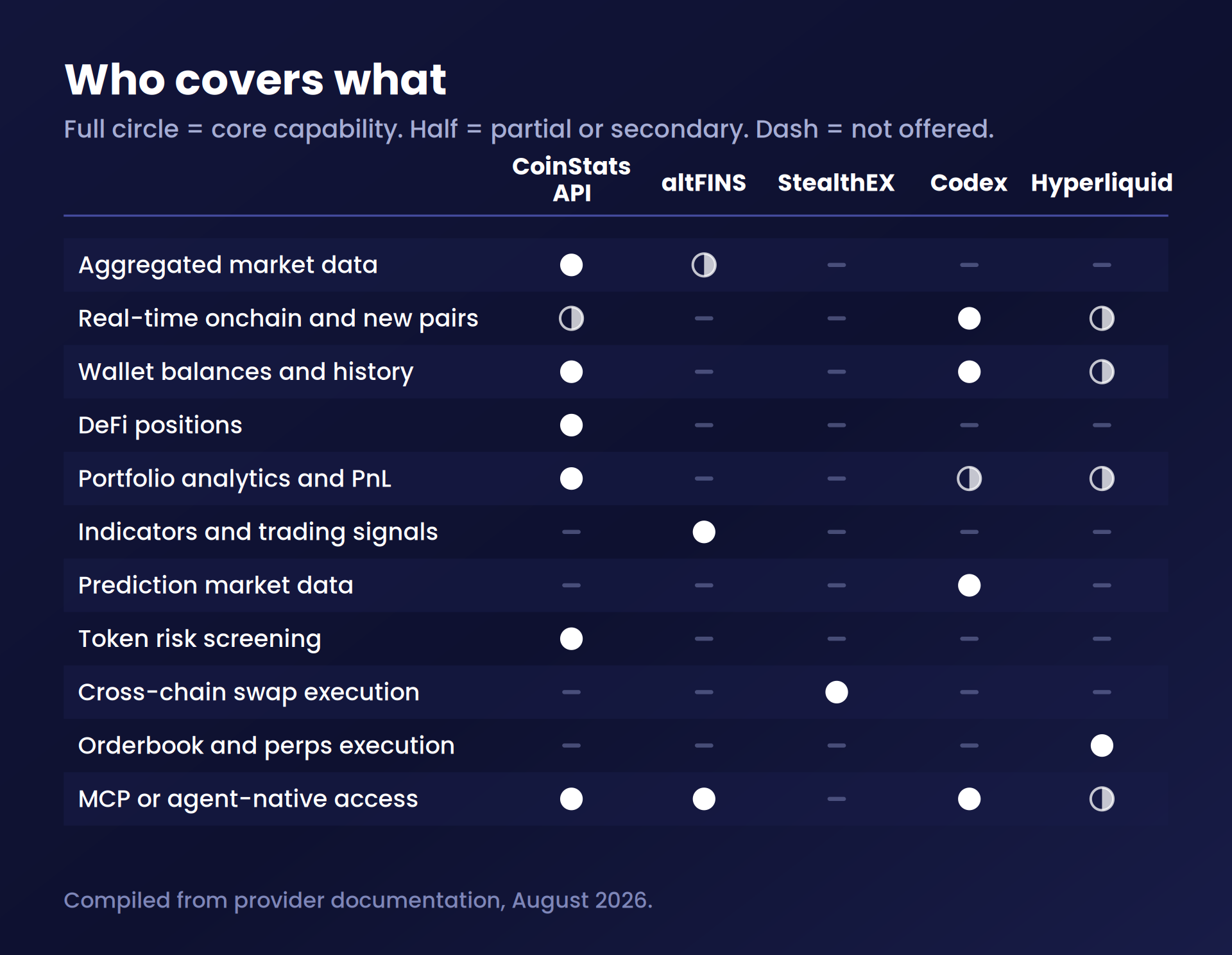
Feature Comparison
| CoinStats API | altFINS | StealthEX | Codex | Hyperliquid | |
| Market data | Aggregated CEX and DEX | OHLC from 30 exchanges | No | Onchain and DEX | Own markets |
| Wallet and portfolio | Yes | No | No | Yes, on Growth plan | Own account only |
| Execution | No | No | Cross-chain swaps | No | Perps and spot orderbook |
| Agent access | MCP plus keyless x402 | MCP on every tier | No | MCP plus keyless MPP | Permissionless, no MCP |
| Delivery | REST | HTTP | REST | GraphQL and WebSocket | REST and WebSocket |
| Coverage | 120+ chains | 2,000+ assets | 2,000+ assets | 80+ chains | Own layer one |
What It Costs To Start
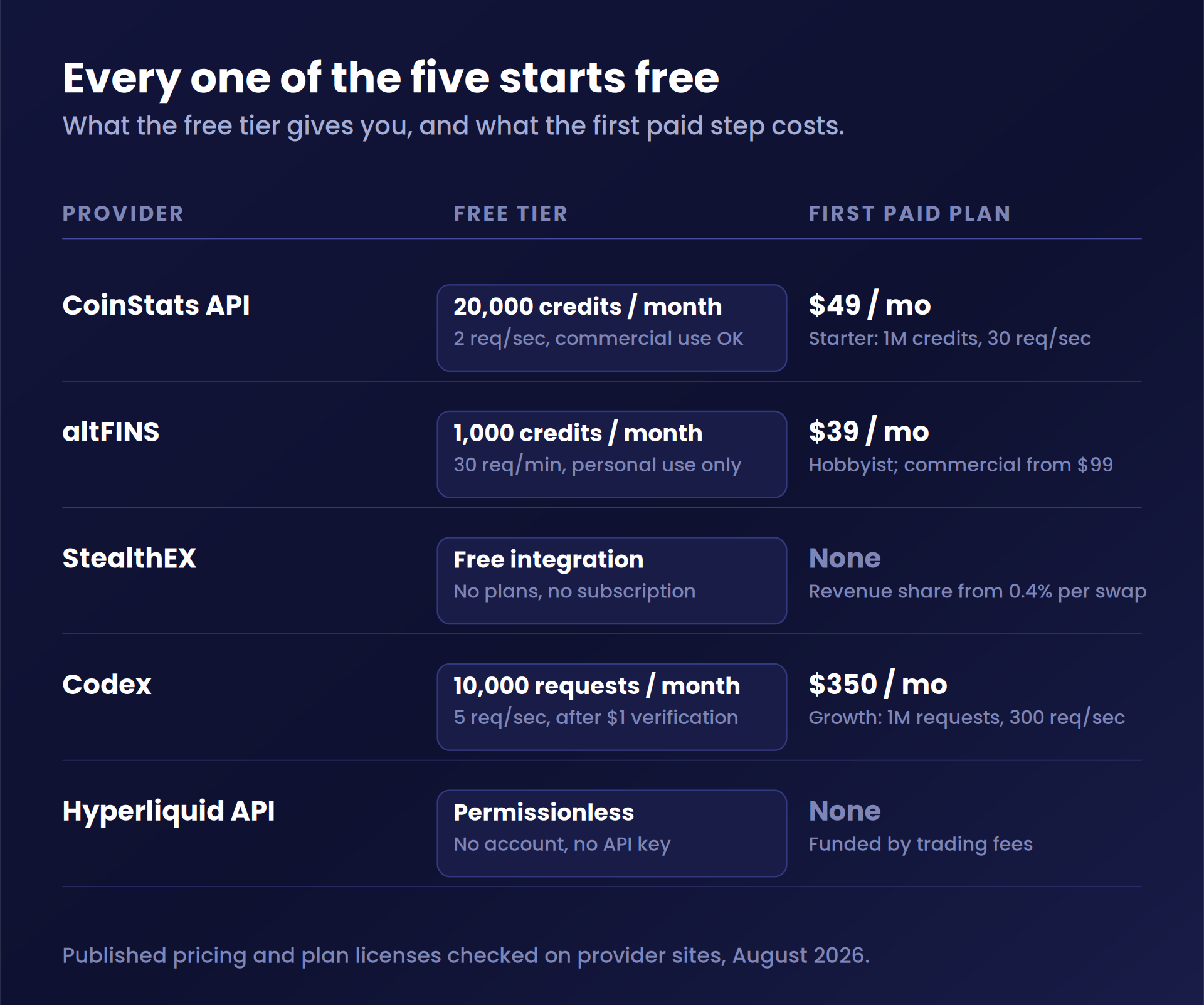
Every one of the five starts at zero. Two do not charge developers directly. StealthEX earns from swap revenue share, Hyperliquid from trading fees. Both monetize the flow rather than the integration.
The other three differ on what a free tier actually permits. CoinStats API gives 20,000 credits a month and allows commercial use on that plan, which is unusual. altFINS gives 1,000 credits, but licenses its free and $39 tiers for personal use only. Commercial work there starts at $99. Codex gives 10,000 requests after a one-time $1 verification fee. Websockets, wallet data, and prediction markets stay behind the $350 Growth plan.
Read the license, not just the allowance. A generous free tier you cannot ship on is a trial, not a plan.
Which Crypto API Should You Choose?
- Choose CoinStats API for market data, wallet, DeFi, portfolio, and token security from one key. Especially with an agent reading it.
- Choose altFINS if the strategy runs on technical signals. Buying the indicator engine beats maintaining one.
- Choose StealthEX if the product moves assets across chains and cannot ask users to open an exchange account.
- Choose Codex if you trade new listings and need pairs indexed in under a second. Also for prediction market data.
- Choose Hyperliquid API if the strategy needs leverage on an onchain orderbook with permissionless access.
Three Stacks That Work
The portfolio agent. CoinStats API for holdings, prices, and profit and loss. An assistant reads it through MCP. StealthEX sits behind the rebalance action. Nothing else is needed, and it runs on free tiers while you prove it.
The launch sniper. Codex indexes pairs the moment they exist, while CoinStats API screens contracts for risks such as honeypots and hidden fees before routing. An RPC provider handles transaction broadcasting. This setup is fast, but can become expensive at higher Codex usage levels.
The signal-driven perps bot. altFINS for entries and exits. Hyperliquid API for execution and position state. CoinStats API for cross-venue pricing and treasury context. Three integrations, and each one is doing a job the others cannot.
Final Thoughts
Ranking crypto APIs on a single axis produces the wrong answer. The five here are not substitutes. The useful question is which job the system currently cannot do.
The 2026 shift worth noticing is agent access. MCP servers, machine payments, and LLM-readable docs went from novelty to table stakes in about a year. Three of these five ship first-party agent support. Two accept payment per request with no account at all.
Every provider listed here offers a free entry point. Validating a combination depends more on integration effort than upfront cost, making it easier to test different stacks before committing to a long-term setup.
FAQ
Data APIs return information: prices, balances, positions, signals. Execution APIs move value, either by swapping assets or placing orders on a venue. Most production systems need one of each. Without execution, a bot effectively becomes a dashboard.
Look for MCP support first. It removes the custom integration layer between a model and the data. CoinStats API, altFINS, and Codex all ship first-party MCP servers. CoinStats API and Codex go further with pay-per-request endpoints that need no account. That suits agents provisioning their own access.
Yes, if the application broadcasts its own transactions or reads raw contract state. None of the five APIs here is a node. Data APIs and RPC providers are complementary purchases, not alternatives.
For validation, usually. CoinStats API allows commercial use on its free tier. StealthEX and Hyperliquid charge nothing for access at all. Codex and altFINS both offer evaluation credits, though altFINS licenses its free tier for personal use only. Production volume is where the paid tiers become unavoidable.
Model Context Protocol is an open standard for exposing tools and data to language models. An MCP server lets an agent call an API without a developer writing a wrapper first. It has become the default way providers make data agent-readable.
Most working systems pair one data provider with one execution rail. A third provider is usually only needed for more complex strategies. Start from the layer you are missing, not the longest feature list.
Disclaimer: The information presented in this article is for informational and educational purposes only. The article does not constitute financial advice or advice of any kind. Coin Edition is not responsible for any losses incurred as a result of the utilization of content, products, or services mentioned. Readers are advised to exercise caution before taking any action related to the company.