



- Bitcoin’s past midterm-election declines do not prove that elections cause price drops.
- A Democratic-controlled Congress could complicate crypto legislation, including the CLARITY Act.
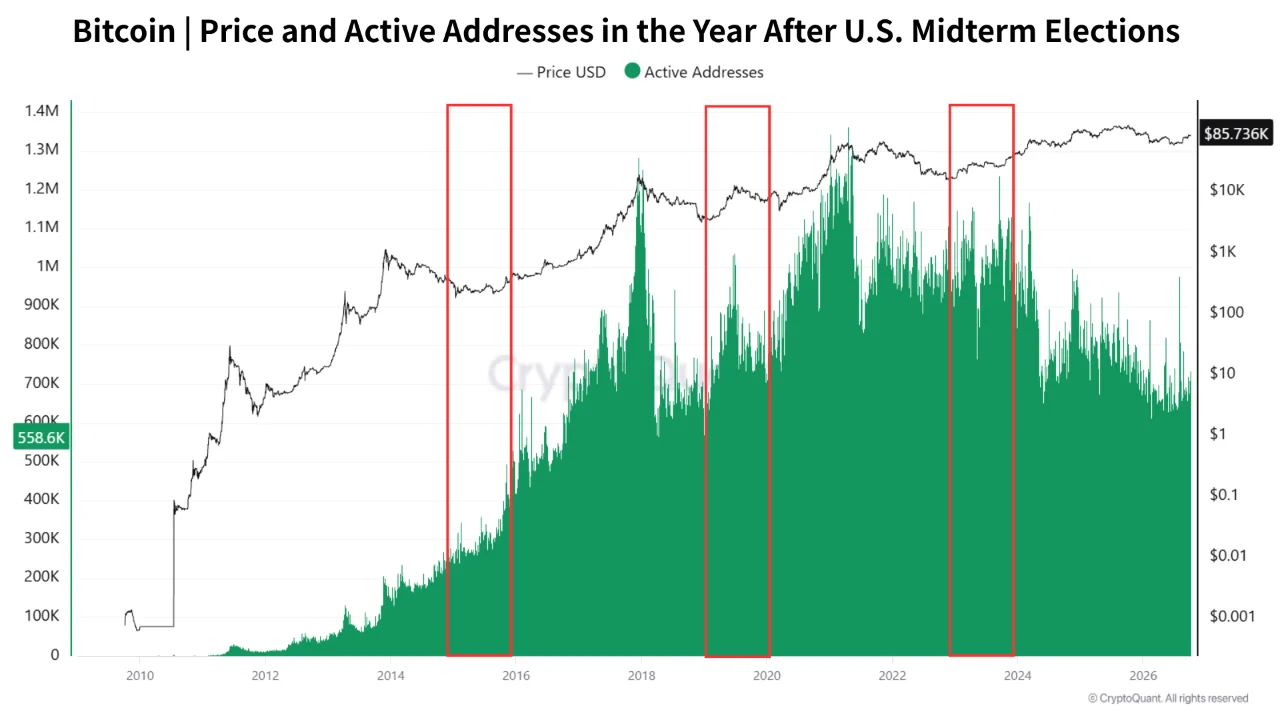
- CryptoQuant reported Bitcoin gains of 24.5%, 44.9%, and 92.3% in the 12 months after those elections.
Bitcoin often dipped around U.S. midterm elections, and traders are watching to see if history repeats itself in 2026. The election will decide who controls the House and Senate during President Donald Trump’s final two years in office.
Democrats are expected to have a strong chance of winning the House, while the Senate race remains close.
How a Democratic Win Could Affect Bitcoin
A Democratic-controlled House could slow down crypto legislation and increase investigations into the Trump administration’s crypto-related business interests. This could make it harder for the government to pass crypto-friendly laws.
One key proposal is the CLARITY Act, which aims to create clear federal rules for digital asset markets. The bill has faced delays after Democrats raised concerns about ethics rules and Trump’s crypto interests.
A Democratic takeover of Congress could make an agreement on crypto legislation more difficult, although bipartisan cooperation remains possible.
Controlling both the House and Senate would also give Democrats great influence over crypto policy and increase pressure on the Trump administration. However, Trump can still veto legislation.
What If Republicans Keep Control?
Republicans retaining control of Congress means crypto-friendly legislation will move forward more easily, boosting investor confidence.
However, Bitcoin would not necessarily rise just because Republicans win. Interest rates, market liquidity, and investor demand would still play major roles in determining its price.
Follow us on X for real-time crypto updates.
What Happened to Bitcoin After Previous Midterm Elections?
Bitcoin has fallen around past U.S. midterm elections. Analyst Rekt Fencer highlighted Bitcoin’s declines after the 2018 and 2022 elections, reporting drops of about 50% and 25%. However, the size of these losses depends on the period being measured.
While Bitcoin hit major lows after all three previous midterm elections, it did not do so immediately after each vote.
- 2014: Bitcoin hit a low on January 14, 2015, about 71 days after the election.
- 2018: Bitcoin reached its low on December 15, about 39 days after the election.
- 2022: Bitcoin bottomed on November 21, just 13 days after the election, during the FTX collapse.
These declines happened during crypto bear markets, so elections alone can’t be blamed for the price drops. Bitcoin’s four-year halving cycle may also have played a role, while the FTX collapse was a major factor in 2022.
There is also a more positive side to the history. CryptoQuant reported that Bitcoin rose by 24.5%, 44.9%, and 92.3% in the 12 months following the 2014, 2018, and 2022 midterm elections, respectively. This suggests that midterm elections do not automatically lead to long-term losses for Bitcoin.
Could 2026 Be Different?
Bitcoin’s current market cycle is already showing a different pattern. The cryptocurrency fell to $57,850 on July 1, about four months before the November 3 election, before recovering to around $81,455 by October 22. This raises the possibility that Bitcoin’s market low has already occurred.
Some crypto influencers, including Crypto Rover, have suggested buying Bitcoin during midterm elections and selling during the following bull market. Others, such as Matthew Stella and DeFiMidas, have warned of another price drop. These are opinions, not reliable predictions.
The Bottom Line
In sum, a Democratic victory could create uncertainty around crypto regulations and Trump’s policies. However, it may also encourage both parties to reach an agreement on crypto legislation.
Other factors, including interest rates, government spending, market liquidity, and Bitcoin’s market cycle, will have a greater impact on its price than the election itself.
While Bitcoin may fall after the 2026 midterms, history does not show that a Democratic victory or a midterm election causes a decline. What matters most is how investors react to the election results and the policies that follow.
Subscribe to our YouTube channel for the latest crypto news.
Related: Trump Rules Out Iran Strike Before November Midterms
Disclaimer: The information presented in this article is for informational and educational purposes only. The article does not constitute financial advice or advice of any kind. Coin Edition is not responsible for any losses incurred as a result of the utilization of content, products, or services mentioned. Readers are advised to exercise caution before taking any action related to the company.