

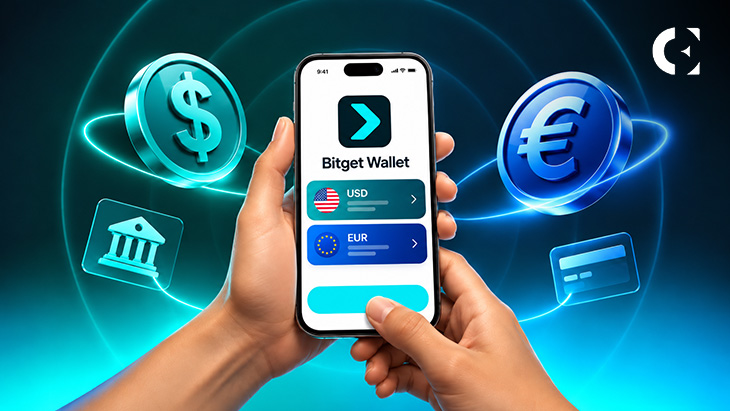

- Bitget Wallet introduces USD and EUR virtual accounts, connecting traditional banking networks with self-custodial crypto wallets.
- Users can receive bank transfers and automatically convert funds into USDT or USDC without going through a centralized exchange.
- The service targets cross-border payments and international workers, with bank withdrawals planned for a future update.
Bitget Wallet has introduced USD and EUR virtual accounts, allowing its more than 100 million users worldwide to receive bank transfers directly into their self-custodial crypto wallet.
The new feature provides personal dollar and euro account details through licensed financial infrastructure partner Noah. Money received is automatically converted into USDT or USDC, allowing users to move funds from traditional banks into stablecoins without using a centralized crypto exchange.
Users can open accounts for free without local residency requirements or visiting a bank. For now, they can only receive transfers, with withdrawals to bank accounts expected in the coming months.
The development reflects a broader shift in the crypto industry, as wallet providers increasingly look beyond trading and asset storage to support everyday financial activities such as payments, transfers and savings.
Connecting Self-Custodial Crypto Wallets to Traditional Banking
One of the longstanding challenges for crypto users has been moving money between conventional bank accounts and digital assets. While stablecoins have made it easier to transfer money across borders, converting traditional bank deposits into crypto often requires additional platforms or intermediaries.
Bitget Wallet‘s new feature addresses part of this gap by connecting familiar banking networks directly to a self-custodial wallet.
Through Noah, users can receive payments via major banking networks, including ACH and Fedwire in the US, SEPA in Europe, and SWIFT internationally. This gives eligible users access to US and European bank transfer systems without needing a traditional bank account in those regions.
Once funds arrive, they are converted into USDT or USDC and can be used for card payments, QR payments, cross-border transfers, yield products and investments in crypto and tokenized real-world assets.
Bitget Wallet COO Alvin Kan said the move reflects how crypto wallets are evolving into financial platforms that let users receive, manage and transfer money globally while maintaining control of their assets.
According to Kan, integrating traditional banking infrastructure with self-custodial wallets could help make international financial services more accessible, particularly in emerging markets where access to foreign currency accounts and cross-border banking remains limited.
Virtual Accounts Target Freelancers and International Payments
The service could be particularly relevant to freelancers, remote workers and people who regularly receive payments from overseas, groups that often face high transfer costs or restrictions when accessing foreign currency accounts.
For example, a freelancer working with a US-based client could receive payment through a USD bank transfer and have the funds converted into stablecoins within their wallet, without opening a US bank account.
The same infrastructure can support family remittances and transfers from personal bank accounts, offering an alternative route for moving funds into digital assets.
Unlike conventional crypto exchange accounts, Bitget Wallet operates on a self-custodial model, meaning users retain control of their wallet’s private keys and the digital assets held in it. The underlying bank transfer infrastructure is provided by Noah.
Noah CEO Shah Ramezani said the service aims to combine access to traditional financial networks with the flexibility of self-custodial digital assets.
The current rollout supports incoming bank transfers, while the ability to withdraw funds to external bank accounts is expected to follow in a future update.
Virtual Account Could Cut Transfer Costs
Bitget Wallet says its Virtual Account feature could make international payments cheaper than traditional remittance services.
The company estimates that receiving a $500 ACH transfer costs around $2 in Bitget Wallet fees. By comparison, the World Bank’s reported average remittance fee of about 6% would make a $500 transfer cost roughly $30.
However, these figures do not include possible extra charges from sending banks or blockchain networks. Actual savings will depend on the transfer method and any additional fees. Lower fees could benefit freelancers and families who regularly receive smaller payments from abroad.
Bitget Wallet Expands Its Financial Services
The launch comes as stablecoins are increasingly being used for purposes beyond cryptocurrency trading, including cross-border payments, savings and international money transfers. Wallet providers are responding by integrating services traditionally associated with banks and payment applications.
Bitget Wallet has been expanding in this direction through crypto-linked payment cards, QR payments and cross-border transfer services. Its latest addition brings bank-based fund receiving into the same application, potentially reducing the number of services users need to manage their money.
The company has more than 100 million users worldwide and a user protection fund worth over $300 million.
The introduction of virtual accounts highlights how the distinction between traditional financial services and crypto wallets is gradually narrowing. Whether such products gain wider adoption will likely depend on their reliability, geographic availability and ability to offer competitive costs compared with established payment providers.
Related: Aurelion, Reality, and Bitget Partner to Launch rAURE, a Tokenized Nasdaq Gold Treasury Stock
Disclaimer: The information presented in this article is for informational and educational purposes only. The article does not constitute financial advice or advice of any kind. Coin Edition is not responsible for any losses incurred as a result of the utilization of content, products, or services mentioned. Readers are advised to exercise caution before taking any action related to the company.