
- CoinGecko says KuCoin evolved from a token exchange to trusted digital asset infrastructure in 9 years.
- KuCoin Pay surged in H1 2026, with off-chain payment volume up 300% and orders up 25x.
- The report says security, compliance, and utility now matter as much as trading volume for exchanges.
Crypto exchanges are no longer judged on trading volume alone. As the industry matures, security, transparency, regulatory readiness, and real-world utility are becoming just as important. That is the central finding of a new report from CoinGecko Research, which looks back at KuCoin’s nine years in business and its performance in the first half of 2026.
The report was released to mark KuCoin’s ninth anniversary. It traces the exchange’s path from a platform built around giving users access to tokens, to what CoinGecko Research now calls “trusted digital asset infrastructure.”
KuCoin says it now serves more than 45 million users in over 200 countries and regions, up from around 5 million users in its early years.
Payments Are Growing Fast
One of the report’s clearest signals is how much KuCoin’s payments business has grown. Off-chain payment volume, transactions processed outside the blockchain itself, similar to how a card network moves money, rose 300% in the first half of 2026.
The number of payment orders grew roughly 25-fold, and KuCoin’s network of service partners and merchants expanded by 60%. On-chain payment activity, meaning transactions settled directly on the blockchain, also grew quickly.
KuCoin Pay, the exchange’s payments product, extended its reach through QR-code payment networks and local payment rails in Latin America, Asia and Africa.
KuCard, KuCoin’s crypto debit card, expanded into Australia through Mastercard’s global network. A limited-edition version of the card was also launched in partnership with the Tomorrowland music festival, tying into KuCoin’s role as the festival’s official crypto exchange and payments partner.
Three Trends Defined H1 2026 Trading
CoinGecko Research highlights three trends in how people traded on KuCoin during the first half of 2026.
Derivatives held up well
Derivatives are contracts, such as futures, that let traders bet on an asset’s price without owning it directly. KuCoin’s spot market, where assets are bought and sold for immediate delivery, averaged $1.99 billion in daily trading volume between January and June.
Its perpetual futures market, a type of derivative contract with no expiry date, averaged $3.07 billion a day. Weekday and weekend volumes in perpetuals differed by only 9.4%, which the report says shows steady demand for a market that runs continuously.
Trading became more spread out
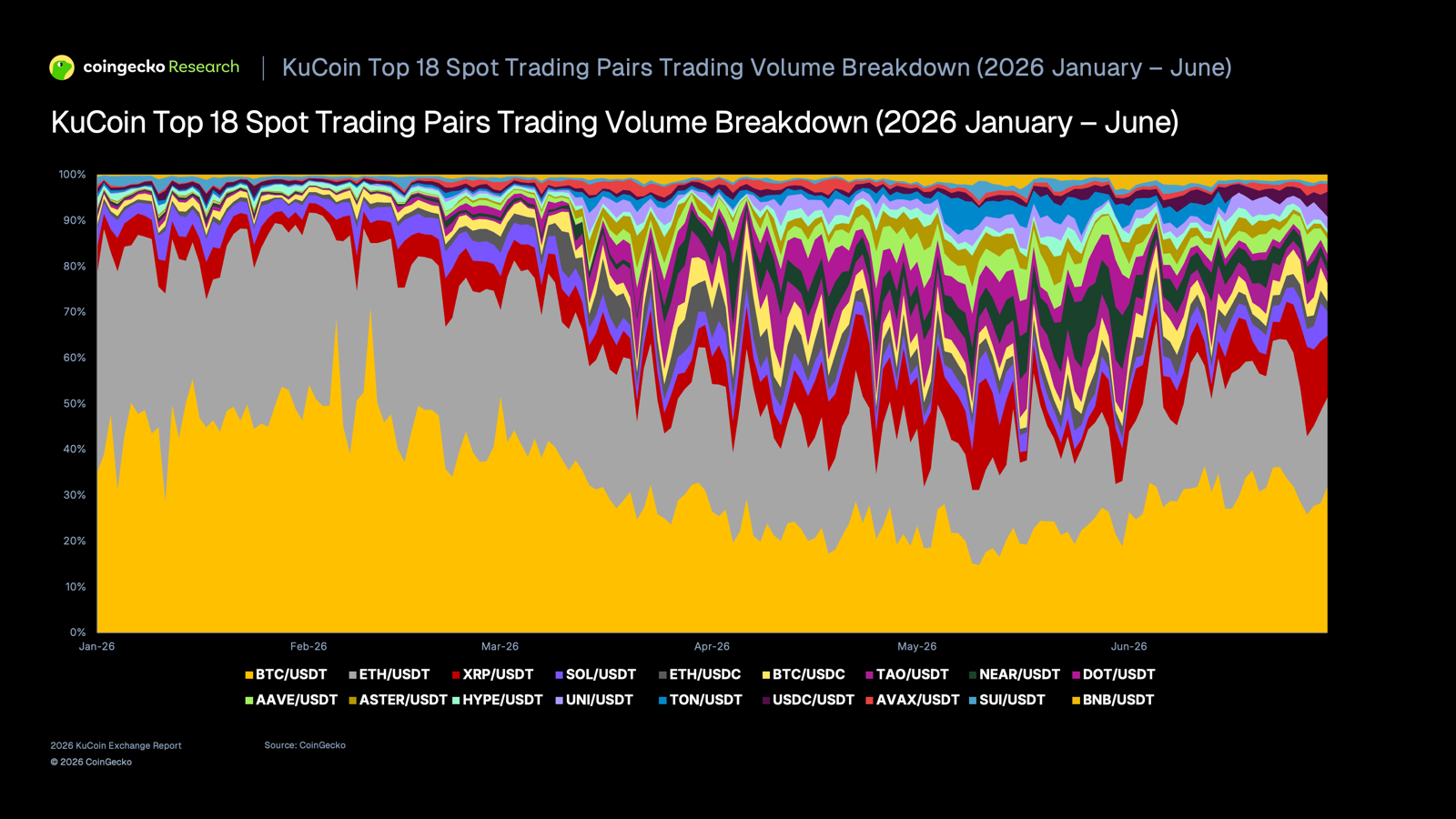
Bitcoin and Ethereum’s combined share of trading among KuCoin’s top 18 spot pairs fell from 74.3% to 45.2% by the end of June. CoinGecko Research attributes this to traders rotating more quickly into altcoins and smaller cryptocurrencies other than Bitcoin as new market narratives emerged. The report notes this pattern of fast rotation was more pronounced on KuCoin than on several other major exchanges.
Tokenized stocks took off
Between March 13 and July 29, KuCoin listed 198 new perpetual futures contracts, of which 121 (about 61%) were tied to tokenized stocks or stock indices. Before that, the category did not exist on the exchange.
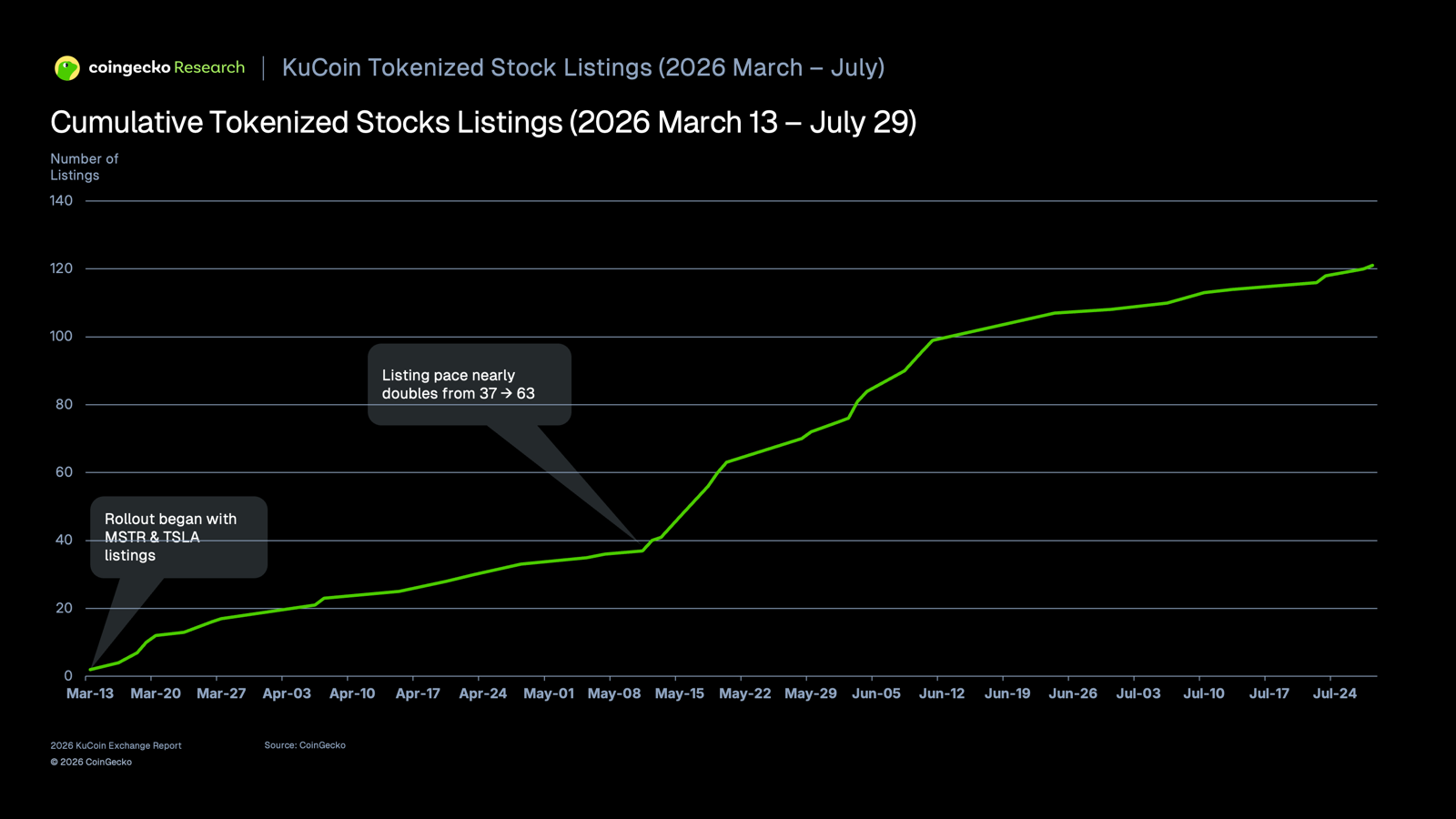
It grew from an initial launch covering Tesla and MicroStrategy to, by late July, contracts covering most major US tech stocks (including Apple, Microsoft, Nvidia, Meta, Alphabet and Amazon), chip makers, financial firms, consumer brands, leveraged ETFs and even a contract linked to OpenAI ahead of any public listing.
Reserves Held Up Better Than Rivals
KuCoin’s Proof of Reserves report, a regular audit showing the exchange holds enough assets to cover user balances, marked its 44th consecutive month and was backed by 14 independent audits from blockchain security firm Hacken.
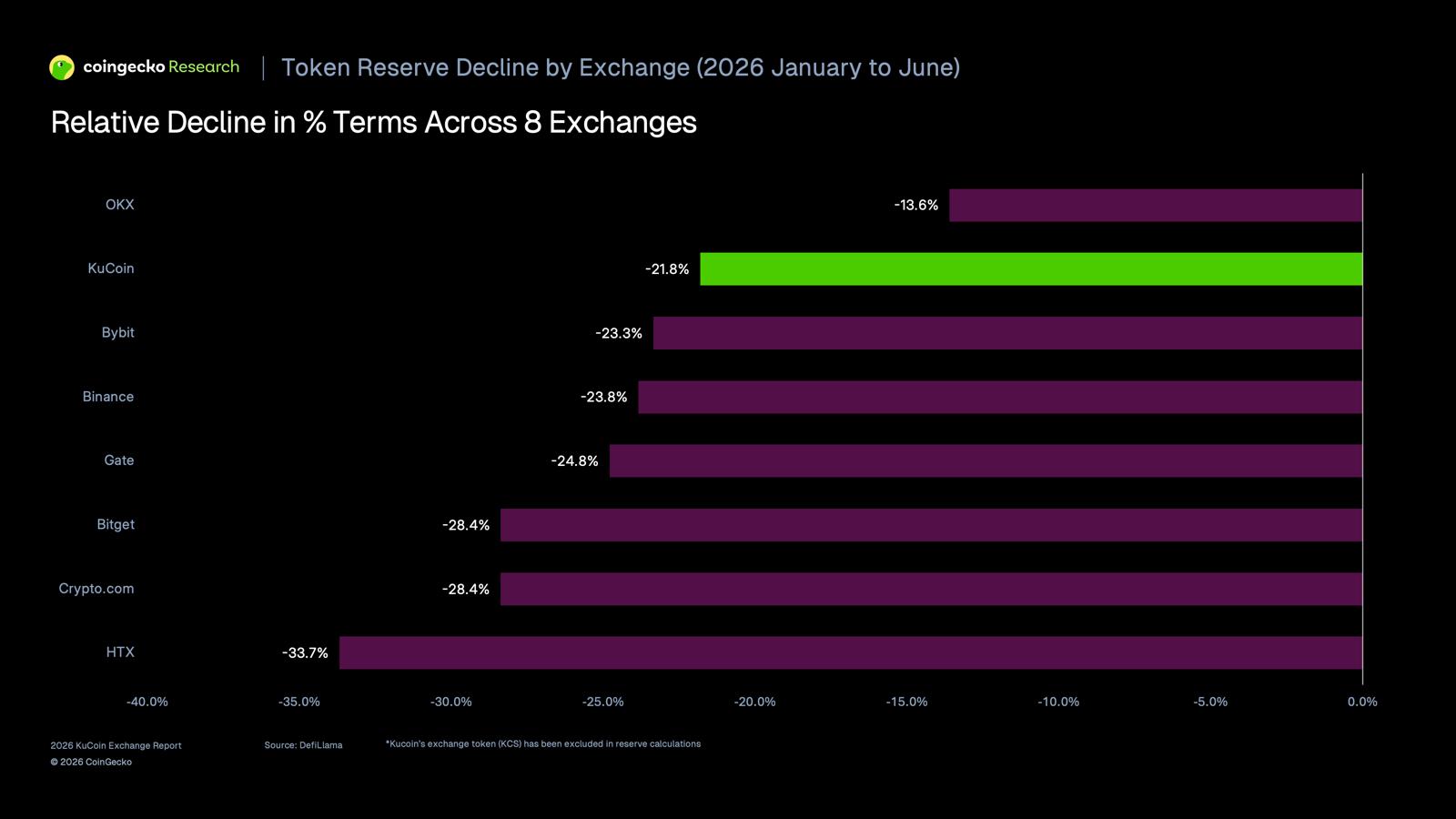
Despite a broader market downturn, KuCoin’s total reserves fell 21.8% over the first half of the year, a smaller decline than the roughly 24.7% average drop seen across the eight largest exchanges. Bitcoin holdings stayed nearly flat, while Ethereum holdings grew 22.1%.
Compliance Push
The report also points to compliance milestones reached over KuCoin’s history. The exchange registered as a Digital Currency Exchange with Australia’s financial intelligence agency, AUSTRAC, and its European arm obtained a license under the EU’s Markets in Crypto-Assets (MiCA) regulation in Austria.
KuCoin also says it became the first global crypto exchange to register with India’s Financial Intelligence Unit and to require mandatory identity verification for users there. The exchange holds SOC 2 Type II, ISO/IEC 27001:2022 and ISO/IEC 27701 security certifications, among others.
CoinGecko Research sees KuCoin’s growth as part of a shift across the crypto industry away from exchanges competing purely on trading volume, and toward competition based on market depth, product relevance, security, transparency and regulatory readiness.
The next phase of competition among exchanges will depend more on how well platforms support everyday participation in the digital asset economy.
Related: KuCoin Ranks Top Three for ETH Spot Execution in TokenInsight’s July 2026 Liquidity Report
Disclaimer: The information presented in this article is for informational and educational purposes only. The article does not constitute financial advice or advice of any kind. Coin Edition is not responsible for any losses incurred as a result of the utilization of content, products, or services mentioned. Readers are advised to exercise caution before taking any action related to the company.