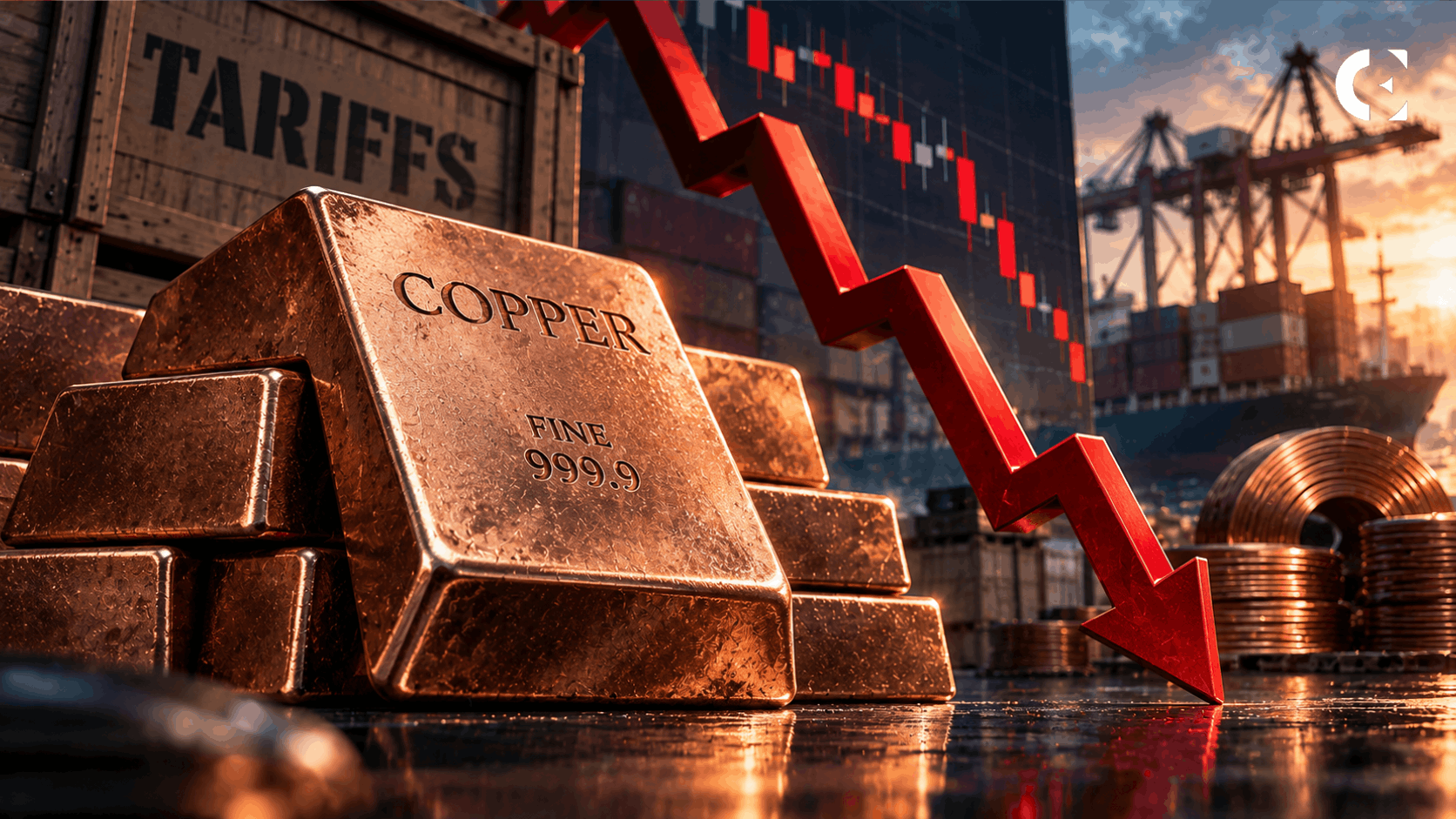

- Copper fell 3% in an hour as the White House tariff delay erased its premium.
- Gold held near $4,400 as silver stayed rangebound, limiting metals contagion.
- The move reflects a tariff-driven unwind, not a broader breakdown in metals demand.
Copper futures fell by 3% within 60 minutes after the White House delayed its decision on tariffs covering refined copper imports. The sudden retreat unwound part of a tariff-driven rally that had pushed copper toward record highs.
However, gold held near $4,400 an ounce, while silver consolidated within its recent range. The divergence confirms that copper’s decline has not yet turned into a broad metals sell-off.
Tariff Delay Removes Copper’s Speculative Premium
Copper prices had risen as traders expected the United States to expand existing duties to refined products, including cathodes and mine-produced concentrates. Industrial buyers moved supplies into U.S. warehouses before any possible tariffs, creating one of the world’s largest copper stockpiles.
The Commerce Department submitted an update to President Donald Trump by a June 30 deadline. However, the White House has not reached a final decision.
Officials must balance support for domestic mining and refining against the higher costs manufacturers face. The United States imports roughly half of its annual copper requirements and operates only two copper smelters.
The delay weakened the tariff premium embedded in futures prices. It also left uncertainty about a proposed 15% tariff that could take effect in January 2027.
Gold Holds as Copper’s Growth Signal Weakens
Copper and gold react to different market forces. Copper corresponds to demand across construction, transportation, electronics, artificial intelligence infrastructure and renewable energy. Gold primarily responds to inflation concerns, geopolitical risks, currency movements, and central bank demand.
The copper-to-gold ratio remains historically depressed. While low readings typically signal economic weakness, current conditions also reflect strong safe-haven demand for gold alongside supply constraints and tariff uncertainty affecting copper.
Silver Faces Conflicting Industrial and Monetary Forces
Silver sits between the two markets because industrial applications account for roughly 50% to 60% of demand. Solar panels, electronics, electric vehicles, and AI infrastructure connect silver to manufacturing activity.
However, investors also use silver as a precious-metal hedge. That monetary demand has limited the effect of weaker industrial sentiment. Prices have recently consolidated broadly between $56 and $68 rather than matching copper’s sharp decline.
The latest move highlights a market driven more by policy signals than broad macro stress. Copper’s pullback reflects the unwinding of tariff-driven positioning rather than a collapse in global demand. As long as gold and silver remain stable, the correction is likely to stay concentrated in copper, with the next direction depending on how the White House ultimately resolves its tariff stance.
Related: Copper-Gold Ratio Hits 15-Year Low: Is the Business Cycle Resetting for Bitcoin?
Disclaimer: The information presented in this article is for informational and educational purposes only. The article does not constitute financial advice or advice of any kind. Coin Edition is not responsible for any losses incurred as a result of the utilization of content, products, or services mentioned. Readers are advised to exercise caution before taking any action related to the company.