

- Ethereum, BNB Chain, and Solana account for 76% of blockchain DEX trading volume.
- Base holds 14%, placing the four largest networks near 90% combined market share.
- Arbitrum keeps a 5% share with established DeFi liquidity and active trading venues.
Decentralized exchange trading now clusters around three networks, although no blockchain holds a majority. CoinGecko has Ethereum at 26%, BNB Chain at 25%, and Solana at 25%; these three sum to 76%, while the remaining monitored ecosystems account for 1/4 of the volume. 14% is base, so the 4 highest ecosystems capture approximately 90% of the volume.
Current figures describe a top-heavy market rather than a single-chain market. Arbitrum holds 5%, while Hyperliquid follows with 3%. Tron and Avalanche each account for 1%, while Monad and Unichain remain below 1%. These shares rank blockchain ecosystems by DEX volume, rather than individual exchanges operating within each network.
Three Networks Divide Most DEX Volume
CoinGecko’s monthly chart also shows lower overall trading activity during 2026. Combined volume fell from $247 billion in January to $155 billion in June. May recorded $146 billion, the lowest total shown across the six months. June then produced a limited rebound, but activity stayed far below January’s level.
Leadership changed several times as market activity declined. Solana held the largest January share, while Ethereum moved ahead during parts of the second quarter. BNB Chain stayed close to both networks across the period. No monthly bar gives one chain a majority, and each leader depends on a broad share of cross-chain trading.
Quarterly data shows how closely the three networks compete. Solana led 2026’s first quarter with 30.6% of spot DEX volume. BNB Chain followed with 24.5%, while Ethereum recorded 23.7%. Ethereum moved ahead in March with 27%, compared with Solana’s 26%, before the rankings shifted again.
Broader crypto trading also weakened during the second quarter. CoinGecko recorded a 12.6% decline in total market capitalization to $2.1 trillion. Spot volume across the ten largest centralized exchanges fell 27.9% to $1.95 trillion. DEX concentration therefore developed while activity declined across both centralized and decentralized markets.
Market Share Moves Beyond Token Valuations
DefiLlama’s supplied market data recorded $74.628 billion in DeFi total value locked. It also showed $6.161 billion in 24-hour DEX volume and $19.345 billion in perpetual volume. Stablecoin market capitalization stood near $307.916 billion. Those measures track different parts of DeFi, so none alone defines available trading liquidity.
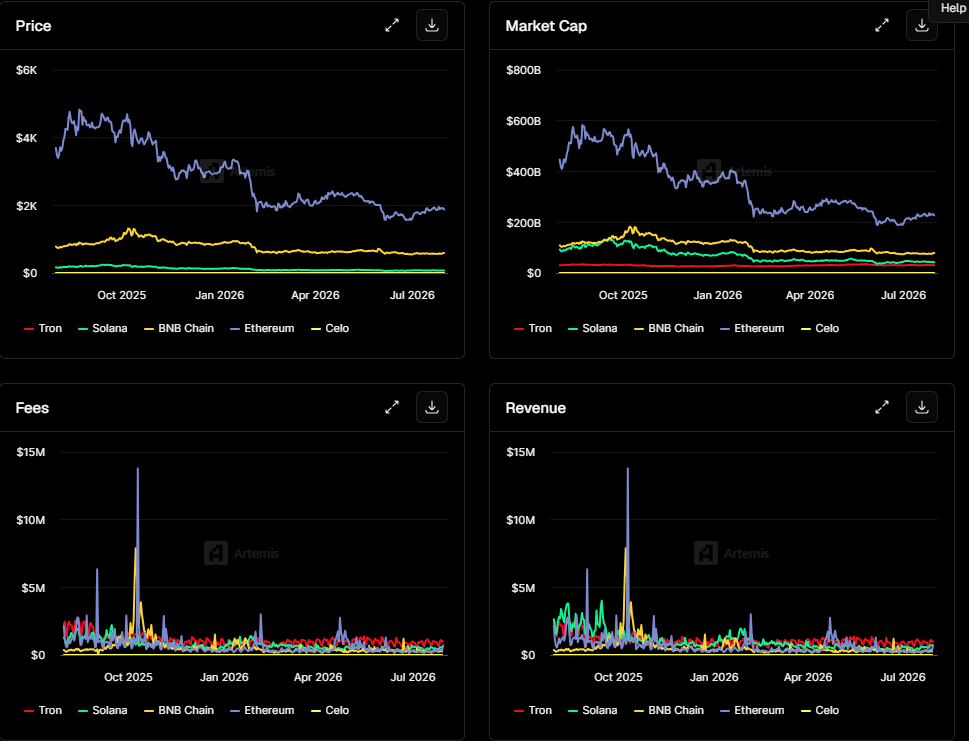
Artemis data shows another gap between network valuation and exchange activity. Ethereum’s token market capitalization stays far above BNB Chain and Solana on the comparison chart. Yet each ecosystem controls roughly one-quarter of DEX trading. CoinGecko’s market-share order therefore differs sharply from the native-token market-cap order shown by Artemis.
Trading volume records completed transactions, while TVL measures assets deposited inside DeFi protocols. A network can process frequent trades without holding the largest pool of locked capital. Order-book and automated-market-maker systems also use capital differently. Method differences also prevent direct comparisons between every dashboard.
Longer-term figures place the current concentration inside a wider move toward onchain trading. CoinGecko reported that DEX spot share rose from 6.9% in January 2024 to 13.6% in January 2026. Absolute monthly DEX volume increased from $95.86 billion to $231.29 billion during that period. Recent monthly totals have since fallen from January’s 2026 level.
Arbitrum Keeps an Established DeFi Base
Arbitrum ranks fifth with 5% of current blockchain DEX volume. DefiLlama tracks about $1.2 billion in DeFi value locked on the network. It also records roughly $3.48 billion in stablecoins and more than two million daily transactions. Thirty-day DEX volume recently stood near $4.1 billion.
Existing capital and applications provide Arbitrum with several active trading routes. There are spot, perpetuals, and lending services within the 3 mentioned: Uniswap, GMX, and PancakeSwap, and other DeFi protocols listed on DefiLlama where users settle with ETH instead. This enables the functioning of numerous market types without any single application dominating.
L2Beat classifies Arbitrum One as a general-purpose optimistic rollup and places it at stage 1. Its tracked secured value stands near $10.34 billion, behind Base among listed scaling networks. Arbitrum’s 5% DEX share sits below Base’s 14%, despite that large secured asset base. Trading volume and secured value therefore produce different rankings.
Arbitrum’s present share does not mark a return to its early 2024 peak. CoinGecko recorded 39.1% and 39.7% monthly shares during an incentive campaign that year. Activity fell after those incentives ended, and March 2024 share dropped to 8.4%. Current data places Arbitrum in the middle tier below Base.
Related: XRP Binance Inflows Fall to Record Low as Exchange Activity Slows
Hyperliquid Expands Through Onchain Trading
Hyperliquid holds 3% of the spot DEX distribution, but its derivatives activity is much larger. DefiLlama recently tracked about $178 million in daily spot volume on Hyperliquid L1. Daily perpetual volume reached about $9.3 billion in the same chart. Its stablecoin market capitalization stood above $6.3 billion, mostly in USDC.
Network design separates Hyperliquid from standard automated market makers. HyperCore runs fully on-chain spot and perpetual order books, and it matches orders by price-time priority. Official documentation reports support for about 200,000 orders each second. HyperEVM shares the network’s consensus and connects applications directly with HyperCore liquidity.
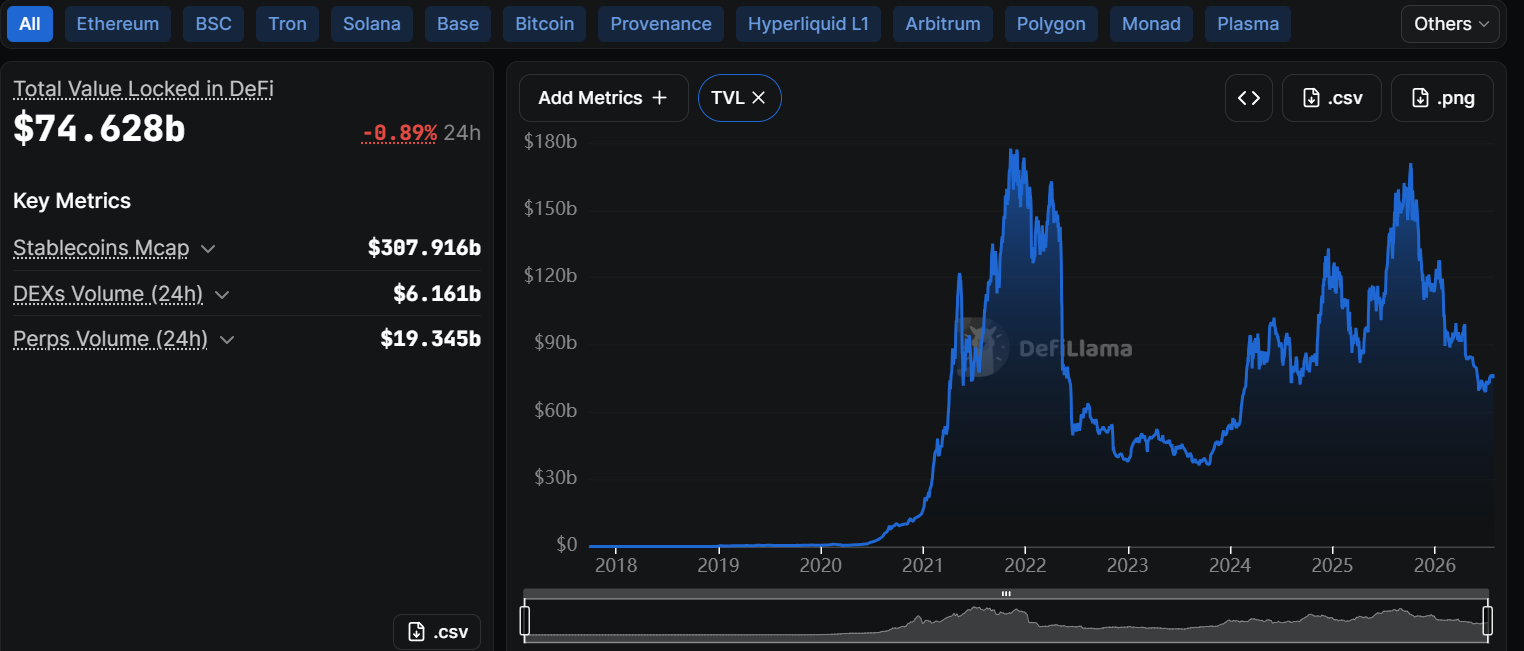
Perpetual volume in that DefiLlama chart was roughly 52 times larger than spot volume. That difference identifies derivatives as Hyperliquid’s main trading segment. CoinGecko also ranked Hyperliquid as the only DEX among ten leading perpetual exchanges during one measured period. Its cumulative volume reached $1.59 trillion from August 2025 through January 2026.
HIP-3 markets widened Hyperliquid’s product range beyond standard crypto contracts. CoinGecko reported that commodity contracts represented about 30% of its open interest during 2026’s first quarter. Two oil contracts produced more than $4 billion in daily volume on April 9. That total exceeded Bitcoin volume on Hyperliquid during the same session.
Base holds the largest share outside the top three at 14%. Its position leaves Arbitrum and Hyperliquid competing within a smaller second group. Monad and Unichain each hold less than 1%, while both sit outside the main volume tiers. Current rankings separate network launches from measurable DEX trading volume.
Disclaimer: The information presented in this article is for informational and educational purposes only. The article does not constitute financial advice or advice of any kind. Coin Edition is not responsible for any losses incurred as a result of the utilization of content, products, or services mentioned. Readers are advised to exercise caution before taking any action related to the company.