

- EIP-8361 would reduce annual ETH issuance to zero near a 50% staking ratio.
- The proposal chart places current staking near 33% and saturation at 50%.
- Exchange reserves fell from above 21 million ETH to about 15.1 million ETH.
Ethereum’s latest issuance proposal places network security policy against the financial uses that now support ETH demand. EIP-8361 would taper annual issuance as staking participation rises, reaching zero near a 50% staking ratio. Supporters target excess staking incentives and lower dilution. Critics fear the design could weaken ETH income, collateral demand, and institutional pricing models.
The debate arrives while ETH serves several roles across Ethereum’s capital markets. Investors hold it, stake it, borrow it, and use tokenized staking claims as collateral. SEC filings also identify staking-focused Ethereum exchange-traded products from iShares and Grayscale. Those structures place protocol yield inside regulated investment products, so reward policy now reaches beyond validator economics.
EIP-8361 Targets Staking Growth Above 50%
Jerome de Tychey presented EIP-8361 as a “tapered issuance burn” on August 4. The submitted chart compares the current reward curve with a proposed 18-month transition. Under the model, annual issuance rises at lower participation, peaks near a 20% staking ratio, then declines. It reaches zero when staking approaches 50% of the total ETH supply.
The chart shows Ethereum at the bottom near a 33% stake around the transition model, as the model saturates 50%. Issuance flattens out below 1% for orange as issuance for blue continues to grow to around 1.5% at 100% share.
Ethereum’s current math is computed based on effective balance and total active stakers in the system. Ethereum’s current base reward for validators is based on the effective balance and total active stakers in the system.
Validators can also receive priority fees and maximum extractable value. Therefore, zero issuance would not automatically remove every validator revenue source.
The proposal focuses on Ethereum’s security budget and staking concentration. A declining curve would remove the reward incentive for stake growth beyond the selected threshold. However, the same curve would make long-term issuance depend more sharply on participation. That change would move ETH yield from a gradually declining schedule toward a policy-defined cutoff.
Predictable ETH Yield Supports Institutional Models
Institutional investors usually model expected income, operating costs, liquidity, and policy risk before allocating capital. A predictable staking range helps managers estimate total return and compare ETH with bonds, credit, and other proof-of-stake assets. A reward curve that approaches zero creates a wider range of future outcomes, especially for long holding periods.
SEC filings show that staking now forms part of regulated Ethereum product design. BlackRock filed documents for the iShares Staked Ethereum Trust ETF, including a staking services agreement. Grayscale also filed materials for Ethereum staking ETF products. These filings don’t specify ongoing demand; however, these filings tie validator return to fund structure and investor disclosure.
Shifts to the return premium that institutions demand could be driven by governance-related changes to the yields themselves, while in such an environment, institutions may demand higher risk-adjusted returns if such a change is accepted, shorter policy windows, lower expected policy rates, and less policy overage, or they could disentangle ETH price exposures from staking exposures. That approach could support holding ETH while reducing reliance on future protocol payments.
Stani Kulechov argued that the proposal would make staking less predictable for institutions and solo operators. He also warned that rewards could become uneconomical near the proposed threshold. “Ethereum should not be punished for its growth,” Kulechov wrote. His criticism centers on adoption costs, yield certainty, and competition from other income-producing assets.
Related: Ethereum, BNB Chain and Solana Capture Three Quarters of Global DEX Volume
DeFi Depends on ETH as Productive Collateral
ETH now supports borrowing, lending, liquidity, and leveraged staking across decentralized finance. Aave allows users to supply collateral and borrow assets under changing utilization rates. Lido issues stETH, which combines staking exposure with a transferable token. That token can enter lending systems while the underlying ETH earns validator rewards.
Leveraged staking strategies often depend on a spread between staking income and ETH borrowing costs. A user may post liquid staking tokens, borrow ETH, and stake the borrowed ETH again. Lower base issuance can narrow that spread. If borrowing costs exceed staking income, users may close positions or reduce leverage.
The proposal would not remove every reason to borrow ETH. Traders also borrow ETH for hedging, market making, settlement, and short exposure. Protocols also adjust borrowing rates through utilization. Still, lower staking income could reduce one major source of recurring ETH borrowing demand within correlated-asset strategies.
Liquid staking protocols would need to pass lower rewards through their tokens. Lending markets could then reprice collateral demand and borrowing rates. The leverage ETH products may employ lower leverage, higher margins, or smaller time horizons. The protocols can also change the dynamics to favor fees, liquidity, or external revenue but do not necessarily indicate long-term holding.
Exchange Charts Show Tighter Tradable Supply
The supplied exchange reserve chart places balances near 15.1 million ETH at the latest point. Reserves stood above 21 million ETH around mid-2025 on the same chart. The long decline indicates that fewer coins sat on tracked exchanges. However, the chart cannot identify ownership, purpose, or final destination.
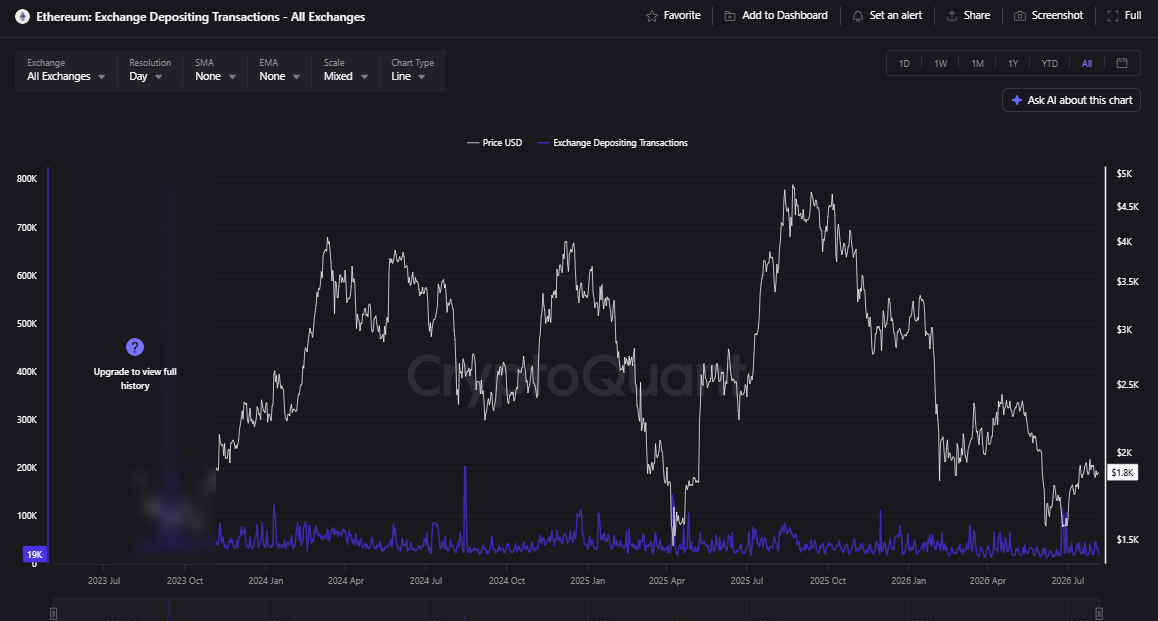
The depositing transactions chart ends near 19,000 daily transactions. Earlier periods often recorded higher counts and several sharp spikes. The withdrawing transactions chart ends near 139,000 transactions, though that series also shows wide daily swings. These charts measure transaction counts, not the amount of ETH moved in each transaction.
Reduction in exchange reserves only represents trading inventory; it is an estimate of coins not in use and not as definitive as how it might flow into a variety of custody and self-custodial products, including staked Ether products, various DeFi protocols, and alternative custodials. The deposit and withdrawal counts also cannot measure net flow without transaction sizes and matching exchange coverage.
These reserve trends add context to the EIP-8361 debate. More ETH now sits outside exchange order books, while staking and DeFi absorb part of the supply. A reward cutoff could change where marginal ETH moves next. Some holders may favor collateral use, while others may compare stablecoin yields, tokenized Treasury products, or other networks.
Ethereum’s official staking page lists about 41.2 million ETH staked, equal to roughly 33% of supply. It also lists a 2.6% current annual percentage rate. Those figures align with the proposal chart’s “today” marker. Any move toward 50% would place the network closer to the proposed zero-issuance point.
Disclaimer: The information presented in this article is for informational and educational purposes only. The article does not constitute financial advice or advice of any kind. Coin Edition is not responsible for any losses incurred as a result of the utilization of content, products, or services mentioned. Readers are advised to exercise caution before taking any action related to the company.