

- EU lawmakers want MiCA reviewed for DeFi, staking, lending, and NFT activity.
- A July 6 vote could establish Parliament’s formal position on crypto policy.
- The report supports euro stablecoins while warning against fragmented national rules.
A European Parliament committee has called for a review of whether major crypto activities outside MiCA’s current scope require dedicated regulation. The ECON report targets DeFi, staking, crypto lending, borrowing, and NFT markets while supporting tokenization and regulated euro-denominated stablecoins across European financial services.
MiCA Scope Review Advances Toward July 6 Parliament Vote
Following negotiations and amendments within the Economic and Monetary Affairs Committee, Belgian lawmaker Johan Van Overtveldt prepared the own-initiative resolution. The report is expected to face a European Parliament plenary vote on July 6.
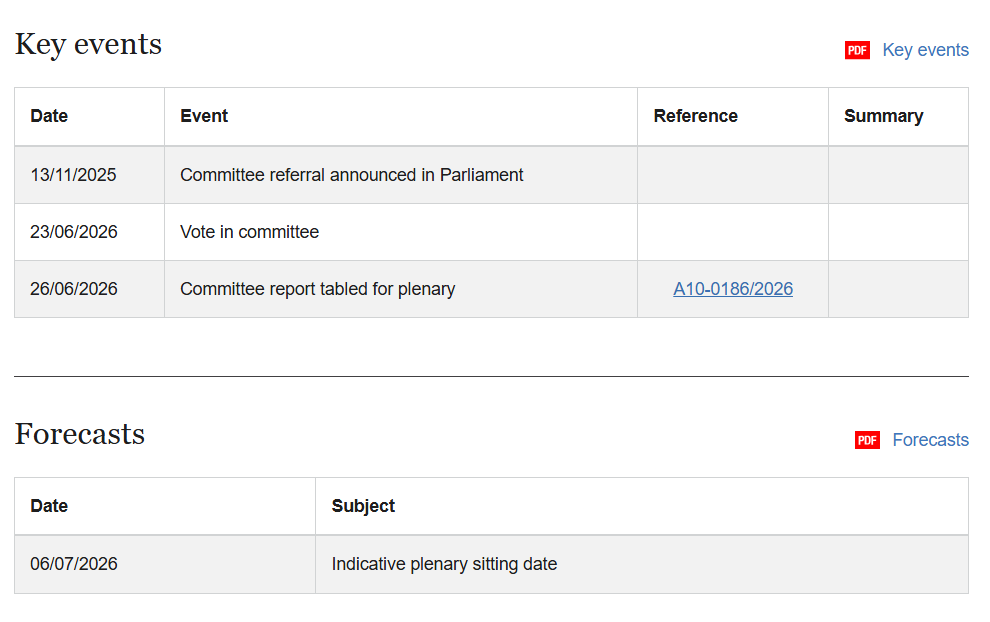
Source: European Parliament
Approval would establish Parliament’s formal digital asset policy position. However, the resolution would neither amend MiCA directly nor create immediate legal obligations for crypto companies operating across the bloc.
Instead, it asks the European Commission to assess whether emerging activities need new safeguards, clearer classifications, or inclusion under the existing regulatory framework. Lawmakers also urged consistent enforcement across the EU and warned member states against adding separate national requirements beyond the regional framework.
Such additional rules could create different compliance standards and weaken the single-market structure intended for companies authorized under MiCA. Meanwhile, the Commission began its own review in May through a public consultation covering DeFi, staking, lending, NFTs, and tokenized financial instruments.
That consultation also reopened discussion about MiCA’s prohibition on interest-bearing stablecoins, which limits how issuers can reward holders. In the meantime, the regulation’s transitional period ends July 1. Consequently, crypto asset service providers must generally secure authorization to continue operating throughout the European market.
Euro Stablecoins Enter Europe’s Broader Digital Money Strategy
Meanwhile, the committee adopted a more supportive position toward regulated euro stablecoins, describing them as useful infrastructure for payments and tokenized finance. According to the report, these assets could complement tokenized commercial bank deposits and wholesale central bank digital currencies rather than replace them.
They could also support faster and cheaper cross-border transactions while improving the competitiveness of European financial markets. The position follows ECON’s support for digital euro legislation, where lawmakers argued that public and private digital money should operate alongside each other.
Van Overtveldt previously sought tighter cryptocurrency restrictions after the 2023 banking crisis involving Silicon Valley Bank, Signature Bank, and Silvergate Bank. During that turmoil, Circle held approximately $3.3 billion of USDC reserves at Silicon Valley Bank, briefly disrupting the stablecoin’s dollar peg.
The latest report, therefore, signals a broader regulatory approach: expanding oversight around DeFi, Staking, and NFT activity while encouraging regulated euro-based digital money.
Related: MiCA Report: Euro Stablecoins Safer but Less Competitive
Disclaimer: The information presented in this article is for informational and educational purposes only. The article does not constitute financial advice or advice of any kind. Coin Edition is not responsible for any losses incurred as a result of the utilization of content, products, or services mentioned. Readers are advised to exercise caution before taking any action related to the company.