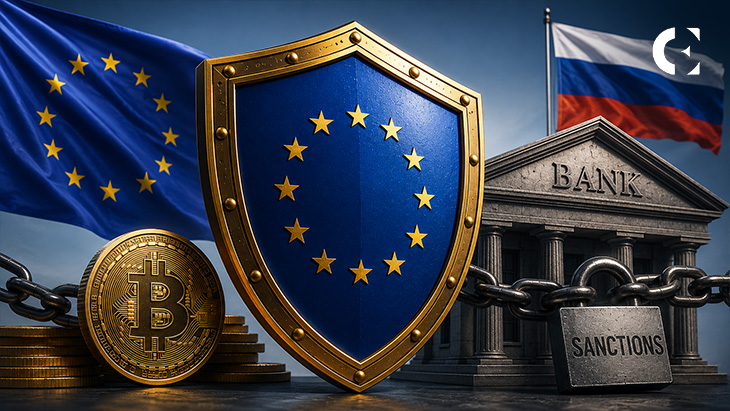

- EU bars transactions with 14 crypto platforms accused of helping Russia evade sanctions.
- The package targets 94 financial institutions, while 33 Russian banks lose SWIFT access.
- Brussels freezes the Russian oil price cap at $44.10 per barrel for the next 12 months.
The European Union approved its 21st sanctions package against Russia on Thursday. It extends restrictions to crypto operators, banks and the Moscow Exchange. Brussels said the measures target financial channels that help sustain Russia’s war economy.
According to a report, EU persons are barred from transacting with 14 crypto platforms accused of helping Russia bypass existing restrictions. The Council did not name the platforms in its initial announcement, although it identified the six jurisdictions where they are based.
EU Expands Crypto and Banking Sanctions
The package also gives the EU authority to prohibit crypto-asset services connected to an entire third-country jurisdiction. Earlier packages did target individual entities. However, the 20th package introduced a sector-wide ban on Russia-based crypto-transfer and exchange platforms. The new rules allow the EU to restrict crypto-asset services from countries hosting providers that help Russia evade sanctions.
However, the EU listed 94 financial institutions, mainly Russian banks, alongside the Moscow Exchange. The Council extended transaction bans to 33 additional Russian credit and financial institutions. Reuters reported that the restrictions would disconnect them from SWIFT.
Overall, the package contains 218 new designations covering 170 entities and 48 individuals. The listed parties face measures that include asset freezes, travel restrictions and transaction bans.
EU foreign policy chief Kaja Kallas called it the bloc’s largest set of listings in four years. She said the measures cover more than 100 banks and crypto operators, over 40 shadow-fleet vessels and several refineries in Russia and Belarus.
Sanctions Target Russia-Linked Crypto and Oil Networks
The new sanctions extend earlier action against ruble-linked digital payment systems. The EU targeted parties behind the A7A5 stablecoin in 2025. Its 20th package later restricted RUBx, the digital ruble and Russian platforms that transfer or exchange crypto assets.
Britain acted separately in May by sanctioning Huobi Global, the company operating HTX, over alleged support for A7 and Garantex. The UK imposed an asset freeze, financial restrictions and measures limiting access to the platform.
Blockchain analytics company, Global Ledger estimated that HTX processed $21.06 billion in high-risk Bitcoin, Ethereum and USDT transactions between 2021 and May 2026. At least $7.64 billion was linked to Russian high-risk entities, including Garantex, Grinex, A7A5 and darknet markets.
Energy restrictions form another key part of the package. The EU froze the price cap on Russian oil at $44.10 per barrel for 12 months. The move blocks an automatic adjustment that could have increased Moscow’s revenue as global crude prices rose.
Related: Binance Outlines Three Key Priorities for India’s Growing Crypto Market
Disclaimer: The information presented in this article is for informational and educational purposes only. The article does not constitute financial advice or advice of any kind. Coin Edition is not responsible for any losses incurred as a result of the utilization of content, products, or services mentioned. Readers are advised to exercise caution before taking any action related to the company.