

- Google raises $80B using financing tools similar to Strategy’s ATM equity and preferred stock offerings.
- Strategy’s Phong Le says AI and Bitcoin are the digital rails of the future.
- Preferred capital from the 1800s railroad era is being revived by digital credit in 2025.
Alphabet, the parent company of Google, announced it will raise approximately $80 billion in equity to fund artificial intelligence compute infrastructure. The scale of the raise and the structure used to execute it have drawn immediate attention across both traditional finance and crypto markets.
Strategy’s playbook for accumulating Bitcoin, convertible preferred stock, and at-the-market equity programs is now being used by one of the world’s largest companies to buy AI chips and build data centers.
“Financing tools popularised by MSTR to acquire Bitcoin are now being used by a Mag 7 company to build AI,” said Strategy CEO Phong Le, and added, “AI and Bitcoin are the digital rails of the future.”
How the $80 Billion Breaks Down
The raise comes in three distinct pieces:
- $30 billion: Split evenly between $15 billion in common stock and $15 billion in mandatory convertible preferred shares converting to common stock around May 2029
- $40 billion: An at-the-market program allowing Google to sell common stock gradually starting Q3 2026
- $10 billion: A private placement directly to Berkshire Hathaway split between Class A shares at $351.81 and Class C shares at $348.20
Berkshire has been building its Google position since Q3 2025. This placement significantly expands that stake.
The Return of Preferred Capital
Phong Le shared a chart showing a structural shift that puts Google’s financing choice in historical context.
Preferred capital was a core part of corporate financing from the 1800s through the early 1900s, representing 20% to 40% of typical capital structures, particularly in railroad and utility companies. The rise of liquid debt markets in the mid-20th century pushed preferred instruments into niche use for decades.
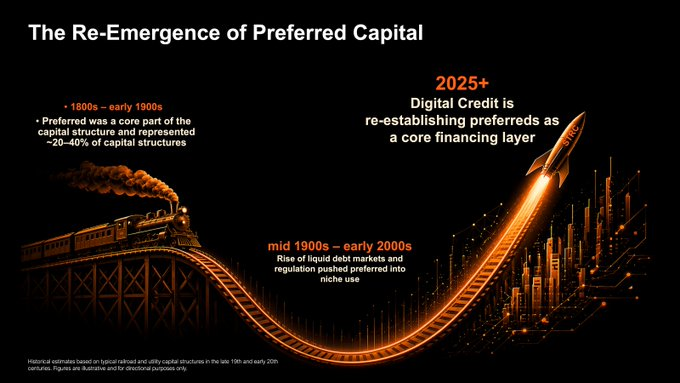
The chart argues that digital credit is now re-establishing preferred capital as a core financing layer in the 2025 cycle. Google’s $15 billion mandatory convertible preferred offering is not an unusual structure. It is a return to a financing model that dominated corporate capital for over a century, now being revived by companies whose asset acquisition needs outpace what traditional debt markets can efficiently absorb.
Strategy normalized this approach for Bitcoin treasury companies. Google has now brought it to the highest tier of global technology capital markets. The asset differs, but the architecture is identical.
Related: Crypto Mining Turns to AI infrastructure Race Between US and China
Disclaimer: The information presented in this article is for informational and educational purposes only. The article does not constitute financial advice or advice of any kind. Coin Edition is not responsible for any losses incurred as a result of the utilization of content, products, or services mentioned. Readers are advised to exercise caution before taking any action related to the company.