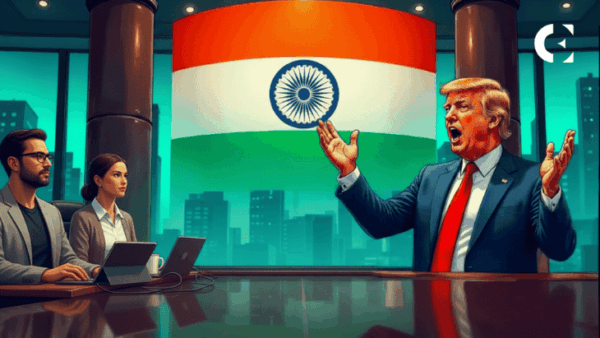

- India-US trade talks have reached a plateau amid unresolved issues.
- The deadlock could affect exporters, businesses and investor sentiment.
- The rupee and Indian stocks remain sensitive to trade uncertainty.
India’s trade talks with the US are now stuck, with both sides struggling to make progress on key areas. According to Finance Minister Nirmala Sitharaman, the long-running India-US negotiations have reached a “plateau,” suggesting that a near-term deal is unlikely.
This uncertainty has significantly affected Indian exporters and businesses that rely on US trade. Investors are now waiting for more clarity on tariffs and market access, as well as the US-India talks’ impact on the rupee and investor sentiment.
Why Have India-US Trade Talks Hit a Plateau?
Reports claim that India-US trade discussions have slowed. Disagreements on several issues continue to remain unresolved. The main areas of debate include tariffs, market access, and trade imbalance between the US and India. While the US intends to reduce its trade deficit with India, the latter seeks better access to the American market for its exporters.
Notably, tariff concerns continue to remain the biggest challenge. Indian businesses face difficulties as they find no clarity on the tax they may face when selling goods in the US. As these issues remain unsolved, Nirmala Sitharaman described the current situation as a “plateau.” This doesn’t mean that the discussions have ended, but it suggests that an agreement could take time.
Could the Stalled Talks Affect Indian Businesses?
It is important to mention that the trade uncertainty could be challenging for Indian businesses that depend on the US market. With this uncertainty, it would become very challenging for exporters to plan their orders and investments since there is no clear information available regarding future tariffs and market access. In case there are changes in the trade regime, then industries dependent on the US market would be under tremendous stress.
Besides, the rise in tariffs and trade barriers would also make it tough for importers. It would not be easy for firms on both ends to plan prices, logistics, and investments.
However, the impact may not be the same across all Indian companies. Even if the India-US trade talks remain stalled, businesses with widespread customers and supply chains would have greater flexibility.
What Could Prolonged Trade Uncertainty Mean for the Rupee and Stock Market?
Significantly, the prevailing uncertainty is critical for financial markets. This is better understood from the rupee’s sustained negative trend. High oil prices, the stronger US dollar, and rising foreign outflows add to the pressure. The rupee is valued at ₹96.24 per dollar and shows some resilience after the Reserve Bank of India intervened. Indian stocks are also feeling the pressure. They remain sensitive to these developments as Indian companies depend heavily on US demand.
Could Bilateral Investment Treaties Reduce India’s Dependence on US Trade?
Meanwhile, India is planning to expand its trade connections beyond the US to strengthen its business and investment relationships. Thus, bilateral investment treaties with other countries could help attract more foreign investment and give Indian businesses access to a wider range of markets. But these treaties cannot replace the importance of the US market as the country remained India’s major trading partner for years.
How Could India’s China Trade Strategy Affect Businesses and Investors?
Importantly, India’s growing efforts to reduce its trade imbalance with China could create both challenges and opportunities for Indian companies. While India imports large volumes of electronics, machinery, chemicals, and other goods from China, Indian exports to China are limited.
If the country reduces dependence on Chinese imports, it could benefit Indian companies in sectors such as electronics, manufacturing, and technology. At the same time, Indian businesses that rely on Chinese components could face higher costs if supply chains are disrupted.
(adsbygoogle = window.adsbygoogle || []).push({});What Should Businesses and Investors Watch Next?
Any fresh movement in the India-US trade talks could be important for businesses and investors. They will be closely watching the countries’ potential moves, negotiations, changes to tariff proposals, or signs of a possible agreement. If the deadlock continues to exist, businesses may need to prepare for long-term uncertainty around costs and access to the market.
Related: Why Higher US Yields Are Making India Less Attractive to Foreign Investors
Disclaimer: The information presented in this article is for informational and educational purposes only. The article does not constitute financial advice or advice of any kind. Coin Edition is not responsible for any losses incurred as a result of the utilization of content, products, or services mentioned. Readers are advised to exercise caution before taking any action related to the company.