

- Indian bond yields hit new highs, with 30-year at 7.87%, 10-year at 7.46%, 5-year at 7.30% and 2-year at 6.77%.
- RBI’s 5.50% repo rate, oil above $110, Middle East tensions and monsoon risks fuel inflation fears.
- Rising yields could increase loan EMIs, pressure stock valuations, & create losses for existing bondholders.
Indian government bond yields have surged to multi-year highs, raising concerns about borrowing costs, household finances, and investment returns. The rise comes as oil prices remain elevated above $110 a barrel, adding to inflation concerns and uncertainty over government borrowing.
Indian Bond Yields Hit Multi-Year Highs: What It Means for Borrowers and Investors
Indian government bond yields have surged to new multi-year highs across the curve. The 10-year government securities (G-Sec) yield stands near 7.46–7.47%, its highest level in four years. The 30-year yield hit 7.87%, its highest in four years, the 5-year jumped to 7.30%, its highest in three years, and the 2-year rose to 6.77%, its highest in two years.
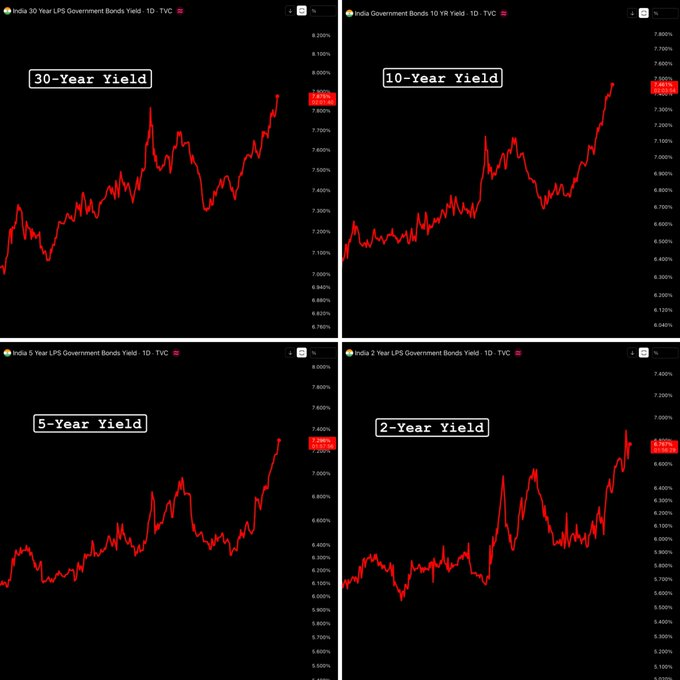
Meanwhile, these levels matter because G-Sec yields serve as benchmarks for borrowing costs. Higher yields increase the government’s cost of new borrowing and translate into higher lending rates at banks, corporate bond yields, and equity valuation discount rates.
For households, this could mean higher interest payments on floating-rate loans, including home loans, although the impact depends on banks’ lending rates and loan terms. Borrowers may face higher EMIs or longer repayment periods if their rates increase.
Investors could also feel the effects. Higher bond yields make fixed-income investments more attractive relative to stocks, potentially putting pressure on share prices. Companies that rely heavily on borrowing and growth stocks whose valuations depend on future earnings may be particularly sensitive to rising rates. However, the actual impact will depend on how yields, inflation, and market expectations evolve.
Follow us on X for real-time crypto updates.
Why Are Indian Government Bond Yields Rising?
The surge in Indian bond yields is caused by a combination of domestic policy tightening and external pressures. On October 7, 2026, the RBI increased the repo rate by 25 basis points to 5.50%, the first such move in almost four years, and adopted a stance of “calibrated tightening”. Markets are already pricing in additional increases, with some estimating up to 100 basis points of cumulative tightening over the next year.
Rising prices of crude oil, currently above $110 a barrel for Brent crude, have added to concerns about inflation. Retail inflation in September was 5.54%, with food inflation higher due to poor monsoon performance. Economists expect CPI to breach the RBI’s 6% upper tolerance band in October.
Furthermore, liquidity-draining measures by the RBI, heavy government bond supply, especially at longer tenors, and rising global yields, including US Treasuries, have further reduced demand for Indian G-Secs, pushing yields higher.
Will Rising Government Borrowing Costs Hurt Loans, EMIs and Stock Market Returns?
For homebuyers, the impact will depend on how lenders respond to changes in borrowing costs. If banks raise rates on floating-rate loans linked to external benchmarks, borrowers could face higher EMIs or longer repayment periods. For example, a rate increase on a ₹50 lakh home loan could raise monthly payments and increase the total interest paid over the loan term. The actual change will depend on the interest rate, remaining tenure, and lender’s terms.
On the stock market, the effects could vary across sectors. Real estate and automobile companies may face weaker demand if financing becomes more expensive for buyers. Businesses carrying substantial debt could also face higher interest expenses, potentially affecting profitability. Companies with stronger balance sheets and steady earnings may be better positioned to withstand these pressures.
Bond investors face a different trade-off. New buyers may benefit from the higher yields available on government securities and other fixed-income investments. Existing holders of long-term bonds, however, could face mark-to-market losses because bond prices generally fall when market yields rise. The eventual impact on portfolios will depend on bond maturity, purchase price, and whether investors sell before maturity.
For investors, the key is to assess how rising yields affect individual loans, companies, and bond holdings rather than assume that all borrowers or asset classes will be affected equally.
Subscribe to our YouTube channel for the latest crypto news.
Related: India’s Bond Yields Hit 3-Year High: Will Inflation Pressure RBI?
Disclaimer: The information presented in this article is for informational and educational purposes only. The article does not constitute financial advice or advice of any kind. Coin Edition is not responsible for any losses incurred as a result of the utilization of content, products, or services mentioned. Readers are advised to exercise caution before taking any action related to the company.