
- The 2021 JPMorgan study assessed Ripple alongside SWIFT, CLS, Fnality, and others.
- XRP scored well on instant settlement, but volatility and fiat spreads raised bank risks.
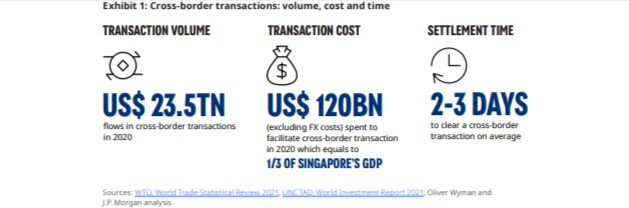
- The report examined $23.5T in annual flows and over $120B in cross-border costs.
A resurfaced 2021 cross-border payments report has revived debate around XRP after a viral X post framed the document as evidence of JPMorgan’s interest in Ripple. However, the original study gives a more cautious picture. “Unlocking $120 Billion Value in Cross-Border Payments” was published jointly by J.P. Morgan and Oliver Wyman in 2021.
The report reviewed several wholesale payment initiatives, including Ripple, SWIFT, CLS, and Fnality, while focusing mainly on a multi-currency central bank digital currency network. The distinction matters, as the report did not announce JPMorgan’s adoption of XRP. Instead, it compared payment approaches and highlighted both strengths and limitations.
Ripple’s Settlement Speed Came With Clear XRP Risks
In Exhibit 3, Ripple appeared among several illustrative commercial payment initiatives. The study described Ripple as cross-border payment infrastructure intended to use XRP as its settlement instrument.
The assessment rated Ripple strongly for instant settlement and relatively well for transparency. Yet it also identified two direct barriers to broader bank use. First, the report said XRP’s high volatility could limit banks’ willingness to use the asset for payments.
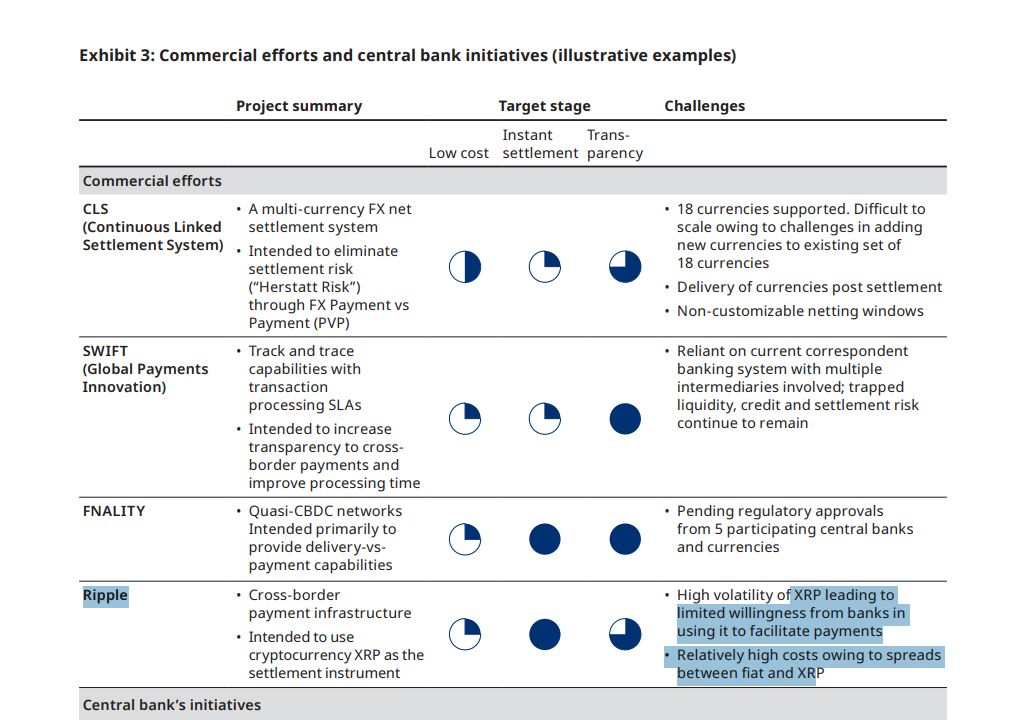
Second, it cited relatively high costs caused by spreads between fiat currencies and XRP. Those points became central to the negative social reaction after the report resurfaced. X user AlewXRP criticized the bullish interpretation and argued that the original post overlooked the report’s stated adoption risks.
That criticism did not dispute Ripple’s inclusion. Instead, it challenged the suggestion that inclusion meant banks were moving toward XRP settlement.
JPMorgan Mention Does Not Equal Planned XRP Adoption
The broader report examined a cross-border payments market where corporations moved about $23.5 trillion annually while paying more than $120 billion in transaction costs.
Against that backdrop, J.P. Morgan and Oliver Wyman estimated that a full-scale multi-currency CBDC network could reduce those costs by around $100 billion each year. That estimate also shows where the report’s attention was directed.
Meanwhile, Ripple’s technology has changed since 2021. Its current platform supports settlement through XRP, fiat currencies, and stablecoins, including RLUSD, USDC, and USDT. Even so, the resurfaced document remains historical evidence that XRP was evaluated as one possible settlement instrument, not proof of JPMorgan adoption.
The debate therefore centers on interpretation rather than whether Ripple appeared in the study. The report recognized fast settlement and transparency while recording volatility and conversion spreads as barriers.
Ultimately, the report’s conclusion is narrower than the viral claim suggests. JPMorgan and Oliver Wyman assessed Ripple, but their analysis also documented risks that could discourage broader bank use within the banking system at scale.
Related: XRP Price Prediction: Can XRP Reach $6 by 2027 After Ripple Signs Mastercard and JPMorgan?
Disclaimer: The information presented in this article is for informational and educational purposes only. The article does not constitute financial advice or advice of any kind. Coin Edition is not responsible for any losses incurred as a result of the utilization of content, products, or services mentioned. Readers are advised to exercise caution before taking any action related to the company.