


- Quack AI price prediction puts the 2026 base case at $0.12, with $0.0980 the level to hold
- Q rose more than 250% in 24 hours, per CoinGecko and CoinMarketCap
- Estimates for a possible November 2 unlock range from 225.67 million to 248.60 million Q
Quack AI price prediction for 2026 points to $0.12 by year-end in the base case as the spike cools, with a hold above $0.0980 needed to keep the rally intact.
Quack AI Price Prediction 2026: Can Q Hold Above $0.10 After Its Spike?
Q could end 2026 between $0.04 and $0.30, with a base case of $0.12 if it holds above the 20-day EMA at $0.0980. A close below the Bollinger Band midline at $0.0862 would put the 50-day EMA at $0.0635 in play. The bull case needs a close above today’s high at $0.2321.
Quack AI Price Analysis: Can Q Hold Above Its 20-Day EMA?
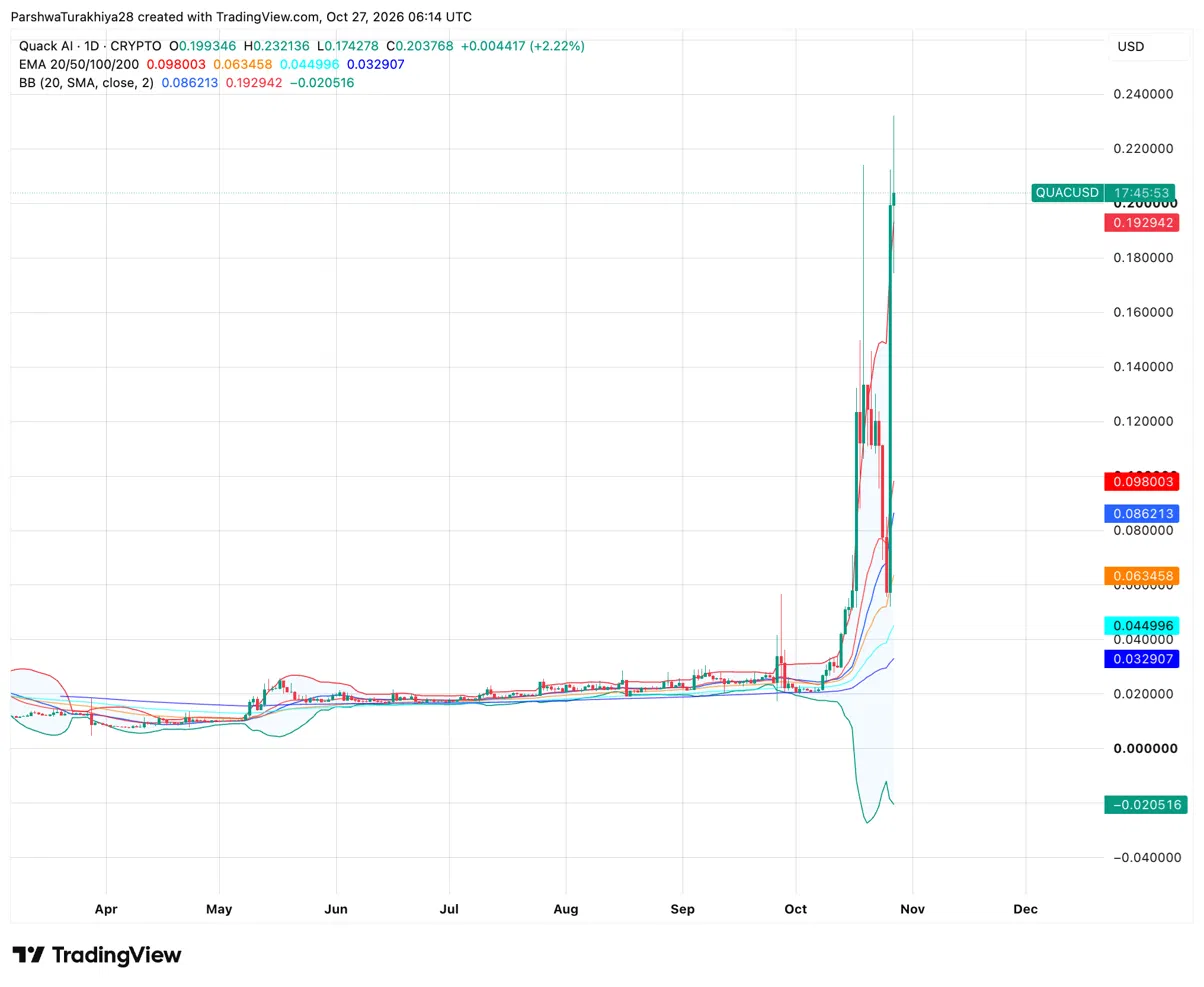
Q is trading above its upper Bollinger Band at $0.1929, at $0.2038 and up 2.22% today after reaching $0.2321 and dipping to $0.1743. The surge came on the previous daily candle, which ran from near $0.06 to a close near $0.1993, so today’s candle is consolidating that move rather than extending it.
The 20-day, 50-day, 100-day and 200-day EMAs at $0.0980, $0.0635, $0.0450 and $0.0329 all sit beneath price. Price has run well ahead of them, at about twice the 20-day EMA, so a pullback toward $0.0980 would be a reset rather than a break in trend.
Related: Axis Robotics (AXIS) Price Prediction & Forecast 2026, 2027, 2028-2030
Q looks more likely to give back part of the spike and test $0.0980 than to push through $0.2321 in the coming weeks, and a daily close below the Bollinger midline at $0.0862 would put the 50-day EMA at $0.0635 in play.
Q Support and Resistance Levels, October 27, 2026
| Type | Price | Why it matters |
| Resistance | $0.2321 | Today’s high |
| Resistance | $0.25 | Round level above today’s high |
| Resistance | $0.30 | Round level, 2026 bull case |
| Support | $0.1929 | Upper Bollinger Band |
| Support | $0.0980 | 20-day EMA |
| Support | $0.0862 | Bollinger Band midline |
Bahattin Says Q’s PancakeSwap Buying Is an Arbitrage Bot, Not Accumulation
Bahattin (@ethereumsever) said that constant buying of Q on PancakeSwap looks like accumulation but is a DEX-to-CEX arbitrage machine, after he traced the flow end to end. His trace of October 26 activity runs as follows:
- Buys: A bot buys on PancakeSwap every 20 to 60 seconds in sizes of $25 to $150.
- Routing: A bot contract holds up to about 31K Q, then passes it through a wallet with a $327 balance and more than 10,000 transactions.
- Sales: About one second later the Q reaches a Gate deposit address, roughly $1.85K per batch, and Gate sweeps it into its own hot and cold wallets.
He said the same pattern appears in JCT, LIGHT, DGAI and DNA across Bitget and Gate, and concluded that on-chain buys do not equal demand.
Quack AI’s Possible November 2 Unlock: What the Estimates Say
Several sources flag a potential token release on November 2, but they disagree on the size:
| Source | Estimated release |
| TokenPost’s review of estimates | 225.67 million to 248.60 million Q |
TokenPost said neither the date nor the amount was confirmed by the project’s published schedule. Quack AI’s release schedule page describes 24 to 36 months of linear vesting, a full unlock at 37 months and 12-month cliffs for the team, investors and advisers. It lists no November 2 quantity.
Quack AI and Prom Plan to Explore Payments Between AI Agents
Quack AI announced a collaboration with Prom on September 11 to explore combining Quack AI’s payment permissions and escrow controls with Prom’s modular zkEVM infrastructure.
The target use is frequent, low-value payments between autonomous agents.
Quack AI Price Prediction 2026 to 2030: Bear, Base and Bull Scenarios
These are year-end price scenarios for Q, built from the chart levels above and the vesting schedule Quack AI has published.
| Year | Bear case | Base case | Bull case | Base case vs $0.20 |
| 2026 | $0.04 | $0.12 | $0.30 | -41% |
| 2027 | $0.03 | $0.14 | $0.40 | -31% |
| 2028 | $0.03 | $0.18 | $0.55 | -12% |
| 2029 | $0.03 | $0.22 | $0.75 | +8% |
| 2030 | $0.04 | $0.28 | $1.00 | +37% |
They are scenario estimates, not guarantees, and each depends on how much vesting supply reaches the market and whether Quack AI’s payment platform finds real usage.
Quack AI Price Prediction 2027: Can an Agent Payments Product Support $0.14?
Q could end 2027 between $0.03 and $0.40, with a base case of $0.14. The base case assumes the AI-agent payment platform moves from the exploration stage of the Prom collaboration to live usage while team, investor and adviser tokens keep vesting. The bear case has vesting supply outrunning demand. The bull case needs payment activity that gives Q demand beyond trading.
Quack AI Price Prediction 2028: Can Q Hold $0.18 as Vesting Continues?
Q could finish 2028 between $0.03 and $0.55, with a base case of $0.18. Linear vesting is still adding supply in 2028, so the base case needs usage to grow at about the same pace. The bear case pairs that supply with weak adoption. The bull case has usage growing faster than the tokens reaching the market.
Related: Cap (CAP) Price Prediction & Forecast 2026, 2027, 2028, 2029, 2030
Quack AI Price Prediction 2029: Can Q Reach $0.22 as the Unlock Schedule Winds Down?
Q could trade between $0.03 and $0.75 at the end of 2029, with a base case of $0.22. Quack AI’s schedule ends in a full unlock at 37 months, and the base case assumes most of that supply is in the market by then. With supply growth slowing, price should follow platform usage more closely. The bull case needs agent payments to become a recurring source of demand.
Quack AI Price Prediction 2030: Can Q Reach $0.28?
Q could finish 2030 between $0.04 and $1.00, with a base case of $0.28, about 1.4 times today’s price. The base case assumes the unlock is complete and the platform carries working agent payments. The $1.00 bull case, about 4.9 times today’s price, needs that usage to scale well beyond its current stage. The $0.04 bear case, about 80% below today’s price, assumes the token fades back toward its pre-spike range.
FAQs
Q could end 2026 between $0.04 and $0.30, with a base case of $0.12 as the spike cools. Holding above the 20-day EMA at $0.0980 keeps the rally intact, and a close below the Bollinger midline at $0.0862 would put the 50-day EMA at $0.0635 in play.
In this forecast, Q could reach $0.28 by the end of 2030 in the base case, $1.00 in the bull case and $0.04 in the bear case. The base case is about 1.4 times today’s price of $0.2038. The scenarios depend on how much vesting supply reaches the market and on whether Quack AI’s agent payment platform gains real usage.
CoinGecko’s snapshot showed Q up 267.80% over 24 hours near $0.21, and CoinMarketCap showed a gain above 250%. The coverage reviewed does not tie the move to a partnership or announcement. Bahattin says recent on-chain buying on PancakeSwap came from a DEX-to-CEX arbitrage bot rather than accumulation.
Several sources flag a possible release on November 2, with estimates from 225.67 million to 248.60 million Q, according to Tokenomics.com, AMBCrypto and TokenPost. TokenPost said the date and amount are not confirmed by the project’s published schedule, which describes 24 to 36 months of linear vesting.
Disclaimer: The information presented in this article is for informational and educational purposes only. The article does not constitute financial advice or advice of any kind. Coin Edition is not responsible for any losses incurred as a result of the utilization of content, products, or services mentioned. Readers are advised to exercise caution before taking any action related to the company.