

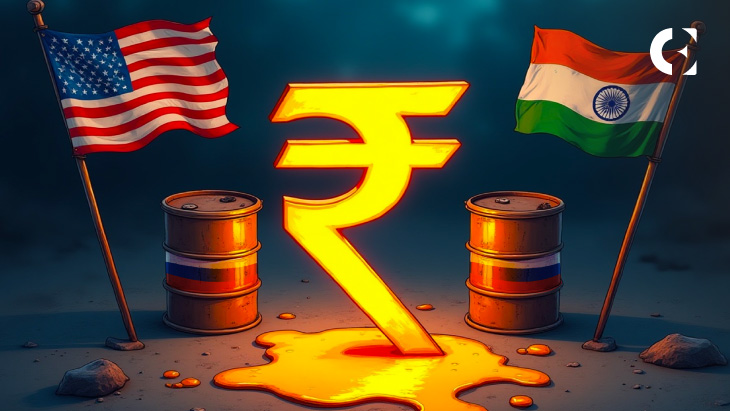

- Surging oil prices threaten the rupee recovery by raising import costs and dollar demand despite a weaker USD.
- Brent crude near $115 and AI jitters fuelled risk aversion, pushing the INR to around 94.8-94.9 per USD.
- Indian investors should track oil and geopolitical risks beyond the USD, as India imports nearly 90% of oil.
On October 23, 2026, the Indian rupee (INR) weakened to 94.96 against the US dollar (USD) as soaring oil prices and artificial intelligence (AI)-related jitters fuelled risk aversion, outweighing relief from a pullback in expectations of Federal Reserve rate hikes.
However, Indian investors should now look beyond the dollar, as currency gains can only offer temporary relief without easing deeper economic pressures from rising oil prices.
Why Is the Indian Rupee’s Recovery Already Under Pressure?
In mid-October, the INR rallied for eight straight sessions to briefly exceed a six-week high close to 94.30 per dollar. Support came from residual inflows linked to the Jio Platforms IPO, Reserve Bank of India (RBI) measures that curbed speculative dollar demand, and the unwinding of long-dollar positions. However, that momentum has reversed suddenly.
As of Oct. 22, the INR had ended its winning streak and stabilized around 94.82. On Oct. 23, INR was trading in the 94.8–94.96 range. The primary reason is the surge in oil prices, which has triggered heavier dollar purchases by importers and oil marketing companies.
Since India imports about 88- 90% of its crude needs, every increase in global oil prices translates into an immediate increase in dollar demand and puts pressure on the rupee.
Rising Oil Prices vs. a Weaker Dollar: Why the Rupee Remains Vulnerable
Normally, a weaker dollar would boost the Indian rupee by relieving emerging-market currencies of pressure. However, rising crude oil prices are offsetting that benefit. Brent crude climbed to around $114–$115 a barrel after Houthi attacks on Saudi infrastructure raised concerns about potential supply disruptions in the Middle East.
Higher oil prices threaten to reverse INR’s recovery by raising India’s import bill and dollar demand. Oil importers also need more dollars to pay for these purchases, adding pressure on the rupee. As a result, even if the rupee temporarily gains, rising oil costs could keep pressure on equities, inflation, and foreign investment.
Follow us on X for real-time crypto updates.
How Higher Crude Oil Prices Could Fuel India’s Inflation and Corporate Costs
Higher crude oil prices increase India’s import bill, raising costs for businesses and consumers. In September, the crude oil import bill rose 47% year-on-year to $15.4 billion, while the first-half FY27 bill reached $90.6 billion. Higher oil prices can increase costs of transport, fuel and manufacturing, and those prices could be passed on to consumers.
Furthermore, this risks adding to inflation, particularly as wholesale inflation reached 11.39% in September and consumer inflation stood at around 5.5%, above the RBI’s 4% target. Businesses unable to pass on these higher costs may also see profit margins fall.
Why Rupee Strength Does Not Guarantee a Stock Market Recovery
A stronger Rupee can boost market sentiment by making dollar-denominated imports cheaper and decreasing the currency risk faced by foreign investors. But it doesn’t necessarily revive equities during a crude oil rally. This is evident in the recent market activity, as despite the rupee’s recovery earlier this month, the Sensex and Nifty faced repeated pressure due to surging crude prices.
With crude oil prices rising above $113-$114 per barrel, selling pressure on banking, metal, and mid-cap stocks offset gains in the rupee and IT shares. Higher oil prices raise corporate costs, fuel inflation concerns, and can trigger foreign portfolio outflows when global risk aversion increases. As a result, rupee appreciation may offer temporary support to markets without easing the broader economic pressures.
Brent Crude, USD/INR and Foreign Flows: What Indian Traders Should Watch Next
Indian traders should watch three indicators: Brent crude, the USD/INR exchange rate and foreign portfolio flows. Oil prices above $115-$120 may drive up the demand for the dollar and put pressure on the rupee, and prices below $105 may bring relief.
For the USD/INR pair, traders should also monitor the 94.20–94.30 support and 95.00–95.30 resistance zones. Renewed foreign investor selling could quickly reverse rupee gains. Combining these three indicators will provide a better overall picture than watching the dollar alone.
Subscribe to our YouTube channel for the latest crypto news.
Related: USD to INR Today: Rupee, Brent Crude, and EUR/INR Signal a Bigger Risk for Indian Markets
Disclaimer: The information presented in this article is for informational and educational purposes only. The article does not constitute financial advice or advice of any kind. Coin Edition is not responsible for any losses incurred as a result of the utilization of content, products, or services mentioned. Readers are advised to exercise caution before taking any action related to the company.