
- Tokenized RWA assets hit $34.18B, but penetration of underlying markets is just 0.01%.
- Only 12% of tracked tokenized capital participates in qualifying on-chain finance.
- Liquidity pools and lending account for 93.5% of deployed tokenized equity value.
Tokenized real-world assets are growing fast, but their expanding market value shows only part of the adoption story. Binance Research’s “RWA Activation Era” report shows that financial use continues to lag behind issuance.
Total RWA assets under management reached $34.18 billion through September 15, 2026, up 85.2% year to date. Yet tokenization covers roughly 0.01% of underlying markets, while approximately 12% of tracked tokenized capital is deployed in qualifying on-chain financial applications.
Rapid Growth Meets Limited Market Penetration
Bond and money-market funds remain the largest tokenized category, holding $18.29 billion in on-chain assets. They contributed 54.7% of this year’s additional RWA value, while equities supplied another 22.4%.
Equities recorded faster percentage growth, climbing by 390.4% to $4.43 billion. Their share of tracked RWA assets increased from 4.9% to 13%.
However, those gains remain small relative to conventional markets. Binance Research’s Programmable Asset Ratio, or PAR, compares qualifying programmable on-chain assets with their corresponding underlying market value.
Across principal asset categories exceeding $300 trillion globally, the roughly $34 billion tokenized balance implies approximately 0.01% penetration. For equities, PAR stands at just 0.0029% against a $151.9 trillion listed-equity reference market.
Strong percentage gains therefore show expansion from a small base. They do not confirm that tokenized products have reached widespread adoption across the markets they represent.
Issuance Does Not Guarantee Financial Use
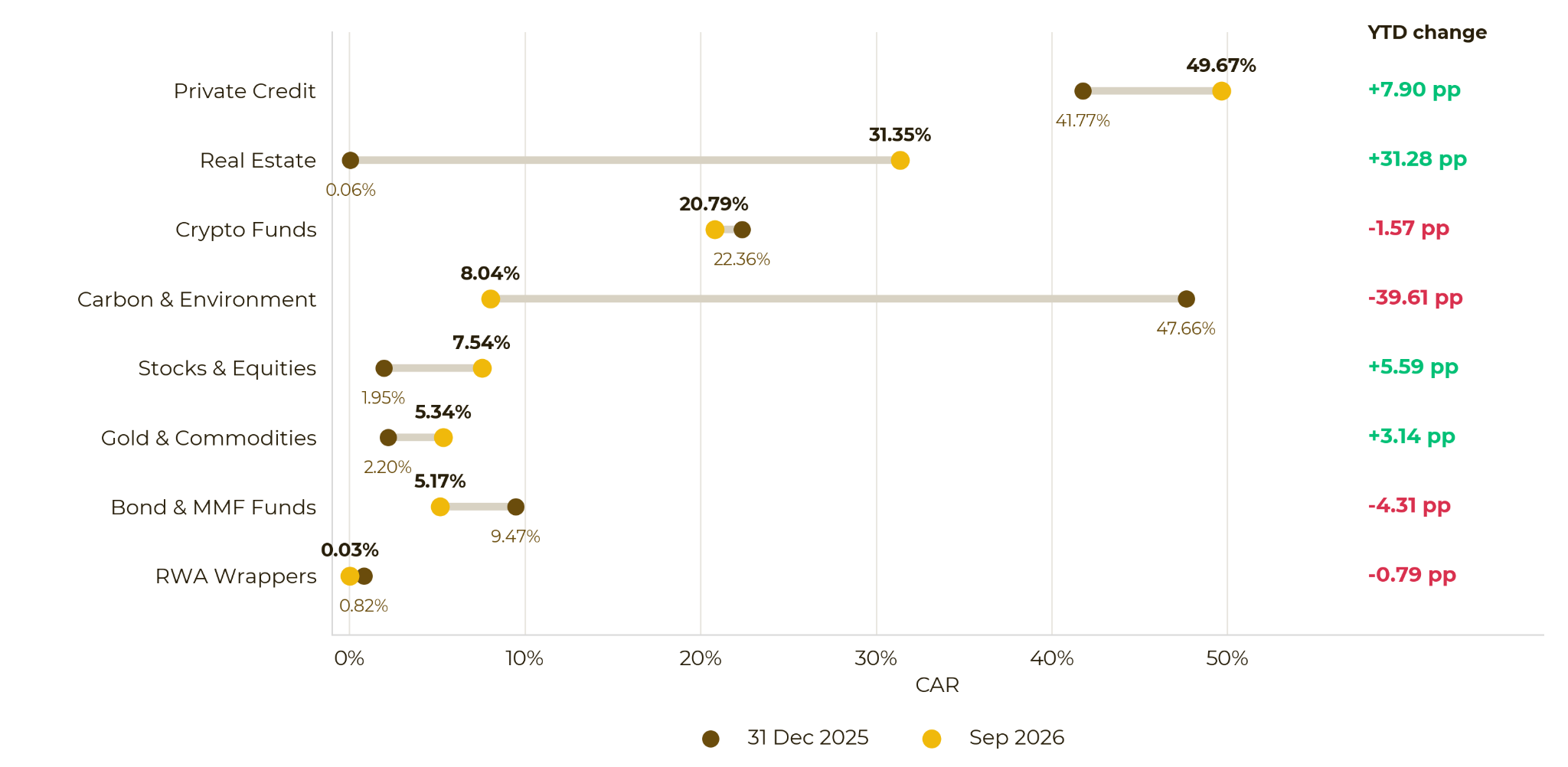
The report’s Capital Activation Rate, or CAR, addresses a different question: how much tokenized capital actually participates in on-chain finance?
CAR compares deduplicated qualifying assets deployed in verified financial applications with the circulating value of those same assets. These applications include liquidity pools, lending platforms, and collateral markets.
At roughly 12%, overall CAR means that around $12 of every $100 in tracked tokenized value participates in qualifying applications. The remaining balance sits outside that measured deployment, although holding an asset can still serve an investment purpose.
This distinction matters because AUM measures the size of the asset base, while CAR measures its deployment. Issuing more tokens can increase AUM without increasing the proportion supporting trading or financing.
Utilization also varies considerably. Private credit leads with a 49.67% CAR, while equity CAR increased from 1.95% to 7.54% this year. Equity activation has increased, but most tokenized equity value remains outside qualifying applications.
Liquidity and Collateral Define the Next Test
Equity deployment already shows where practical demand stands out. Liquidity pools account for 65.4% of equity DeFi total value locked, with lending contributing another 28.1%. Together, these activities represent 93.5% of deployed equity value.
Binance Research’s scenarios illustrate why activation matters independently of issuance. Under its 2030 base case, approximately $349 billion of tokenized equities would imply a 0.23% PAR. Within that scenario, increasing CAR from 10% to 20% would lift deployed capital from $34.94 billion to $69.87 billion without additional tokenized supply.
Tokenized assets are growing rapidly, but scale alone does not signal adoption. The gap between issuance and on-chain activation shows that real-world utility still lags behind market expansion. Bridging that gap will be key to determining whether RWA tokenization becomes a core financial layer or remains a niche market.
Related: South Korea Plans Three-Phase Tokenized Asset Rollout Starting 2027
Disclaimer: The information presented in this article is for informational and educational purposes only. The article does not constitute financial advice or advice of any kind. Coin Edition is not responsible for any losses incurred as a result of the utilization of content, products, or services mentioned. Readers are advised to exercise caution before taking any action related to the company.