
- Escalation in the Strait of Hormuz raises risk for global oil supply disruptions ahead.
- U.S. naval posture and Iran’s response increase the risk of miscalculation at sea events.
- Crypto liquidations and rising oil prices signal broader risk-off market pressure.
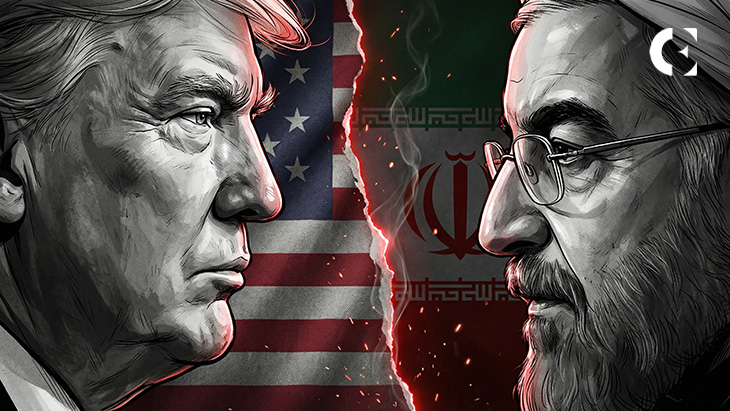
President Donald Trump’s order authorizing the U.S. Navy to destroy any boat laying mines in the Strait of Hormuz has sharply raised geopolitical risk, while deepening uncertainty across energy and financial markets. The directive came as the United States intensified minesweeping operations and enforced a tougher naval posture in one of the world’s most strategic shipping corridors.
Because the strait carries roughly 20% of global oil flows, any military escalation there threatens immediate consequences for crude prices, inflation expectations, and broader risk sentiment. Consequently, investors now face rising uncertainty over whether the order will pressure Iran toward negotiations or trigger retaliation.
Military Pressure Raises Escalation Risks
Trump’s order signals deterrence through force, yet it also increases the possibility of confrontation. U.S. Central Command reportedly redirected 31 ships, while tanker traffic remains far below normal levels.
In peacetime, more than 100 ships crossed the strait daily. However, only eight vessels, including three oil tankers, reportedly transited on Wednesday.
Iran responded with resistance rather than concession. Mohammad Bagher Ghalibaf stated reopening the Strait of Hormuz remains impossible while the U.S. naval blockade continues. That response suggests Tehran views the U.S. move as coercion rather than a pathway to diplomacy.
Besides, the “shoot and kill” language raises the risk of miscalculation. Small naval encounters can escalate rapidly, especially in crowded waterways. A single incident involving minesweepers, patrol boats, or tankers could trigger broader military exchanges. Hence, rather than ending the conflict, the order may harden positions in the near term.
Oil, Risk Assets, and Crypto Face Pressure
Markets could react first through oil. Reduced tanker movement and shipping disruptions may push crude higher, especially if insurance costs rise. Higher energy prices would likely pressure equities and increase volatility across global markets.
Source: Coinglass
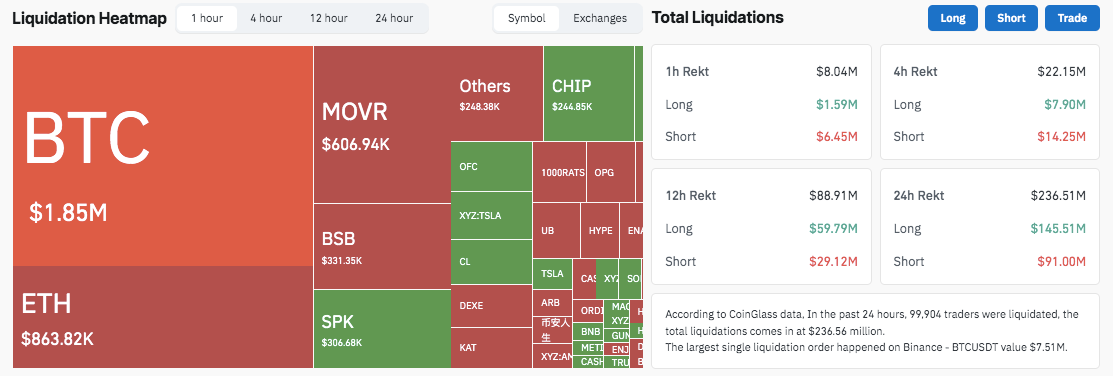
Additionally, crypto markets already show signs of stress. CoinGlass liquidation data over the past 24 hours highlights broad risk unwinding.
Bitcoin led liquidations at $76.09 million, while Ethereum recorded $61.78 million. The “Others” category reached $21.69 million, while CHIP posted $17.25 million.
RAVE registered $6.09 million in liquidations, while Solana stood at $5.48 million. These figures point to leveraged traders cutting exposure as geopolitical risks intensify.
Related: Ethereum Price Prediction: ETH Faces Range Pressure as Bulls Eye $2,500 Breakout Zone
Disclaimer: The information presented in this article is for informational and educational purposes only. The article does not constitute financial advice or advice of any kind. Coin Edition is not responsible for any losses incurred as a result of the utilization of content, products, or services mentioned. Readers are advised to exercise caution before taking any action related to the company.