
- XRP’s institutional adoption sees an influx via banking, custody, and tokenization by Ripple.
- Jeonbuk Bank has adopted Ripple Payments, but its release does not indicate direct XRP settlement.
- Large XRP transactions rose 280% in one day, but transfers do not prove new institutional buying.
XRP has gained institutional entry points while its market price still sits near $1.10. Banks, asset managers, and regulated funds now use Ripple services or XRP Ledger infrastructure. Yet those relationships do not always require clients to buy XRP or hold it for long periods.
That gap now shapes the debate around XRP institutional adoption and its effect on price. A post from Versan Aljarrah said banks are onboarding while large ledger transactions rise. The available evidence shows wider infrastructure use, but sustainable token demand needs separate confirmation.
XRP Institutional Adoption Reaches More Banks
Ripple announced a partnership with Jeonbuk Bank on August 18. The Korean regional bank will use Ripple Payments for cross-border remittances. Ripple said the service provides settlement within seconds or minutes and operates around the clock.
The Jeonbuk Bank announcement covers business clients, including exporters, technology companies, and online creators. It makes Jeonbuk the first Korean regional bank to deploy Ripple payments. The statement does not say the bank will purchase XRP or settle every transfer with it.
Ripple also signed Kbank, Korea’s first internet-only bank, in April. Kbank will use Ripple Custody for institutional wallet services across multiple blockchain networks. That deal expands Ripple’s banking presence, although it does not establish direct XRP buying.
Kyobo Life Insurance presents another institutional case in their project with Ripple Custody to settle tokenized Korean government bonds. In all of these instances, regulated entities are experimenting with payment, custody, and securities infrastructure as opposed to a singular XRP product.
Asset management adoption has also reached the ledger itself. Aviva Investors and Ripple plan to develop tokenized traditional fund structures on XRPL during 2026. Aviva gains access to issuance, management, compliance tools, and near-instant settlement.
Regulatory Access Expands Around Ripple
The legal setting has changed since the long-running SEC case dominated XRP coverage. In August 2025, both sides dismissed their appeals. The SEC said the final judgment kept a $125.04 million penalty and an injunction against future unregistered institutional sales.
The court’s earlier findings separated programmatic exchange sales from certain direct institutional sales. As a result, the case outcome dissolved an area of dispute for sales restrictions, while other remaining issues still need to have institutional XRP structured in line with the appropriate securities law requirements.
He also attended an August 19 White House ceremony with business executives and lawmakers, where President Trump called for Congress to adopt a fair version of the CLARITY Act. Reuters reported that Ripple, Coinbase, Kraken, Robinhood, and major financial firms attended.
That meeting supports Aljarrah’s statement that Ripple now participates in policy discussions. Still, attendance does not equal enacted legislation. Congress has not completed the CLARITY Act, so federal market rules can still change during negotiations.
Europe offers a clearer operating route. Luxembourg granted Ripple a full MiCA crypto-asset service provider authorization in July. The authorization lets Ripple offer regulated crypto payment services across all 30 European Economic Area countries.
Ripple says it now holds more than 75 regulatory licenses. Those approvals can reduce onboarding barriers for banks and companies. They expand the addressable market for Ripple services, though customers may choose XRP, RLUSD, another asset, or fiat settlement.
Binance Flows Show Limited Immediate Supply Change
The supplied CryptoQuant reserve chart places Binance holdings near 2.6 billion XRP. Price appears close to $1.10 on the same daily chart. Reserves have moved below several peaks above 3 billion recorded during 2024 and 2025.
CryptoQuant defines exchange reserves as coins held in exchange-controlled addresses. Rising reserves increase available trading supply, while falling reserves reduce that available balance. Neither direction proves that every owner plans to trade.
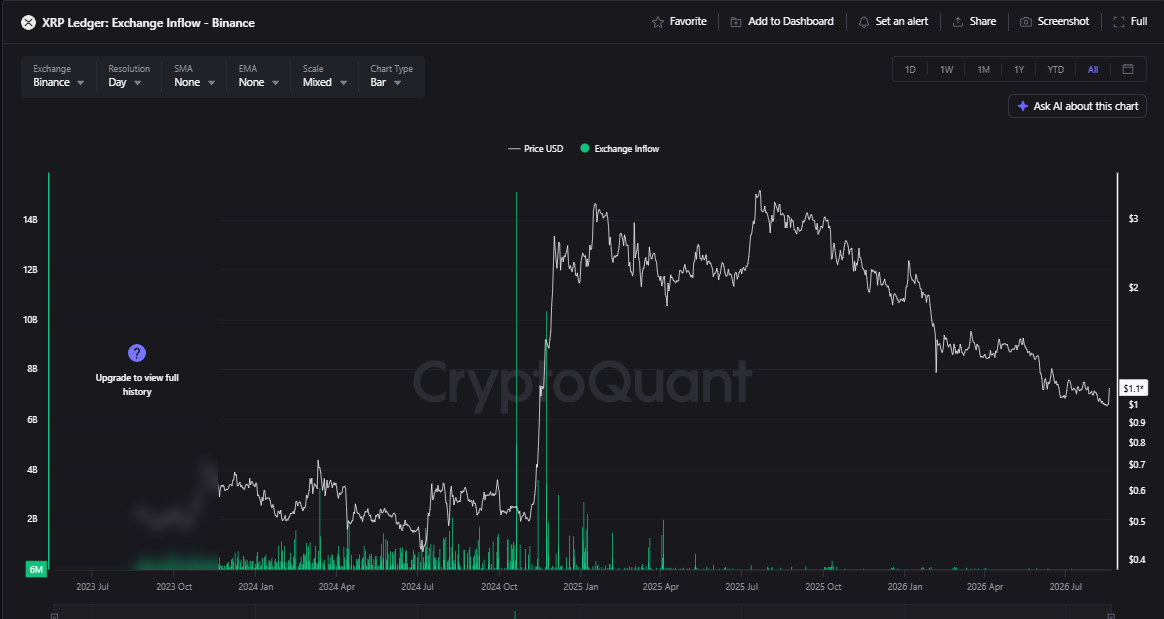
Another chart records approximately 6 million XRP flowing into Binance at press time. The third shows about 6.6 million XRP leaving the exchange. Subtracting outflows from inflows produces a net outflow near 600,000 XRP for that daily reading.
That net change equals roughly 0.02% of the 2.6 billion XRP reserve. This demonstrates very minimal movement compared with the balance that Binance holds in its own wallet.
Also, the wallet labels of CryptoQuant can change, and thus the recent readings will be subject to alteration. Historical flow charts display much larger deviations, but these peaked much more in 2024, whereas present inflows and outflows were much lower.
Large-value network activity offers a different measurement. Transactions above $1 million increased 280% within one day and exceeded 38, according to data cited by Benzinga. That count tracks transfer size, not the identity or purpose behind each transaction.
A custodian can move funds between wallets without creating new investment demand. Exchanges can also consolidate balances, and one owner can control several addresses. Large transactions therefore show active capital, but they cannot confirm institutional purchases on their own.
What Could Connect Adoption With XRP Price
XRP price needs recurring demand that removes more tokens from sale than holders return. Ripple Payments can create such demand when a corridor explicitly uses XRP as bridge liquidity. A client using custody software or stablecoin settlement may create little direct XRP exposure.
Ledger activity alone also has a limited scarcity effect. Every transaction destroys XRP, but the standard minimum cost is only 0.00001 XRP. Even millions of transactions consume a small amount compared with circulating supply.
Tokenized funds can increase ledger use while settling through stablecoins. Aviva has not publicly shared the asset volumes of its project, the planned go-live date for the custody solution, or the required balance of XRP in order to proceed with this project—this lack of transparency may make it difficult to quantify the market demand that Aviva is addressing with their XRP holdings.
Regulationally-minded products offer a clear indicator. Franklin Templeton’s fund, which was released in November 2025, called XRPZ, holds XRP and bases its movement on the CME CF XRP-Dollar Reference Rate (excl. fees and expenses).
In their March 2026 filing, Franklin revealed the holding of 159.66 million XRP, worth $215.06 million in net assets. The trust’s exposure must grow with new creations or fall with redemptions.
A constant level of ETF creations (referred to as “XRP settlement corridors”) coupled with declining exchange holdings of XRP could translate to tangible demand for XRP. Price would also need persistent trading volume and a series of higher highs. Brief whale-transfer spikes do not meet those tests.
Related: Trump’s Bitcoin Buy Plan Sparks Rally: Can BTC Break Higher?
Disclaimer: The information presented in this article is for informational and educational purposes only. The article does not constitute financial advice or advice of any kind. Coin Edition is not responsible for any losses incurred as a result of the utilization of content, products, or services mentioned. Readers are advised to exercise caution before taking any action related to the company.