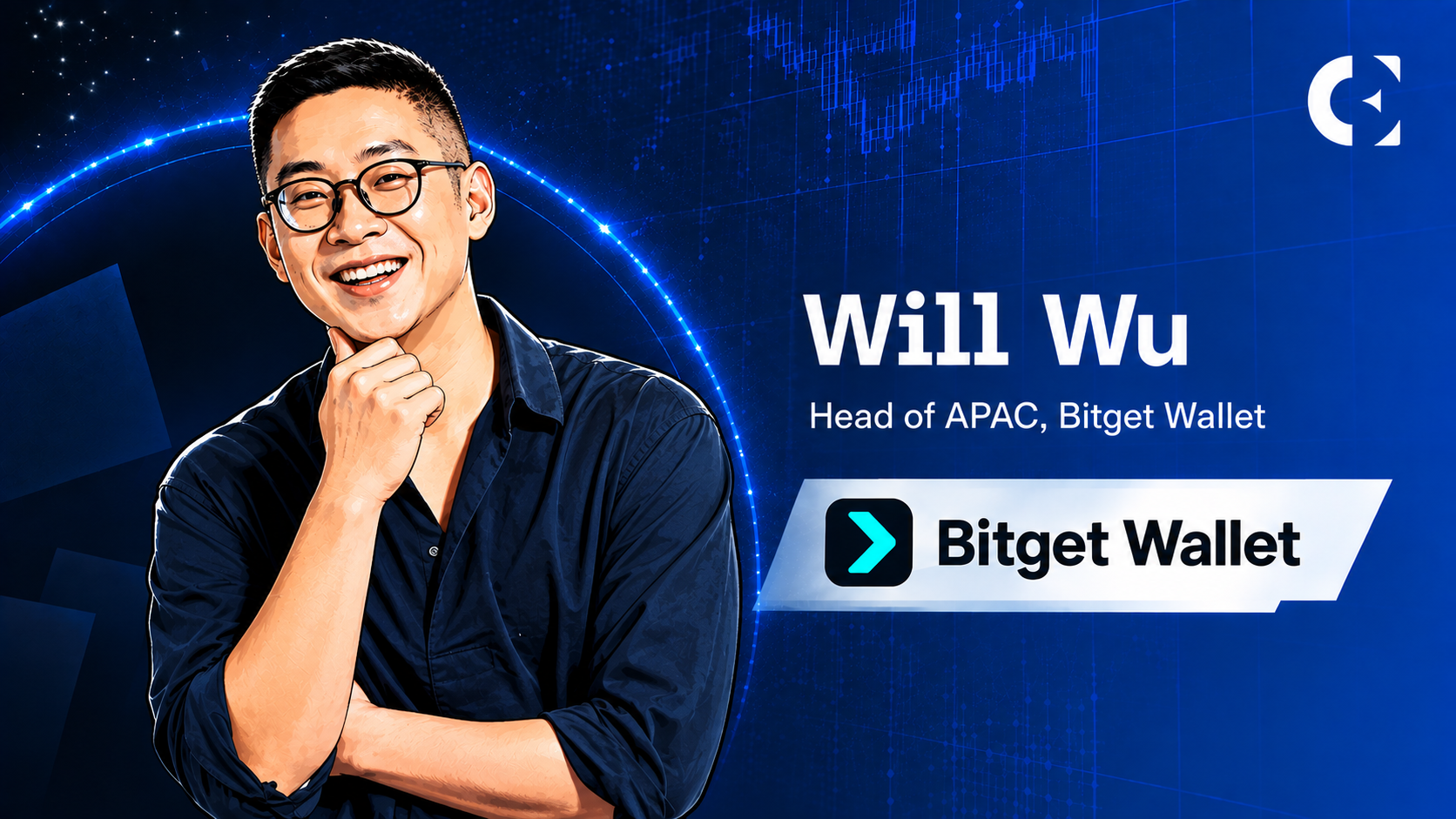

CoinEdition spoke with Bitget Wallet’s APAC Lead Will Wu about the changing landscape of crypto adoption across Asia. In this interview, Wu shares his perspective on why users are looking beyond trading, the growing role of stablecoins and payments, and what the industry needs to do to make crypto more practical and accessible for everyday users.
1. You’ve worked across both Web2 and Web3 and now lead Bitget Wallet’s growth in APAC. From what you’re seeing on the ground, what’s getting people in this region genuinely interested in crypto today?
What I see changing across APAC is that trading is no longer the only meaningful entry point. In South and Southeast Asian markets like Pakistan, Bangladesh, Vietnam, and Indonesia, people are also coming in for practical reasons: access to dollar-denominated value, cross-border transfers, digital work income, or simply financial products that may be harder to access through traditional channels. That creates a different kind of adoption, because the wallet is solving a recurring need rather than serving a single market cycle.
The motivation really splits along economic context. In developed markets where the local currency is stable, users are drawn in more by trading and yield; it’s about efficiency, getting more out of capital they already trust. In emerging markets, the need is different and more fundamental: stablecoins act as a hedge to preserve value against currency instability, and they open access to global assets. Tokenized stocks, for instance, that simply aren’t available to these users through local channels.
Stablecoins are an important part of that shift because they let people use crypto infrastructure without necessarily taking directional market risk. That doesn’t replace the appeal of upside, but it gives users another reason to keep using crypto even when they’re not actively trading.
2. You’ll be speaking at CoinFest Asia 2026 in Bali alongside people building different parts of the Web3 ecosystem. What do you think the industry needs to be talking about more if we really want to see crypto become part of everyday life?
I think the industry still underestimates reliability. We spend a lot of time debating the next narrative, but everyday finance depends on much less glamorous questions: does onboarding work, are fees predictable, can users get help when something goes wrong, and does the product behave consistently when markets are volatile, or networks are congested?
That’s why having builders, traders, and institutions in the same room matters: they optimize for different things, but mainstream adoption depends on solving some of these operational problems together.
For me, the test is simple: can my friend complete a transaction confidently without understanding gas, bridges, or which blockchain they’re using? The real breakthrough won’t be when everyone understands blockchain. It will be when they no longer need to.
3. Stablecoins and crypto payments seem to be gaining a lot of traction across Asia. Do you think we’re getting closer to a point where people use stablecoins without even thinking of them as “crypto”?
Yes, and I think stablecoins are more likely to become infrastructure before they become a consumer category.
A remittance user or a small business settling an invoice doesn’t need to have an opinion on blockchains. They care about how quickly value arrives, what it costs, whether the amount is predictable, and what currency sits on the other end. Stablecoins are increasingly competitive on exactly those dimensions.
Regulatory clarity will accelerate that process by giving traditional banks, fintechs, and payment providers more confidence to integrate stablecoin rails into products people already use. Over time, I think stablecoins will matter less as something consumers actively choose to hold and more as a settlement layer that makes certain payments faster, cheaper, and easier to move across borders.
It’s worth separating the two sides of demand here, though. Institutional volume in stablecoins is large and will keep growing as settlement infrastructure matures. But consumer demand in emerging markets is durable in a different way; it’s driven by a real, ongoing need to preserve value and access dollar liquidity, not just by market cycles, so that demand isn’t going away regardless of how institutional flows move.
4. Bitget Wallet is moving beyond just being a place to store and trade crypto, with payments, cards, and tokenized assets. What do you think needs to happen for someone who has never used crypto to feel comfortable making that first transaction?
I think the first transaction is a trust test. A new user is asking very basic questions: How much am I paying? What will I receive? Can I verify what happened? And what happens if something goes wrong? If a product can answer those questions clearly, the user doesn’t need to become technically sophisticated before they can feel comfortable using it.
But trust only matters if there’s already a reason to transact. For a traveler moving through Southeast Asia without easy access to local cash, or someone in Latin America watching their savings lose value to currency depreciation, the need comes first; the transaction is simply how they solve it. When the underlying problem is that concrete, the first transaction isn’t an abstract “try crypto” moment; it’s a practical decision: does this get me what I actually need, right now? That’s why we think about coverage in terms of real demand, making sure the product genuinely serves people facing cash access gaps, currency instability, or cross-border income, not just users who are curious about crypto for its own sake.
Familiar behaviors can help lower that barrier. Assetback is one example: eligible Bitget Wallet Card users can keep spending through a card and choose to receive rewards in assets such as Bitcoin, gold, or tokenized stocks. It introduces on-chain exposure through something the user already understands rather than asking them to begin with an unfamiliar investment flow.
For a first-time user, confidence comes from clarity. If the first transaction works exactly the way they expected, the second one becomes much easier.
5. APAC is such a diverse market. What works in Singapore may not necessarily work in Indonesia, the Philippines, or Japan. How do you balance having one global product with adapting to the very different needs of users across the region?
The first mistake is treating APAC as one market. Some product principles should be non-negotiable everywhere: security, self-custody, and reliability, for example. But the reason someone tries the product, what earns their trust, and which use case matters first can be completely different.
In the Philippines, remittances and community distribution can be strong entry points. Indonesia is highly mobile and community-driven. In Japan, users tend to scrutinize compliance and product reliability much more closely, while Singapore combines a sophisticated user base with a very high regulatory bar.
That means localization goes far beyond translation. It affects partnerships, fiat access, education, support, distribution, and even which feature we lead with. Especially for crypto payment products, given how fragmented the regulation and infrastructure are across this region, we work with regional and local licensed partners for our payment products; the on-ramp, off-ramp, and compliance requirements are simply too diverse for any single global setup to cover well. Localization isn’t a marketing layer we add after the product is built; it’s a part of our product strategy.
6. You’ve spoken at several major Web3 events across Asia over the past couple of years. Have you noticed any change in what users, investors, or builders are actually asking for compared with a few years ago?
Definitely. A few years ago, many conversations started with upside: what might appreciate, how fast TVL could grow, or which token would lead the next cycle. Today, the questions are more demanding. Users ask more about security and what they can actually do with an asset. Investors want to understand where yield comes from and whether tokenized exposure has real underlying value. Builders are thinking much earlier about distribution, compliance, and interoperability rather than treating those as problems to solve after launch.
I hear that shift consistently in conversations at events across Asia. It doesn’t mean the market has suddenly become conservative or that speculation is disappearing; it means the people who genuinely need a dollar account, not just speculative capital, are now aware the product exists. That awareness makes the conversations far more efficient and targeted, giving us a clearer understanding of what these users need from the product and where we should focus our efforts. It also helps us move faster as we build. Put simply, the bar has gone up. A strong narrative can still win attention. Increasingly, though, the product has to prove it deserves retention.
Disclaimer: The information presented in this article is for informational and educational purposes only. The article does not constitute financial advice or advice of any kind. Coin Edition is not responsible for any losses incurred as a result of the utilization of content, products, or services mentioned. Readers are advised to exercise caution before taking any action related to the company.