

- Bitcoin now nears $60,000 as Fidelity tracks power-law support around $58,237.
- ETF flows remain volatile after $296 million exited before $223.5 million returned.
- Citi cuts its 12-month Bitcoin target to $82,000 as institutional demand weakens.
Bitcoin is nearing a threshold around $60,000 as Fidelity macro director Jurrien Timmer tracks weakening momentum and fading speculative demand. In a July 2 update, Timmer placed power-law support near $58,237, turning the $58,000 to $60,000 zone into a market test.
At press time, Bitcoin traded near $61,600 after reaching its lowest level since September 2024 that week. Moreover, the asset remained more than 51% below its October 2025 record of about $126,198.
Bitcoin’s $58,237 Power-Law Floor Comes Into Focus
Basically, the power-law model maps BTC price history across logarithmic upper, median, and lower trend lines. According to Jurrien Timmer’s post, the model’s current lower boundary sits near $58,237, placing Bitcoin close to a level that has repeatedly attracted attention during major downturns.
Historical data reinforce the importance of that baseline. In 2015, BTC fell to $230 against modeled support near $252. Three years later, the token’s price reached $3,204 while support stood near $2,521. During 2022, the market bottomed at $16,366 against a modeled level of $15,006.
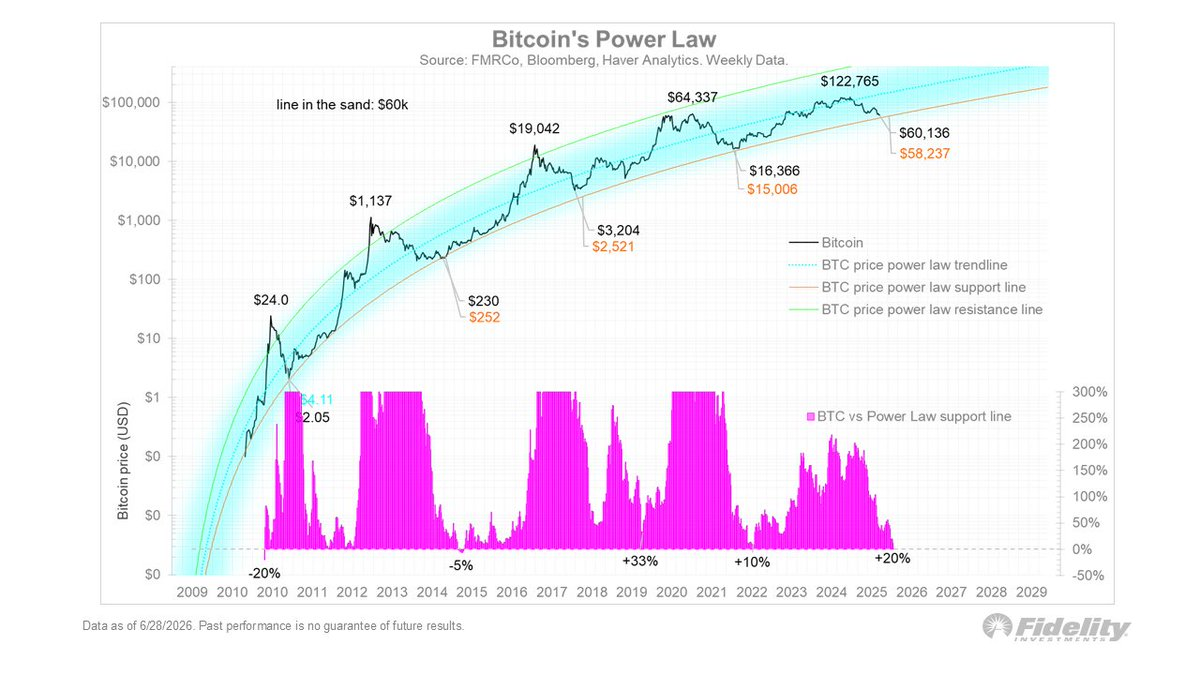
Beyond the support line itself, Timmer’s chart tracks the premium between Bitcoin’s market price and the model’s lower boundary. That premium expanded during previous rallies but has now narrowed sharply.
He linked the contraction to slower global money supply growth and reduced speculative demand. At the same time, capital has rotated toward high-growth technology sectors, weakening interest in alternative stores of value.
ETF Volatility Exposes Fragile Institutional Demand
Institutional demand has also softened, although daily exchange-traded fund flows remain inconsistent. Citigroup recently lowered its 12-month Bitcoin target to $82,000 from $112,000, citing weaker market conditions.
The bank pointed to persistent ETF outflows, reduced investor appetite, and slow progress on United States cryptocurrency legislation. Citi also estimated that spot Bitcoin ETF flows had recorded approximately $3.3 billion in net outflows during 2026.
Nevertheless, daily fund data showed that institutional positioning was not uniformly bearish. United States spot Bitcoin ETFs registered $296 million in net outflows on July 1 before reversing course the following day.
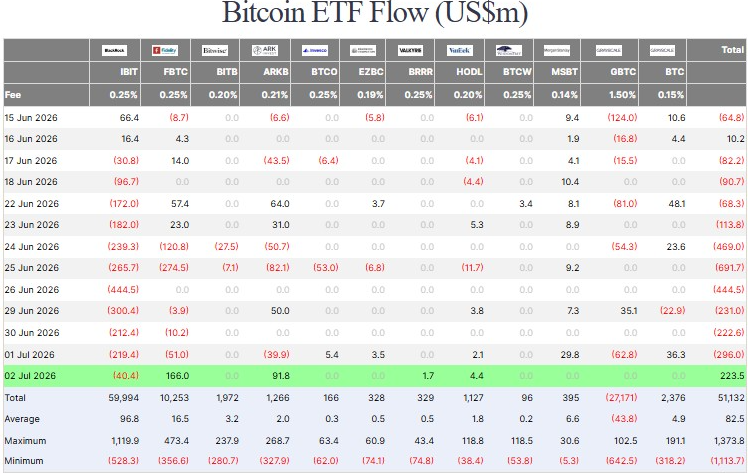
On July 2, those products attracted $223.5 million in net inflows, according to Farside Investors. Fidelity’s FBTC led the rebound after receiving $166 million during the session.
Taken together, the technical model and shifting ETF flows place the $58,000 to $60,000 range at the center of Bitcoin’s next market assessment. However, Timmer remained cautious about identifying an immediate bottom, noting that BTC’s price could remain near support before a sustained recovery develops.
Related: Why Bitcoin Usually Rises in July and What Traders Should Expect This Time?
Disclaimer: The information presented in this article is for informational and educational purposes only. The article does not constitute financial advice or advice of any kind. Coin Edition is not responsible for any losses incurred as a result of the utilization of content, products, or services mentioned. Readers are advised to exercise caution before taking any action related to the company.