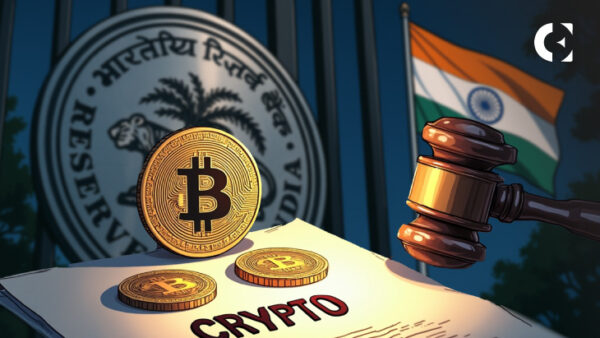

- India’s crypto regulation is now expanding beyond the 30% tax and 1% TDS rules.
- The government is giving more importance to investor safeguards and financial stability.
- Despite clear taxation rules, tax compliance remains a major challenge.
India’s crypto market has been facing regulatory challenges as the authorities have focused solely on taxation. But now the situation is changing, with the government shifting attention towards broader issues associated with the industry. As per the latest reports, Indian crypto regulation is moving beyond mere tax rules in an attempt to mitigate threats and fraud.
Recent developments indicate that the regulators are paying closer attention to the Indian crypto market. The authorities’ tougher stance on crypto regulation underscores that policymakers aim to introduce a comprehensive system that compiles compliance, enforcement, taxation, and investor protection.
How India Is Strengthening Crypto Regulation?
Social media platforms are now abuzz with discussions on Indian crypto regulation. In an X post earlier today, the on-chain research platform India Crypto Research shed light on the ways in which the country’s regulatory framework is evolving. The country is reportedly focusing more on financial stability, anti-money laundering (AML), investor protection, and stricter crypto rules.
Although India lacks a solid digital asset law, the country is expanding its crypto regulation. For instance, the Reserve Bank of India (RBI) has recently reiterated its restrictive stance on cryptocurrencies. A Reuters report revealed that the central bank intends to prevent banks and financial institutions’ exposure to digital assets.
Enforcement efforts are also reportedly becoming stricter. The Indian State of Maharashtra introduced an amendment to the MPID Act on July 1. The state authorities intend to include Virtual Digital Assets (VDAs) and NFTs under the depositor protection law. With this move, the enforcement agencies could trace, freeze, seize, and sell cryptocurrencies linked to fraud. Under this crypto regulation, law enforcement gets greater power to recover funds from crypto scams and hacks.
AML and PMLA Rules Shape the Crypto Market
It is worth noting that in March 2023, the Indian government included crypto businesses under the Prevention of Money Laundering Act (PMLA). This makes crypto exchanges and other platforms responsible for customer verification and record maintenance. They are also required to report suspicious transactions to authorities.
In January 2026, the crypto regulation became even stricter. The Financial Intelligence Unit (FIU-IND) launched tougher Know Your Customer (KYC) and reporting standards. These crypto regulations, along with the 30% tax and 1% TDS rules, highlight that the country is building a strong background for a secure financial system.
Crypto Tax Compliance Remains Challenging
According to India’s crypto regulation framework, exchanges are required to deduct 1% TDS on every sale or transfer of VDAs. Many investors see this as an extra tax, but according to experts, this actually works as an advance tax payment. This means that if the deducted TDS is more than the investors’ tax liability at the end, they can claim it as a refund while filing an Income Tax Return (ITR).
However, tax compliance remains a major challenge. Recent reports claim that nearly 39 million Indians held around $2.1 billion worth of cryptocurrencies as of the end of May 2026. Only less than 25% of the 645,000 traders of the FY2023 reported their transactions to tax authorities.
Related: India Leads the World in Crypto Usage, Says Coinbase
Disclaimer: The information presented in this article is for informational and educational purposes only. The article does not constitute financial advice or advice of any kind. Coin Edition is not responsible for any losses incurred as a result of the utilization of content, products, or services mentioned. Readers are advised to exercise caution before taking any action related to the company.