
- The Indian oil tanker Sanmar Herald, fired upon by Iranian gunboats on April 18, 2026, fell victim to a crypto scam.
- Indian authorities and the owner confirmed no crypto payment was made, labeling any such reports as fake news.
- The incident highlights growing crypto scams of offering “fake” safe passage in the Strait of Hormuz.
On April 22, 2026, India’s official Ministry of External Affairs (MEA) account issued a “Fake News Alert” denying the viral claims about the Indian-flagged oil tanker Sanmar Herald falling victim to a crypto scam for safe passage through the Strait of Hormuz.
Indian authorities and the vessel owner confirmed the scam narrative is false, though the tanker was fired upon by Iranian gunboats on April 18, 2026, prompting MEA to summon Iran’s ambassador.
Indian Authorities Deny Crypto Scam Claims Involving Sanmar Herald Tanker
On April 22, 2026, Indian authorities issued a “Fake News Alert” via X denying the viral claims about the Indian-flagged oil tanker Sanmar Herald falling victim to a crypto scam for safe passage through the Strait of Hormuz.
The circulating post from @Megatron_ron alleged that the captain transferred a large amount of USDT to an Indian man claiming to represent the Islamic Revolutionary Guard Corps (IRGC) Navy in exchange for safe passage.
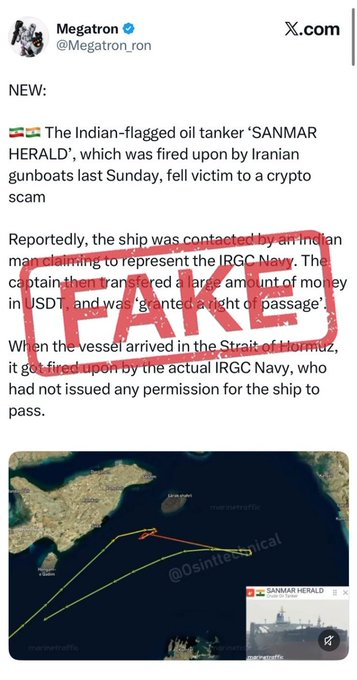
Source: X
Meanwhile, Indian authorities and the Chennai-based Sanmar Shipping company confirmed that the scam narrative is false, even though Iranian gunboats fired on the tanker in mid-April 2026, prompting the MEA to summon Iran’s ambassador.
Fake News Emerges After Indian Tankers Attacked in the Strait of Hormuz
On April 18, 2026, two Indian-flagged vessels, including the very large crude oil carrier Sanmar Herald, attempted to cross the Strait of Hormuz amid the ongoing regional tensions. Iranian gunboats opened fire, forcing the ships to turn back.
Before turning back, an audio recording of the Sanmar Herald’s captain urgently pleaded with Iranian forces, saying, “This is motor vessel Sanmar Herald. You gave me clearance to go, my name is second on your list… You are firing now. Let me turn back”. This audio went viral, prompting speculation that the vessel had fallen victim to a cryptocurrency scam.
Broader Context: Rise in Maritime Crypto Scams
The Sanmar Herald incident highlights crypto’s dark role in geopolitical crises. Scammers using BTC and USDT have turned the Hormuz blockade into a lucrative fraud market, preying on desperate shipowners with fake IRGC clearances. This has blurred lines between digital scams and real kinetic threats, raising costs and risks for the entire maritime sector while exposing crypto’s irreversible nature in high-stakes fraud.
Furthermore, the broader impact could include eroded trust in crypto for emergency payments and potential regulatory backlash. Maritime war-risk premiums have surged over 1000% since the February 2026 escalation, with VLCC voyage costs rising by $800,000+ due to Hormuz risks, intensifying volatility in oil shipping routes. Chainalysis reports that $17B was lost to crypto scams and fraud in 2025.
Looking ahead, we could see more sophisticated deepfake-enabled scams and industry adoption of blockchain verification tools. P&I clubs may push for official crypto channels, while regulators tighten stablecoin rules. Until the strait reopens, ship operators must rely solely on verified government routes, marking crypto’s evolution into a dual-edged tool in global trade conflicts.
Related: Crypto Scam Drains $72,000 as Hackers Exploit Timing Tactics
Disclaimer: The information presented in this article is for informational and educational purposes only. The article does not constitute financial advice or advice of any kind. Coin Edition is not responsible for any losses incurred as a result of the utilization of content, products, or services mentioned. Readers are advised to exercise caution before taking any action related to the company.