
- The Indian rupee fell to a record low, weakening past 96.50 against the U.S. dollar.
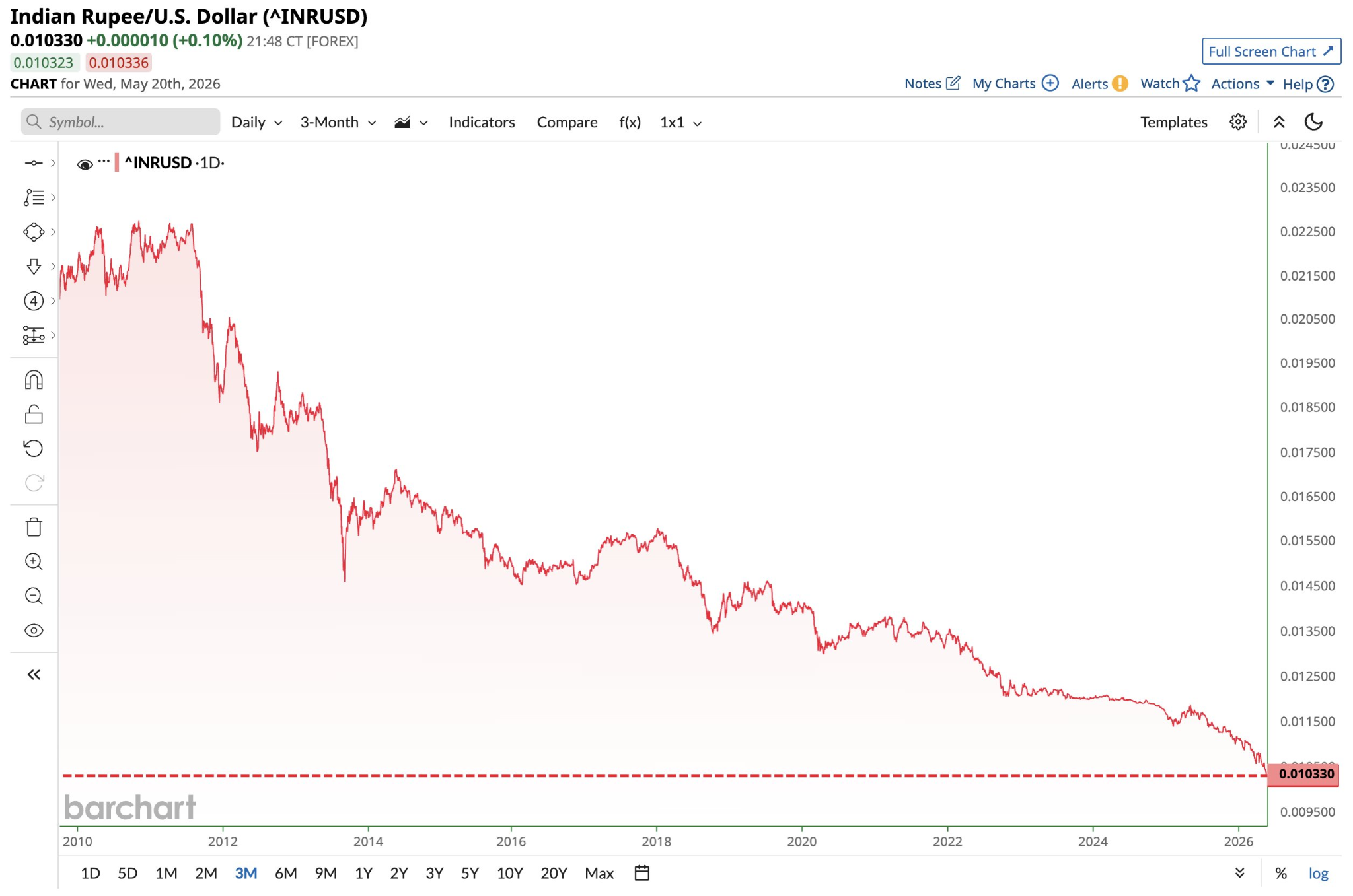
- Currency data shows INR has lost more than 50% of its value against USD since 2009.
- Rising crude oil prices, foreign capital outflows, and a stronger US dollar affected the INR.
The Indian rupee dropped to a new record low against the US dollar this week, extending a decline that has erased more than half of its value since 2009.
Market data showed the rupee weakening beyond 96.50 per dollar for the first time in history. Intraday trading pushed the currency to 96.8 before it closed near 96.6 against the dollar.
The long-term currency chart shows the scale of the move. In 2009, one rupee traded near 0.0225 dollars. The rate has now fallen to roughly 0.0103 dollars, marking a decline of more than 50% over the period.
Rupee Extends Losing Streak
The rupee has now fallen for 12 straight trading sessions. Traders pointed to rising crude oil prices, a stronger US dollar, and continued foreign capital outflows as the main drivers behind the move.
Higher oil prices directly increase India’s import costs because the country remains heavily dependent on imported energy.
The US Federal Reserve’s high-interest-rate stance also continued pulling money toward dollar-based assets and away from emerging markets.
Analysts said the Reserve Bank of India still holds large foreign exchange reserves, but intervention can only slow volatility rather than reverse broader global pressure.
Santosh Meena, head of research at Swastika Investmart, described the move as a “structural reaction” to global macro conditions rather than a short-term correction.
Pressure Builds Across Emerging Market Currencies
The rupee is not the only Asian currency under pressure. Indonesia’s rupiah also hit a record low this week, falling to 17,670 per dollar despite aggressive intervention from Bank Indonesia.
Indonesian authorities increased currency market operations after stocks and the local currency weakened sharply. Turkey’s lira remains another major example of long-term currency collapse.
The lira has lost nearly 98% of its value against the US dollar since 2010 after years of high inflation, weak reserves, and unstable monetary policy.
The broader trend shows global investors continuing to move toward dollar safety while emerging market currencies absorb pressure from higher oil prices, geopolitical tensions, and tighter financial conditions.
India Slips Behind the UK in Global Economy Rankings
The currency decline came alongside reports that India slipped behind the United Kingdom in nominal GDP rankings.
Recent estimates placed the US as the world’s largest economy at roughly $32.38 trillion, followed by China at $20.85 trillion. Germany ranked third, Japan fourth, and the UK fifth at around $4.26 trillion. India followed closely at approximately $4.15 trillion.
The ranking change added to the online debate around the rupee’s weakness and the broader direction of India’s economy. Some analysts also pointed to the rupee weakening not only against the dollar but against regional currencies.
Market commentators highlighted that the Indian rupee lost ground against the Pakistani rupee over the past year despite Pakistan’s own economic challenges.
Related: Sam Altman Reveals 1B India AI Images, CoinDCX Founder Responds
Disclaimer: The information presented in this article is for informational and educational purposes only. The article does not constitute financial advice or advice of any kind. Coin Edition is not responsible for any losses incurred as a result of the utilization of content, products, or services mentioned. Readers are advised to exercise caution before taking any action related to the company.