

- Compliant domestic Indian crypto exchanges saw their share of local volume drop from around 7% to 0.7%.
- The strict 1% TDS drove capital offshore as traders moved to global exchanges to reduce tax friction.
- FIU mandates on offshore entities are now closing tax loopholes to push crypto trading volumes back to India.
The Indian cryptocurrency market remains a hub for speculation and centralized exchange (CEX) volume, even as the wider region sees localized economic shifts, with India outpacing neighboring economic hubs like Singapore and Australia across Central & Southeast Asia and Oceania (CSAO).
According to the latest data from the Chainalysis 2026 Geography of Crypto Report, India-based users pulled in a massive $88.4 billion in CEX inflows between July 2025 and June 2026, while domestic platforms’ share fell to just 0.7%, signaling a major market shift.
India Leads CSAO With $88.4B in CEX Inflows
India has attracted the highest volume of CEX inflows among all the countries in CSAO, totaling $88.4 billion in the period between July 2025 and June 2026. India’s CEX inflows topped Singapore at $82.3 billion, Australia at $79.3 billion, and Vietnam at $69.8 billion.
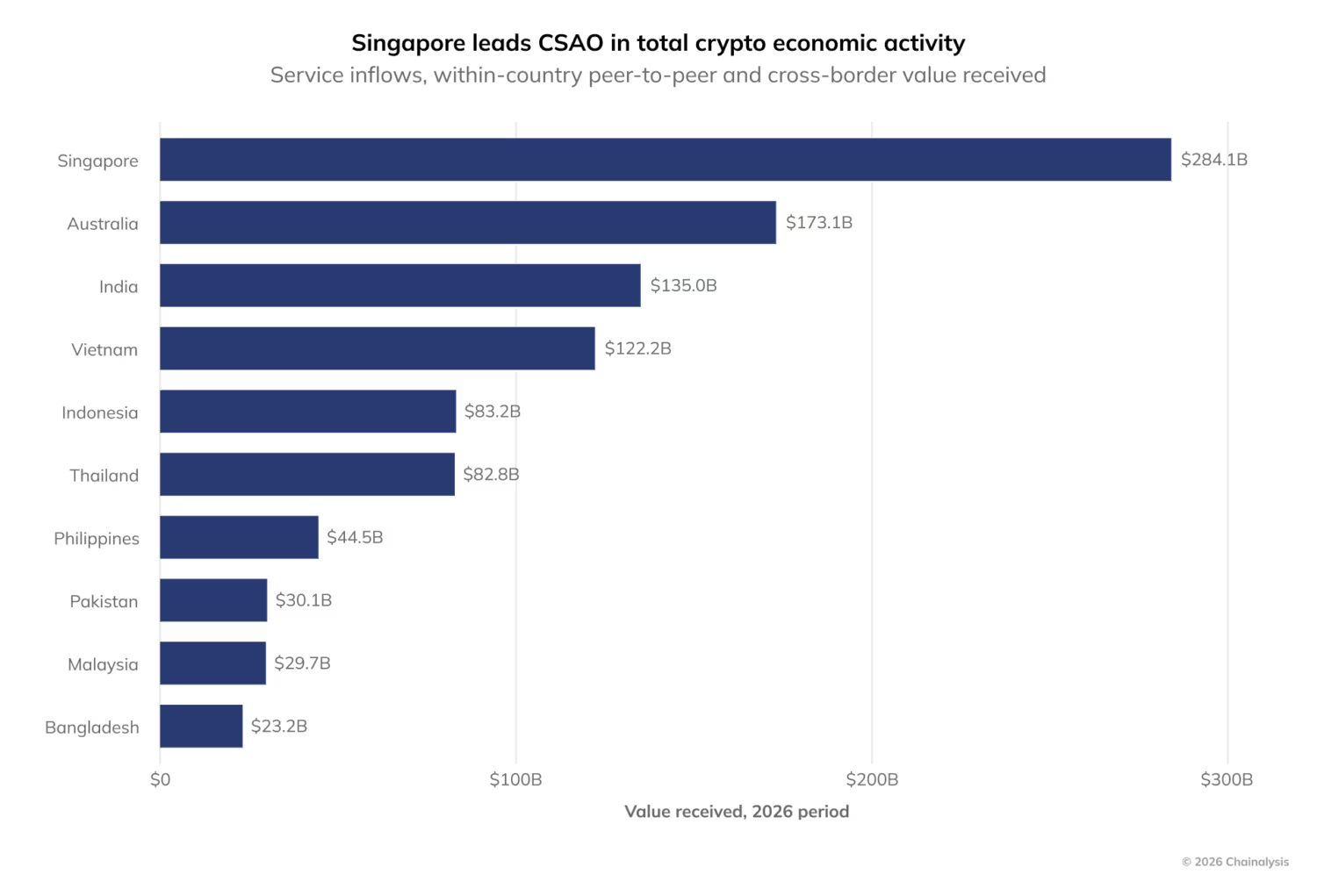
Meanwhile, the overall crypto economy in India dropped by 14.7% to $135 billion in the same timeframe, making it one of the steepest declines in the region during the broader global bear market. However, India still has the third-largest absolute crypto economy in CSAO, behind Singapore at $284 billion, and Australia at $173.1 billion.
Moreover, Chainalysis data indicate that the CEX inflows of India have been fluctuating quarter to quarter, but their overall increase since the end of 2021 has been relatively consistent with the rest of the CSAO region. A relative-growth index that starts at 100 in Q3 2021 ends at the same level of 100 by mid-2026, indicating India’s exchange activity kept pace with regional trends over the multi-year period.
Why Indian Crypto Traders Are Shifting to Offshore Exchanges
The most striking structural change on India’s crypto market is the stark drop in local platform trading volume share. Chainalysis states that this share has dropped by approximately 7 percent to only 0.7% since mid-2022 and has been lingering at that low level since. By comparison, domestic platforms across the rest of CSAO continue to process an average of approximately 7% of their respective local volumes.
The data reveals that the biggest friction cited is from regulatory issues stemming from India’s tax regime. In 2022, the government introduced a 1% tax deducted at source (TDS) on the transfer of virtual digital assets at exchanges. Different domestic platforms are obligated to collect and remit this tax on transactions. This deduction is, however, not applicable in many offshore exchanges.
Ashish Singhal, Co-founder at Indian exchange CoinSwitch, has cited this tax friction as one of the major factors driving capital and trading off Indian platforms. Consequently, the overwhelming majority of India’s CEX volume is currently conducted on offshore platforms, despite the fact that the total crypto investment asset demand is still strong.
What’s Next as Indian Domestic Platforms’ Share Falls to Just 0.7%?
The decline in the market share of domestic platforms has continued over three years without any significant improvement. This extended imbalance calls into question the sustainability of India’s onshore exchange ecosystem amidst continued user interest.
The investor profile is also changing in a direction that may contribute to more enduring activities in the future. An increasing number of individuals aged 35 or older, and with larger portfolios, are no longer viewing crypto as a short-term trading vehicle but as a longer-term diversifying asset that they have held alongside equities, gold, and mutual funds.
Such a change of attitude, observed by the leaders of major Indian platforms, indicates a maturing user base that might ultimately demand higher regulatory assurance and local infrastructure.
According to the report, regional experts interviewed emphasize that the next step of adoption, institutional and retail, is dependent on more regulation, greater investor protection, asset quality, and improved supporting infrastructure.
In the case of domestic platforms particularly, these factors will be decisive in whether or not they can re-establish their relevance. Unless measures are taken to mitigate the prevailing structural disadvantages, most trading is likely to continue beyond India’s borders, and the economic and employment gains that would be realized domestically will be curtailed.
In this environment, the broader industry conversation is already moving beyond pure speculation. Whether the domestic platforms can play a significant role in that next stage is one of the open questions facing the Indian market.
Related: Indian Stocks Are Entering a Prolonged Selloff: What Does It Mean for Crypto Traders?
Disclaimer: The information presented in this article is for informational and educational purposes only. The article does not constitute financial advice or advice of any kind. Coin Edition is not responsible for any losses incurred as a result of the utilization of content, products, or services mentioned. Readers are advised to exercise caution before taking any action related to the company.