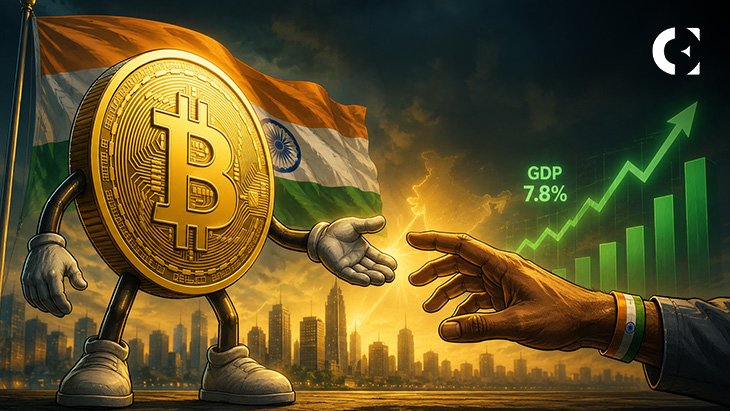

- India’s GDP hits 7.8%, but low per capita income keeps Indians turning to BTC for wealth and global assets.
- India leads global crypto adoption, with about 68M BTC holders and over 100M crypto users driving demand.
- Rising incomes could expand the Indian crypto market, making BTC an increasingly important global asset.
Despite India’s headline grabbing 7.8% GDP growth, millions of Indians are embracing Bitcoin (BTC) even as per capita incomes remain far below those of advanced economies. The growing demand for BTC points to a deeper economic reality, where rapid GDP expansion has yet to fully translate into household wealth, stronger wages or protection against inflation, raising questions about what is driving India’s unusually strong appetite for crypto.
India’s GDP Is Booming, but Household Wealth Lags: Why Indians Are Buying Bitcoin
India’s economy is expanding rapidly as real GDP rose 7.8% year on year in the April to June quarter of FY27, up from 6.9% a year earlier. But India’s economic size does not mean the average Indian is wealthy. On the IMF’s April 2026 World Economic Outlook, India’s GDP per capita is about $2,810, placing the country around 150th in the world, while Bangladesh is slightly higher at about $2,910. India is still in the top six economies in terms of total size. The two rankings describe two different realities: a big production machine, and a thin slice of income per person.
This is an important distinction because GDP is a measure of output, whereas Bitcoin is an indication of what people wish to own. India has been topping the global rankings in the Chainalysis Global Crypto Adoption Index for the past three years and is estimated to have more than 100 million crypto users. The World Inequality Report 2026 finds the top 10% of Indians own about 65% of wealth, while the bottom 50% own just 6.4%. Income-wise, the top 10% earn around 58%, while the bottom 50% earn 15%. The numbers depict surging growth, concentrated wealth, and robust demand for cryptocurrencies.
Why Are Indians Taking Crypto Risk Despite Lower Per Capita Wealth?
Younger Indians are fueling fresh crypto adoption. According to CoinSwitch data, almost 75% of investors are aged 35 or below, and 18-25 year olds account for 54.4% of new investors in Q2 2026. WazirX noted that 72% of new investors were from the Gen Z group, with 79.6% having an income between ₹1 lakh and ₹5 lakh per year. Students made up 40% of Gen Z users.
For these investors, Bitcoin is becoming an aspiration asset. While wealth building through property and mutual fund SIPs takes years, Bitcoin can be purchased in little quantities and provides the opportunity for quicker gains. This is why some younger Indians are willing to take the risk of crypto despite the 30% VDA tax, 1% TDS and no set off loss.
The Rupee, Dollar Exposure and Bitcoin’s Appeal: Is India’s Crypto Demand Really Speculative?
Global asset exposure is more relevant for Indian investors, given the long term depreciation of the rupee against the U.S. dollar (USD/INR). Restrictions on remittance and taxation and banking may be factors in accessing assets abroad. Bitcoin is another option as it is traded all over the world and can be purchased directly in small quantities. For Indian investors, that means exposure to an asset outside the rupee system that doesn’t require traditional avenues to invest overseas.
India’s crypto demand is not necessarily driven only by short term speculation. Bitcoin’s global pricing enables younger investors to diversify away from domestic holdings and pursue greater returns. Bitcoin’s appeal therefore extends beyond price speculation for some investors, combining the search for dollar exposure, global assets and faster wealth creation.
Related: Gen Z Is Flooding India’s Crypto Market: Are Younger Traders Driving the Next Volatility Wave?
What Rising Incomes Could Mean for India’s Crypto Market
Rising incomes could give Indian households more room for long term crypto investments. With the increase in disposable income, Bitcoin could become more of a portfolio investment than a get-rich scheme. Yet the bigger question remains whether Bitcoin is filling a wealth gap that GDP does not show. GDP measures output, not household wealth and Bitcoin provides another route to owning assets and accumulating wealth globally.
Related: Crypto Outlook August 19: Bitcoin Revival Meets SHIB Catalyst
Disclaimer: The information presented in this article is for informational and educational purposes only. The article does not constitute financial advice or advice of any kind. Coin Edition is not responsible for any losses incurred as a result of the utilization of content, products, or services mentioned. Readers are advised to exercise caution before taking any action related to the company.