
- Qivalis has announced 25 new banks joining its consortium, bringing total support to 37 banks.
- The European banks are uniting to launch a MiCA-compliant, fully regulated 1:1 euro-backed stablecoin.
- The expansion strengthens Europe’s push for monetary autonomy and challenges US dollar dominance.
On May 20, 2026, Qivalis announced that 25 additional lenders have joined its euro stablecoin project, bringing total support to 37 European (EU) banks across 15 countries. The consortium, initially comprising ING, BNP Paribas, UniCredit, and others, is developing a fully regulated, 1:1 euro-backed stablecoin scheduled for launch in the second half of 2026 under the EU’s MiCA framework.
Qivalis Consortium Expands to 37 European Banks
According to sources, Qivalis, the European banking consortium developing a regulated euro-denominated stablecoin, has significantly expanded its membership, adding 25 new banks and tripling its network from 12 to 37 financial institutions across 15 European countries.
Notably, new participants include major lenders such as ABN AMRO, Rabobank, Intesa Sanpaolo, Nordea, Erste Group, National Bank of Greece, Banco Sabadell, Bank of Ireland, Swedbank, Groupe BPCE, Handelsbanken, and others.
Meanwhile, Spain has emerged as a key growth hub within the initiative, contributing five new members, including ABANCA, Banco Sabadell, Bankinter, Cecabank, and Kutxabank. Additional participants include institutions such as Spuerkeess of Luxembourg, further broadening the consortium’s geographic and institutional reach.
Why EU Banks are Uniting to Launch a MiCA-Compliant Stablecoin
EU banks are uniting behind the Qivalis Consortium to seize control of the digital payments infrastructure that is rapidly shifting on-chain and to end Europe’s heavy dependence on dollar-denominated stablecoins. USD-pegged stablecoins like USDT and USDC dominate the over $320B global market, accounting for about 99% of total issuance, while euro-pegged stablecoins remain small at around €615M but are gradually growing.
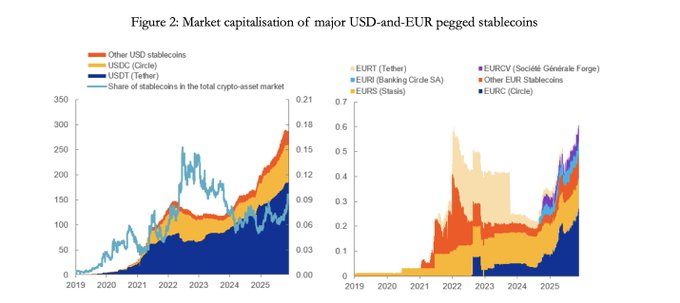
This imbalance creates structural risks and strategic vulnerabilities for Europe. Reliance on foreign-issued stablecoins exposes European institutions, corporates, and payment flows to external monetary policy spillovers, dollar liquidity shocks, and counterparty risks outside EU regulatory oversight.
What’s Next as EU Banks Challenge U.S. Dollar Dominance
The Qivalis Consortium’s growth to 37 banks signals strong institutional momentum for tokenized euro assets and could accelerate adoption of on-chain payments across European commerce and DeFi. It positions Europe to compete more effectively with US-led stablecoin giants while fostering innovation in real-world asset tokenization and digital finance infrastructure.
Launch remains firmly targeted for the second half of 2026. Once live, the fully regulated, 1:1 euro-backed stablecoin will deliver instant, 24/7 settlement for cross-border payments, tokenized asset transfers and programmable treasury operations, capabilities that today are almost entirely routed through dollar-pegged tokens.
Furthermore, S&P Global Ratings projected that the euro stablecoin market could grow from about €770 million to as much as €1.1 trillion by 2030, driven by rising institutional demand for on-chain euro liquidity.
Related: EU Banks Partner With Fireblocks to Launch Regulated MiCA Stablecoin
Disclaimer: The information presented in this article is for informational and educational purposes only. The article does not constitute financial advice or advice of any kind. Coin Edition is not responsible for any losses incurred as a result of the utilization of content, products, or services mentioned. Readers are advised to exercise caution before taking any action related to the company.