
- Robinhood Chain became the largest blockchain by RWA holders with over 328,000.
- Robinhood Chain leads in RWA holders, while Ethereum remains dominant in institutional asset value.
- Robinhood Chain’s long-term growth now depends on sustained RWA adoption beyond retail participation.
Robinhood Chain has become the largest blockchain network by real-world asset (RWA) holder count with 328,039, surpassing Solana and Ethereum less than a month after its public mainnet launch. This shows the growing market for tokenized RWAs in the fight between different blockchain networks to attract users and financial products.
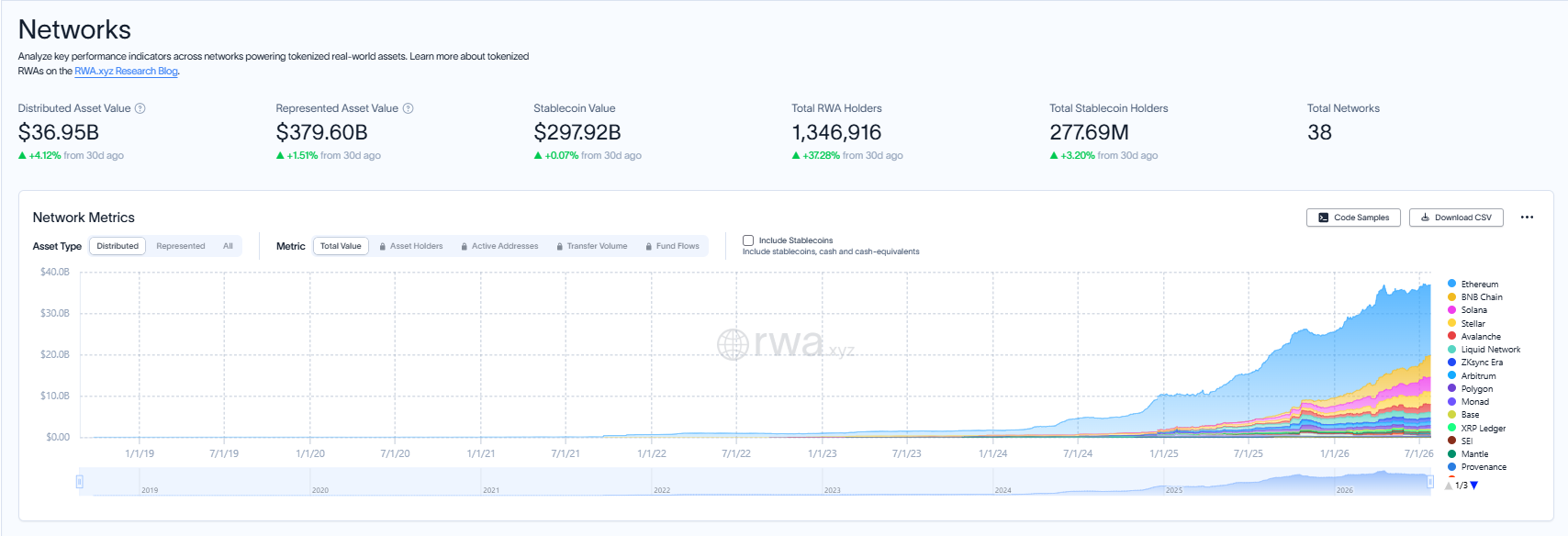
Data from RWA.xyz indicates that the wider tokenized asset ecosystem that is integrated into RWA.xyz now has a distributed asset value of $36.95 billion and a represented asset value of $379.60 billion through 38 networks. Ethereum and Solana have been able to build larger ecosystems by asset and infrastructure maturity, while Robinhood Chain’s to-date growth in the number of its holders has been impressive.
Robinhood Chain RWA Holders Surge After Mainnet Launch
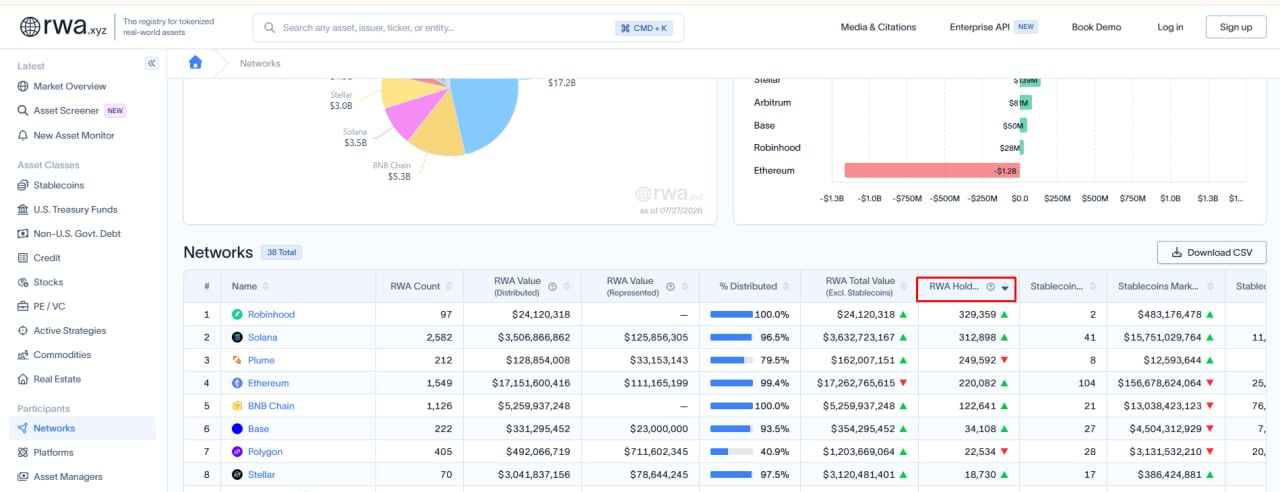
Robinhood Chain had 328,039 RWA holders as of a few days after it came to the public market. Today, there are 97 RWA tracking real-world asset products on the network, with the distributed RWA value being around $24.12 million.
The holder count paves the way for Robinhood to be a leader ahead of other existing networks. Based on the data from RWA.Xyz, for instance, Solana has close to 312,000 RWA holders, while Ethereum has close to 220,000 HOLDERS.
On the other hand, each network is exhibiting different strengths in terms of numbers. Robinhood Chain has been acquiring users through its retail-based distribution, whereas Ethereum is still dominating the market in terms of institutional participation and larger tokenized asset markets.
In the initial phase of network growth, Robinhood prioritized the creation of tokenized stocks and other financial assets on blockchain. The exchange commenced Robinhood Chain as the Layer 2 network based on Arbitrum, intended to provide a platform for tokenized assets, lending, and decentralized finance services.
Notably, an increasing number of holders does not necessarily represent enlarging capital flows. A variety of wallets points towards widespread ownership, whereas asset value refers to capital locked into tokens.
Tokenized Real-World Assets Drive Network Competition
One of the fastest-growing industries within the world of blockchain has been that of tokenized real-world assets. Data from RWA.xyz indicates that stablecoin amounts across networks were $297.92 billion.
Robinhood Chain’s development coincides with increased interest from worldwide users in tokenized stocks and other financial instruments. It offers a platform for financial services based on traditional financial markets, such as tokenized stocks and others.
Even so, the early activity on Robinhood Chain was problematic. The first trades on the network were very heavily centered around speculative tokens and memecoins and lacked openness to modern financial tools. This led to concerns about the network’s ability to sustain RWA adoption.
The recent rise in the number of RWA holders indicates that the ecosystem is turning back to its initial goal. The rise of tokenized asset participation reflects the users’ paid experience with financial products outside of speculative trading.
The retail presence of Robinhood also gives the network a potential distribution advantage over newer blockchain platforms, given Robinhood has a large user base that is already established.
Robinhood Chain Faces Test Beyond Holder Rankings
Robinhood Chain, even though it is the biggest network in number of holders, still has to convince them in the long term. Actually, they provide only info on how many people are involved, but nothing about liquidity, demand from institutions, and depth of assets.
The Ethereum network still maintains its position as the single strongest network for tokenized assets, given its historical foundation and relationships with institutional investors. Likewise, Solana’s RWA ecosystem continues to thrive with high transactional throughput and retail investors’ participation.
According to RWA.xyz, Robinhood Chain maintains a bit more than $481 million in stablecoin value. While itself behind major blockchain ecosystems such as Ethereum, BSC, or AVAX, it has been showing increased activity since launch.
What comes next will ultimately be dictated by whether or not asset owners will continue to hold and trade the tokenized assets after the feasting period. Only then will the demand and the number of asset underwriters for blockchain finance products truly grow.
The Robinhood Chain reaching this number of RWA holders is an important early milestone, but the extent to which the network’s position long-term will be driven by continued growth in user activity in RWA.
Related: What crypto assets have growing revenue but lagging token prices?
Disclaimer: The information presented in this article is for informational and educational purposes only. The article does not constitute financial advice or advice of any kind. Coin Edition is not responsible for any losses incurred as a result of the utilization of content, products, or services mentioned. Readers are advised to exercise caution before taking any action related to the company.