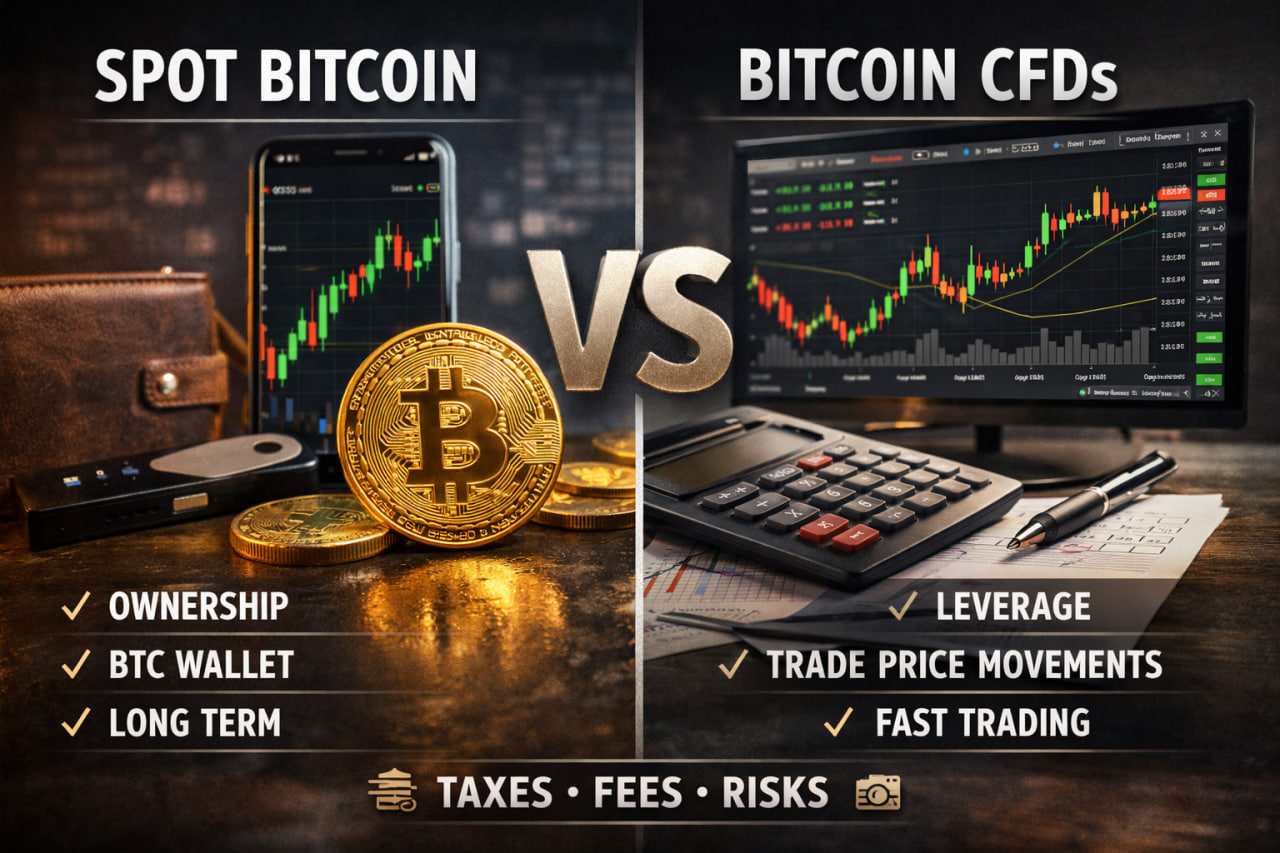

Thinking about investing in Bitcoin but feeling unsure whether to buy the asset itself or trade its price? We have two pieces of advice for you.
One: never invest money you cannot afford to lose. Bitcoin can be highly profitable, yes, but it’s also one of the most volatile large financial assets. Sharp corrections of 20–40% still occur within weeks.
Two: superficial comparisons between “buying Bitcoin” and “trading Bitcoin” are not enough if you’re serious about this. They hide details that actually matter. Ownership? Important, but it’s just one piece of the puzzle. There is also tax treatment, liquidity mechanics, margin rules, and fee structures to think about.
So, below, we break down spot Bitcoin vs Bitcoin CFDs the way experienced traders actually evaluate them, so you can do the same. You’ll see how both work, where hidden costs appear, how taxes differ, and why the right choice depends less on ideology and more on how you intend to use the market.
Understanding the Two Instruments
In short, both options give you exposure to Bitcoin, but they do it in fundamentally different ways. One route involves owning the asset recorded on the blockchain, the other relies on a financial contract that tracks Bitcoin’s price without transferring the coin itself.
But since the short version is not nearly enough (as we mentioned at the beginning), here is the longer, more comprehensive one.
Spot Bitcoin: Direct Ownership of BTC
Spot Bitcoin means you buy the actual cryptocurrency at the current market price through a crypto exchange. For this, you need a virtual wallet.
Once the transaction settles, Bitcoin (BTC) exists on the blockchain under your wallet address. Ownership and control ultimately come down to private keys (more on that later).
Ownership creates flexibility, which is its biggest selling point. You can:
- Transfer Bitcoin between wallets
- Store it offline in cold storage
- Send it as payment
- Use it inside decentralized finance applications
So yes, with spot Bitcoin, you have more control. But the same control also creates more responsibility. If you lose your private keys or you get hacked, that’s unfortunately it. Because there is no central authority or customer service that can help you restore access. Keys here equal ownership and, therefore, total responsibility.
Bitcoin CFDs: Exposure to Price
Bitcoin CFDs (Contracts for Difference) are financial derivatives. Because you’re not purchasing BTC itself, you don’t need a virtual wallet.
Instead, you open a contract with a broker that mirrors Bitcoin’s price. Profit or loss equals the difference between the entry and exit price of the position.
CFDs remove blockchain mechanics entirely. No wallets, no transfers, no custody concerns. You simply speculate on price movements inside a broker platform.
Because they are derivatives, CFDs allow capabilities that spot markets typically cannot offer. They include:
- Leveraged exposure
- Short selling (profit when price drops)
- Faster entry and exit for active traders
- No custodial risk
This is why derivatives dominate professional trading volume across many financial markets. They’re easier to get into (you don’t pay thousands to buy BTC), and tend to be less risky.
Ownership: Asset Control vs Contract Exposure
Ownership is the most obvious distinction between these approaches. So let’s get a bit more technical, so you get a full picture.
Spot Bitcoin: You Hold the Asset
Buying spot Bitcoin means you possess the digital asset itself.
It’s this ownership that enables several things derivatives cannot replicate:
- Transferring coins between wallets
- Holding Bitcoin indefinitely without financing costs
- Participating in blockchain events such as forks or airdrops
But, as mentioned, custody risk becomes your problem. And this isn’t some theoretical issue; crypto history includes numerous examples of exchange hacks and lost wallets. Check out this story on how a UK couple lost around $315,000 to thieves – they could see their money on the public blockchain, but could do nothing about it. Again, this isn’t a rare example; it happens all the time.
So, what’s important to understand here is that all security practices are your responsibility. Only yours.
Bitcoin CFDs: No Custody or No Blockchain Interaction
CFD traders never receive Bitcoin. This means less responsibility but also less flexibility.
Here, you hold a financial contract that tracks price movements while the broker manages the underlying exposure. What this does is eliminate several operational risks tied to crypto ownership.
So:
- No private keys
- No blockchain transaction fees
- No lost wallets
But the trade-off is counterparty exposure. Instead of trusting cryptography, you trust the broker infrastructure handling the contract.
Experienced traders view this as a simple swap: custody risk disappears, counterparty risk replaces it.
Moral of the story: nothing is perfect. You just need to decide what works better for you, personally.
Strategy Differences: Investor vs Trader Mindset
If you’re still struggling to decide between the two, know that the right instrument usually becomes obvious once you define your goal in the market.
Spot Bitcoin Fits Long-Term Exposure
Spot BTC aligns naturally with long-term investment strategies. If you can afford to invest in actual Bitcoin and have a long-term strategy, this may be the better path for you.
Many investors accumulate BTC, holding it for multiple years, expecting scarcity and adoption trends to drive long-term appreciation. Often, they do.
And here’s the thing: holding the asset carries no leverage risk and no ongoing financing costs. Losses cannot exceed the amount invested. That’s the main reason many investors hold their currencies for many years. The possibility for profit is strong, and the risk of liquidation is zero (though the asset remains volatile).
If you’re wondering why long-term Bitcoin holders dominate on-chain metrics during bull markets, this is the reason.
CFDs Serve Active Trading Strategies
CFDs attract traders focused on short-term price action. Also, those who cannot afford to pay thousands of dollars for one Bitcoin.
Common strategies here include:
- Intraday momentum trading
- Macro event speculation
- Volatility trading during market announcements
- Hedging existing crypto portfolios
Because CFDs allow both long and short positions, traders can react to market direction quickly. In other words, there’s no need to wait for potential appreciation.
So, if your objective is purely to trade price movements, derivatives often make the process more efficient than repeatedly buying and transferring coins between exchanges. Brokers that specialize in crypto CFDs like Axi build their platforms exactly around this type of activity (which is why we’ve linked to their website). You get tight spreads, rapid execution, and tools designed for short-term positioning.
For active traders, this setup removes a few frictions that are common in spot markets. You can move more quickly, open both long and short positions, and adjust exposure without worrying about wallet transfers or blockchain settlement times.
Fees: Where the Real Costs Hide
At first glance, trading costs may look pretty straightforward. Warning: they’re not.
Spot markets and derivative platforms structure fees in very different ways, and these differences can reshape your profitability. So, look at each cost category separately (just the way we’ve separated them) to make the comparison clearer.
Spot Bitcoin Cost Structure
Spot trading usually includes three categories of fees.
1. Exchange Trading Fees
Crypto exchanges charge maker/taker fees for executing trades.
They typically range between 0.1% and 0.5% per transaction, depending on platform and trading volume.
Here’s an example:
- Buy $10,000 worth of BTC
- Exchange fee: 0.25%
- Cost: $25
High-frequency traders quickly accumulate significant costs under this model.
2. Network Transaction Fees
Naturally, Bitcoin transfers require miners to validate transactions. So when you move BTC between wallets or withdraw from exchanges, you have to pay network fees.
How much are the fees? They usually fluctuate depending on blockchain congestion. During busy periods, they can become surprisingly expensive.
3. Deposit and Withdrawal Fees
It’s good to know that some exchanges charge additional fees when funding accounts or withdrawing assets. However, this is relatively uncommon.
Still, it can happen, and in these cases, the payment method often matters. Card purchases typically cost more than bank transfers.
Bitcoin CFD Cost Structure
CFDs rely on a different model.
1. Spread
The spread represents the difference between the buy and sell price quoted by the broker. It functions as the primary transaction cost.
2. Commission
Certain brokers charge a small commission on each position.
The commission percentage often decreases for higher trading volumes.
3. Overnight Financing or Swap Fees
CFD positions held overnight usually incur financing charges.
These fees reflect the cost of leveraged exposure and accumulate daily. That’s why derivatives often suit short-term trading rather than long-term holding.
4. Leverage: Opportunity and Risk
Leverage remains the feature that draws many traders to CFDs.
Here’s an example:
- $2,000 margin
- 10× leverage
- $20,000 market exposure
A 5% move in Bitcoin’s price would produce a $1,000 profit or loss on that position. It’s exactly this amplification that explains why leverage attracts experienced traders and intimidates risk managers. A small market move can liquidate an overleveraged position quickly.
Taxes: A Frequently Ignored Difference
Taxes rarely appear in beginner guides, but they do influence strategy for most people. The way profits are classified and reported can vary significantly depending on whether you own the asset or trade a derivative contract.
And the rules differ widely across jurisdictions.
Spot Bitcoin Tax Treatment
First thing you should know: the Internal Revenue Service (IRS) treats cryptocurrencies as property, not currency (this is also true for some other countries, but not all, which is why it’s essential to check local laws).
Why is this important? Because this classification creates several implications, including:
- Selling Bitcoin triggers capital gains tax
- Swapping BTC for another cryptocurrency also triggers tax
- Spending Bitcoin counts as disposing of property
So, before you do any of these things, you should calculate the difference between the purchase price and the sale value.
Also know that if the asset is held less than a year, gains are taxed as ordinary income. Holding longer than a year qualifies for lower long-term capital gains rates.
CFD Tax Treatment
CFD taxation, on the other hand, heavily depends on the jurisdiction. Still, the structure often resembles traditional financial trading rather than asset ownership.
In many regions, profits are treated as trading income rather than capital gains tied to individual assets. Because you only calculate profit and loss from closed positions rather than tracking every coin movement, this often simplifies reporting.
However, tax frameworks vary significantly, so professional advice remains essential. Probably not what you wanted to hear, but it is what you need to hear.
Liquidity and Market Access
Liquidity determines how efficiently you can enter or exit positions. Both spot exchanges and CFD brokers offer deep Bitcoin markets, but they operate through different infrastructure, and it’s important to understand these differences.
Spot Bitcoin Liquidity
Large platforms handle billions in daily trading volume. It’s high liquidity that typically results in tight spreads and reliable execution, especially for BTC pairs.
But settlement still involves blockchain infrastructure. Withdrawals and transfers may take minutes or longer, depending on network conditions.
CFD Liquidity
CFD execution occurs inside broker platforms. Because they often execute instantly, there’s no waiting for blockchain confirmations.
So for traders reacting to fast market changes like economic data releases, ETF announcements, and regulatory news, that speed is everything.
Risk Comparison: Different Types of Exposure
Every financial instrument carries risk, but you already know that. So the question you need to ask yourself is: what type of risk am I willing to take on?
Spot Bitcoin Risks
Primary risks include:
- Extreme price volatility
- Exchange insolvency
- Wallet security failures
- Regulatory changes
However, spot ownership carries no leverage liquidation risk.
Again, losses cannot exceed the amount invested.
CFD Risks
CFDs introduce additional factors:
- Leverage amplification
- Margin liquidation
- Broker counterparty risk
- Overnight financing costs
Leverage makes derivatives powerful but pretty unforgiving.
Professional traders treat position sizing as seriously as trade direction.
A Practical Example
Still unsure? Comparisons tend to become clearer when you look at real-world scenarios.
Two investors can approach Bitcoin with completely different objectives and end up choosing different instruments for rational reasons.
A simple example, like this one below, illustrates how that plays out.
Investor A: Long-Term Holder
You believe Bitcoin adoption will increase over the next decade.
The logical move is buying spot BTC and transferring it to a secure wallet. Fees remain limited to exchange costs and occasional network transfers.
Investor B: Active Trader
You follow macro events and expect price swings after major policy announcements.
A derivative structure allows faster positioning. So, instead of buying and transferring coins repeatedly, you open and close contracts quickly.
For traders operating on short timeframes, CFDs often provide a cleaner, more efficient structure.
Decision Framework: Choosing the Right Approach
At this point, the mechanics should be clear, but the decision still depends on your objectives. Here’s a simple framework that can help narrow the choice without overcomplicating it.
Ask yourself three questions:
How long do you plan to hold exposure?
Years suggests spot Bitcoin. Days or hours suggest derivatives.
Do you want to own the asset itself?
If yes, spot markets is the obvious route.
Do you need leverage or short selling?
Since these capabilities exist primarily in derivative markets like CFDs, the route should be clear.
But many experienced traders actually combine both approaches. They hold spot Bitcoin for long-term exposure and use derivatives to hedge volatility or speculate on short-term moves.
Common Mistakes New Traders Make
Before you decide, it also helps to inform yourself of common mistakes that both spot buyers and derivative traders make. Most of them stem from a misunderstanding of how the market structure actually works, so recognizing these mistakes early can save you a lot of money.
Ignoring Fee Structures
Beginners often focus only on trading commissions, which is understandable. But they forget spreads, network fees, and financing costs that accumulate over time.
Using Too Much Leverage
Leverage amplifies both profits and losses. The latter is surprisingly underestimated.
Professional traders? They often use modest leverage or none at all.
Neglecting Security
Spot Bitcoin investors sometimes store large holdings on exchanges without strong security practices. This is a huge mistake.
But hardware wallets and secure backups reduce that risk significantly.
Quick Comparison
| Feature | Spot Bitcoin | Bitcoin CFDs |
| Ownership | Underlying Asset (BTC) | Price Contract (Derivative) |
| Custody | Personal Wallet / Exchange | Broker Account |
| Leverage | Generally No (1:1) | Available (e.g., 2x, 5x, 10x) |
| Short Selling | Complex (Requires Lending) | Built-in / Seamless |
| Fees | Exchange + Network (Gas) | Spread + Overnight Swap |
| Holding Period | Ideal for Long-term | Best for Short/Medium-term |
The Real Takeaway
Spot Bitcoin and Bitcoin CFDs can both be profitable investments, but they serve different purposes.
Spot markets focus on ownership and long-term exposure. Here, you hold the asset itself, manage custody, and participate in the broader crypto ecosystem.
CFDs focus on flexibility and trading efficiency. Here, you gain access to leverage, short positions, and rapid execution without managing wallets or blockchain transfers. It’s operationally simpler.
However, it’s impossible to say that one approach is objectively better than the other. That should be clear by now, if you’ve stayed with us until the closing thoughts. The real question is which option is better for you, and this can only become clear once you define your goal.
Investors who want Bitcoin itself choose spot markets. Traders who care about volatility, speed, and strategy prefer derivatives.
But the smartest participants frequently use both: holding Bitcoin long term while trading around it when market conditions demand a faster approach.
Author bio: Daniela Kovac is a markets analyst and independent trading systems researcher with years of experience studying retail and proprietary trading models. Her work focuses on risk management frameworks, capital allocation structures, and the psychology of performance under constraints.
Disclaimer: The information presented in this article is part of a sponsored/press release/paid content, intended solely for promotional purposes. Readers are advised to exercise caution and conduct their own research before taking any action related to the content on this page or the company. Coin Edition is not responsible for any losses or damages incurred as a result of or in connection with the utilization of content, products, or services mentioned.