

A recent Bitget Wallet research piece lays out an argument worth sitting with: for most of the past decade, savers who kept their money in cash weren’t doing anything wrong on paper, yet they still ended up worse off in real terms. The problem becomes clearer when you look at what happens to an ordinary saver over time.
Let’s say that over the past decade, you’ve done your best to be financially responsible. You worked long hours, got a promotion, cut unnecessary spending, bought things when there were discounts, figured out which Credit card gives you the best cashback, all so you can enjoy it later.
But here’s the thing: the growing bank balance can hide a very serious problem. Your salary, even if it’s increased over the years, may be worth less than it was 10 years ago. A house deposit, family holiday, or even an ordinary dinner can consume a larger share of that income than it did a decade ago.
The main issue isn’t the budget; it’s the purchasing power.
Modern monetary systems are built around positive inflation targets. Most major central banks aim for inflation around 2% annually. That means the purchasing power of cash is expected to decline gradually rather than remain constant.
The more important question now is not simply how much money someone has saved. It is where that money has been stored.
The 2% Target That Changes the Value of Cash
Most people think inflation is something that happens when economies face wars, supply shortages, or policy mistakes. But modern monetary policy takes a different approach: major central banks generally aim to maintain a low, positive rate of inflation rather than eliminate inflation altogether.
New Zealand became the first country to adopt inflation-targeting frameworks through the Reserve Bank of New Zealand Act 1989 after the high inflation of the 1970s and 1980s. Its 1990 Policy Targets Agreement established a consumer-price inflation target of 0% to 2%.
This approach quickly spread to other countries. During the early 1990s, the UK, Canada, and Sweden followed suit. And in the next few decades, major economies followed, with the US Federal Reserve in 2012 adopting a 2% longer-run inflation objective. The very next year, the Bank of Japan adopted a 2% price stability target, and in 2021 the European Central Bank moved to a symmetric 2% target.
Now, major central banks consider the 2% inflation objective common. But this doesn’t mean policymakers want consumers to become poorer. The objective is to maintain price stability while avoiding the economic problems associated with prolonged deflation.
But for savers, there is an unavoidable consequence: if prices rise over time, cash that earns no return loses purchasing power.
Why Central Banks Accept Inflation
Why not simply target zero inflation?
There are several reasons.
1. Avoiding Deflation
Although short-term deflation might be a good thing for consumers, persistent deflation can encourage them to postpone purchases because they expect prices to fall further. In response, businesses may reduce investment and hiring, weakening demand and potentially reinforcing the price decline.
Japan’s “Lost Decades” is one of the most prominent examples of how difficult such a cycle can be to reverse.
2. Wages Are Difficult to Cut
Employers try their best not to reduce the nominal wages of their employees because doing so often results in low morale, creates legal complications, and increases staff turnover.
Modern monetary policy provides a workaround: moderate inflation can keep nominal wages unchanged while gradually reducing their purchasing power.
3. Giving Central Banks Room to Cut Rates
Central banks can only cut interest rates so far before reaching zero.
If inflation and interest rates were permanently close to zero, central banks would have less room to reduce rates when an economy enters a downturn. A positive inflation target allows interest rates to remain somewhat higher during normal periods, giving policymakers more room to respond when growth weakens.
The framework therefore has a clear rationale. But there is another side to it. For people holding large amounts of cash over long periods, even modest inflation compounds.
The Problem With 2% Is the Compounding
2% may seem small, but inflation compounds every year.
At a steady 2% annual inflation rate, prices would be roughly 22% higher after 10 years. The purchasing power of money would fall by roughly 18%.
Over approximately 35 years, the purchasing power of money would be cut roughly in half.
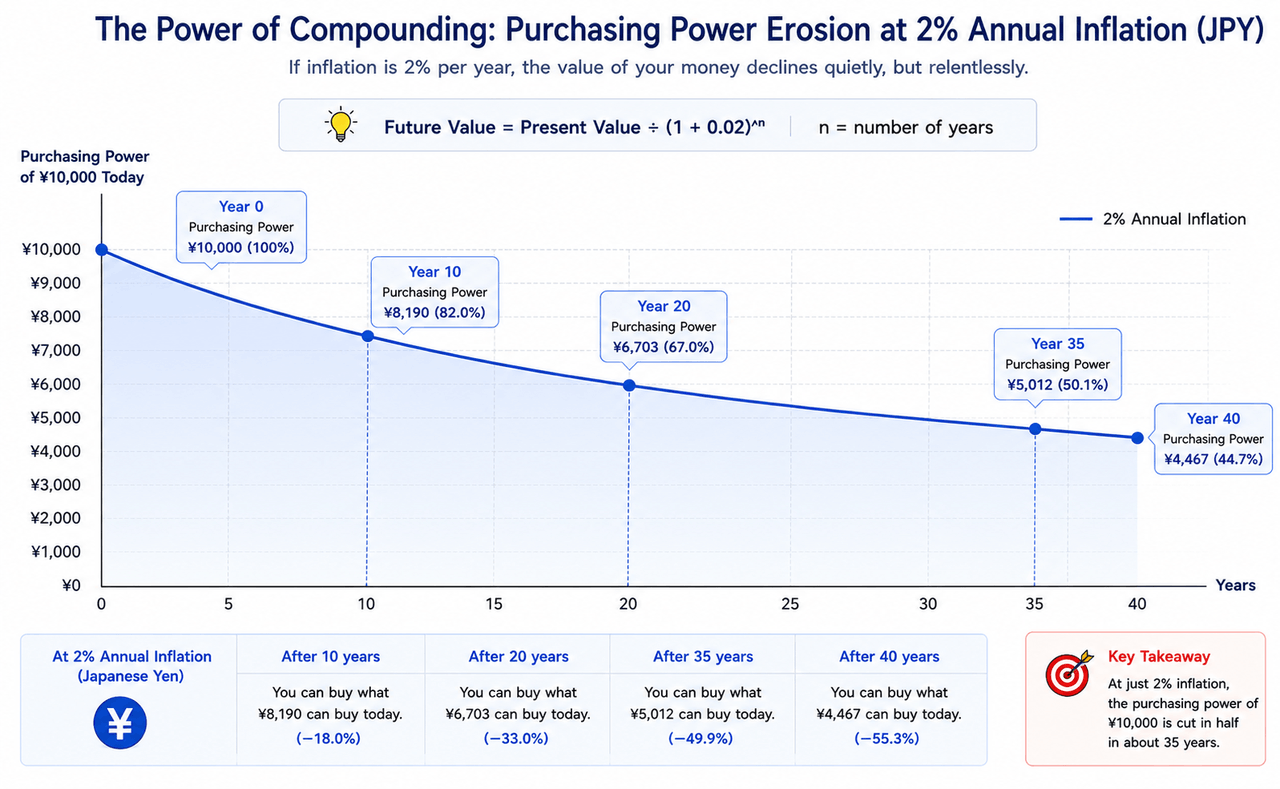
That’s the real weight of 2% annual inflation. Cash in your savings account becomes less and less valuable with each passing year.
And the historical experience has often been more severe than the theoretical 2% path.
The inflation shock of 2021–2023 pushed inflation well above target across many developed economies. US inflation reached 9.1% at its peak, while eurozone inflation reached 10.6%.
Even after inflation began to moderate, the cumulative increase in prices meant households had permanently lost purchasing power compared with where they would have been under a stable 2% path.
Other currencies show how prolonged depreciation against the U.S. dollar can become much more severe. Between June 2015 and June 2025, the Japanese yen depreciated about 20.9% against the dollar. Over the same period, the Turkish lira lost roughly 95.9%, while the Argentine peso fell about 99.4%.
The difference is stark when measured in dollar terms. 10,000 yen held in 2015 would have been worth about $80.60, compared with $63.73 in 2025. For 10,000 Turkish lira, the dollar value fell from about $3,960 to $164, while 10,000 Argentine pesos declined from roughly $1,128 to just $6.60.
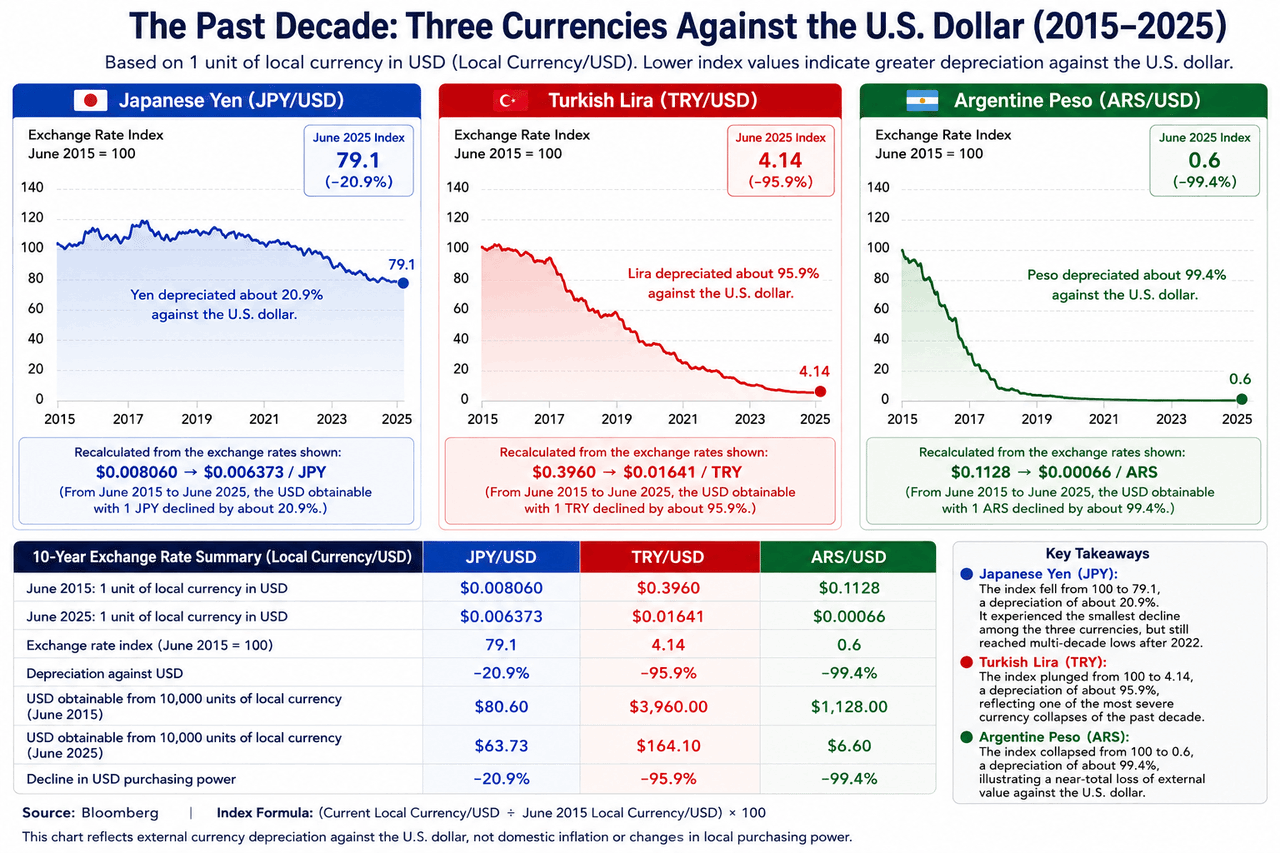
These examples illustrate how persistent currency depreciation can erode the dollar value of cash holdings over time, even when the decline happens gradually rather than through a single dramatic shock.
The lesson is straightforward: a central bank’s inflation target is a target, not a guarantee.
Cash Is Stable, But That Does Not Make It a Good Store of Wealth
This creates an important distinction between using money and storing wealth.
When inflation rises above the 2% level, the purchasing power of money falls, and there is no mechanism that automatically compensates people for the loss.
This is very important because when you lend money, there’s usually some protection in the form of collateral, contractual rights, or legal recourse in case of default. But the same doesn’t apply when you hold cash; you can only passively absorb it.
That distinction matters because money serves three different functions: a unit of account, a medium of exchange, and a store of value. The first two are embedded in everyday transactions. Salaries are paid in local currencies. Taxes, mortgages, loans, and most financial contracts are denominated in them.
Long-term wealth storage is different. There is generally no requirement to keep savings in cash. People can hold stocks, property, gold, Bitcoin, or other assets instead.
So why do so many people continue to keep most of their savings in cash?
Part of the answer is friction. Moving from cash into other assets requires opening investment accounts, completing compliance requirements, understanding different asset classes, deciding what to buy, and determining when to invest. For someone accustomed to keeping money in a bank account, that process can be intimidating.
There is also a psychological barrier. For generations, saving has meant putting money aside in a bank, while investing has meant taking risks. Many people hold cash not because they expect it to outperform other assets, but because it’s familiar, accessible, and easy to understand.
That convenience, however, can come at a cost when inflation steadily erodes purchasing power.
Three Savers, Three Very Different Outcomes
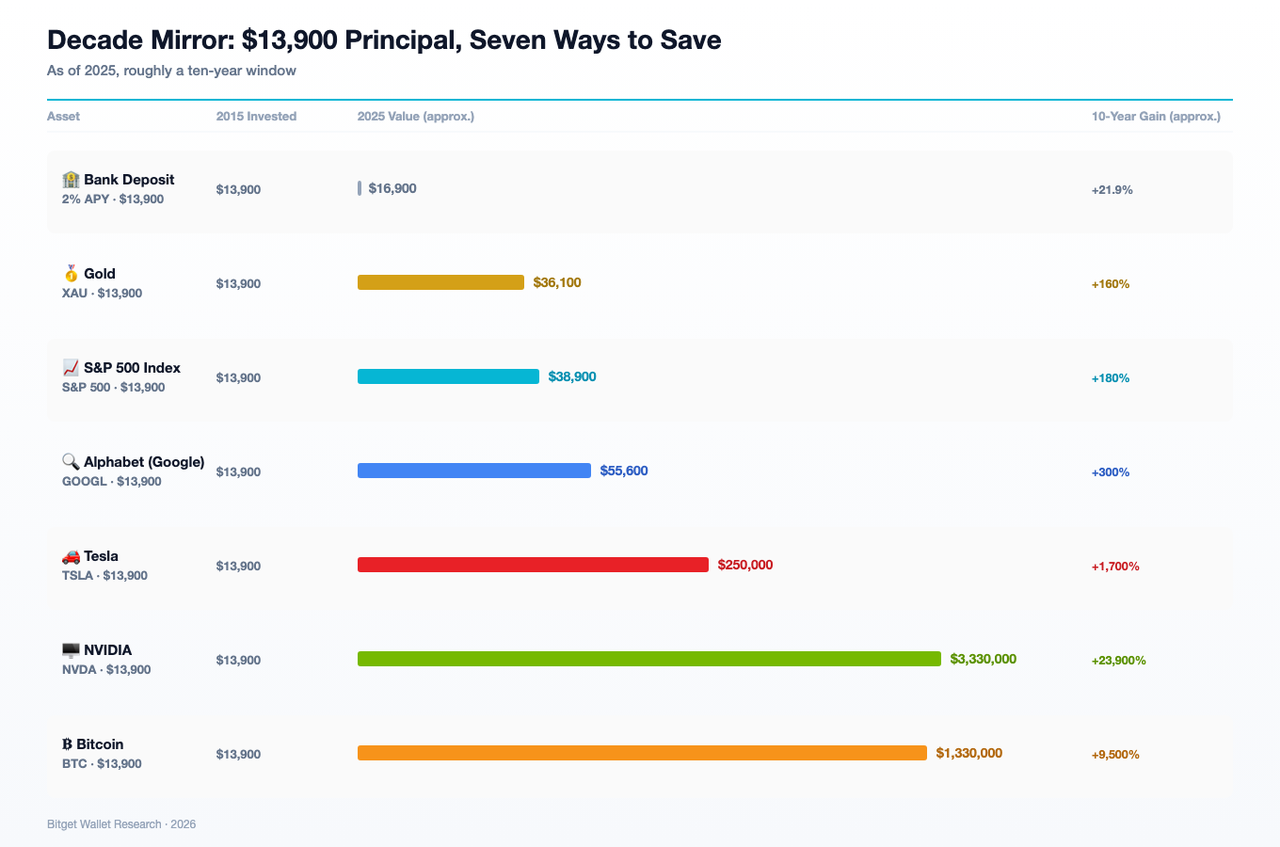
Let’s take a simple example. It’s 2015, and you are investing the same amount of money in different types of assets, then leaving it untouched for the next decade. The results will show why the distinction between saving money and preserving wealth matters.
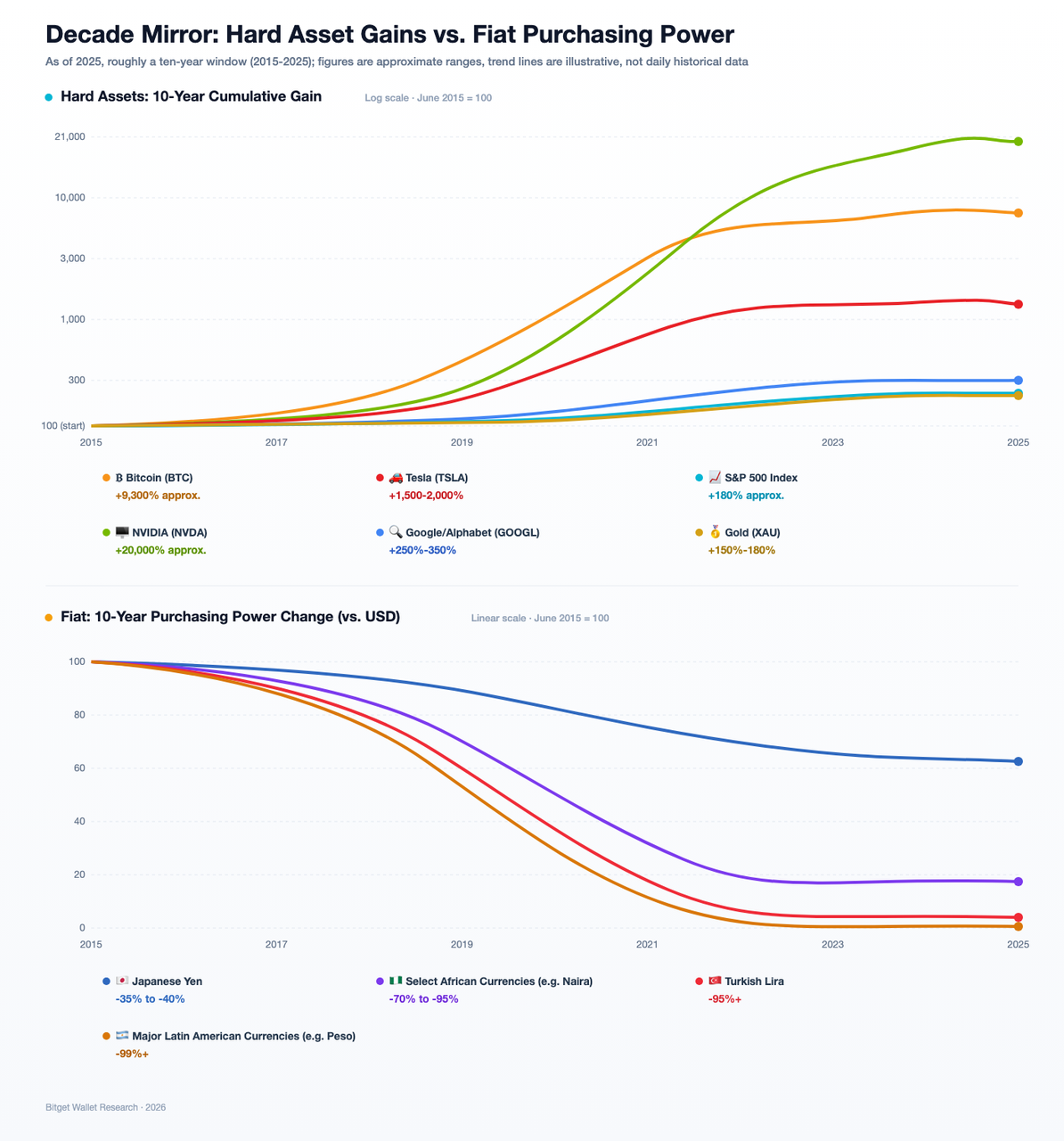
The comparison highlights two very different outcomes. On one hand, the purchasing power of several major currencies declined over the decade, and on the other hand, assets such as Bitcoin, NVIDIA, Tesla, the S&P 500, Google, and gold recorded significant gains.
But the broader lesson is not that every asset will outperform cash. It is that the asset in which savings are held can materially change the outcome over a long period.
The Cash Saver
The first person keeps the money in a savings account, fixed deposit, or money-market product. The balance may increase over time, particularly when interest rates are high. But a higher nominal balance does not necessarily mean greater wealth.
If inflation rises faster than the return earned on the account, purchasing power falls even as the account balance grows. This is the easiest mistake to make when measuring wealth: focusing on how much money is accumulated rather than what that money can still buy.
The Long-Term Asset Holder
The second person takes a different approach. Instead of keeping excess cash idle, they allocate it toward assets such as gold, equities, Bitcoin, or other assets and hold them over the long term.
They do not necessarily need to be professional investors or actively trade the market. The key difference is that their savings are exposed to assets that can appreciate in value rather than remaining entirely exposed to the gradual erosion of cash purchasing power.
The Altcoin Speculator
This represents another side of the argument. The third person, understanding the risks of holding fiat, invests in alternative assets. But the thing is, just investing in any alternative asset doesn’t mean it will preserve wealth.
Over the past decade, many altcoins have lost most or virtually all of their value. This creates an important distinction between moving away from fiat and choosing an asset capable of retaining or building value.
The lesson, therefore, is not that every non-fiat asset is better than cash. It is that escaping fiat devaluation is only one part of the decision. Choosing what to hold matters just as much.
Central Banks Are Buying Gold Too
Another way to examine the question is to look at what central banks themselves are doing.
Central banks around the world have increased their gold purchases in recent years. According to the World Gold Council, official-sector gold buying has remained near historically elevated levels, contributing to gold’s strong performance through 2025.
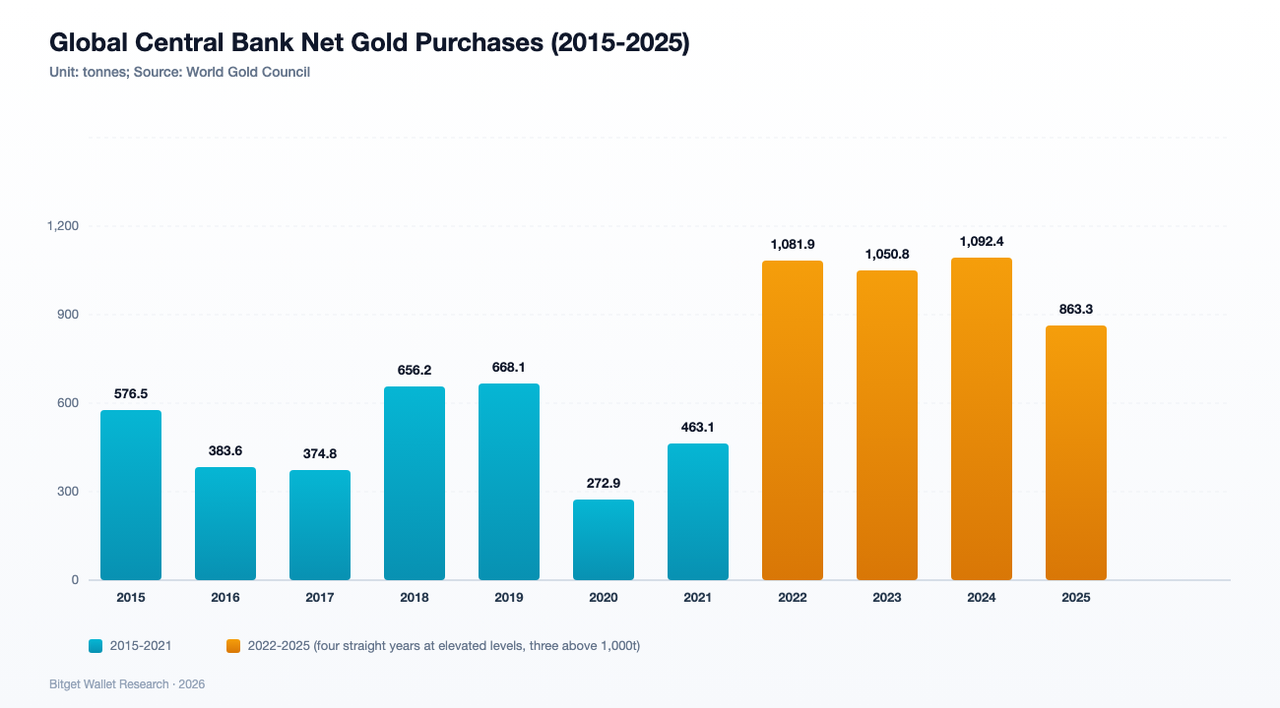
The reason is not that central banks have abandoned fiat currencies. Currencies remain essential for monetary policy and economic activity. Gold serves as a long-term reserve asset.
The institutions responsible for managing national currencies do not keep all of their reserves in cash. They also diversify into scarce assets. Whether gold, equities, Bitcoin, or another asset ultimately delivers the best long-term return is a separate question.
The institutions responsible for managing national currencies do not keep all of their reserves in cash. They also diversify into scarce assets. Whether gold, equities, Bitcoin, or another asset ultimately delivers the best long-term return is a separate question.
The broader takeaway is simpler: holding money and preserving wealth are not necessarily the same thing.
If Assets Can Build Wealth, Why Doesn’t Everyone Own Them?
This is where the problem becomes less about financial knowledge and more about financial infrastructure. Most people understand that investing can produce higher returns than leaving money in a low-yield account. But knowing that does not necessarily make investing easy.
Saving is almost automatic. A salary arrives in a bank account. Bills are paid. Some money is transferred into savings. The process requires very little active decision-making.
Investing is different. It can require opening accounts, completing verification, choosing assets, managing risk, tracking portfolios, and deciding how much to invest.
For someone with limited time or financial experience, that friction can be enough to keep them in cash. The challenge, therefore, may not be convincing everyone to become a better investor. It may be reducing the friction between everyday financial activity and long-term asset accumulation.
From Stablecoin Cashback to “Assetback”
For most of modern finance, spending and investing have been separate decisions. Money used for everyday purchases was money that could no longer be invested, so building wealth meant deliberately setting some income aside and putting it into an asset.
That made sense when investing required time, knowledge, and active participation. But what happens when the process of accumulating assets can take place alongside the spending people already do?
Consider paying for a coffee, groceries, or a flight while also building an asset position in the background. The spending itself has not changed, and there is no need to time the market. The difference is that part of the financial activity associated with the purchase is also directed toward accumulating an asset.
The shift is relatively simple, but it changes how spending and investing can work together. If accumulating assets becomes something that happens alongside everyday financial activity, building wealth may require less effort than it traditionally has. For consumers, that could make the process of moving beyond cash less dependent on making a separate investment decision every time.
Disclaimer: The information presented in this article is for informational and educational purposes only. The article does not constitute financial advice or advice of any kind. Coin Edition is not responsible for any losses incurred as a result of the utilization of content, products, or services mentioned. Readers are advised to exercise caution before taking any action related to the company.