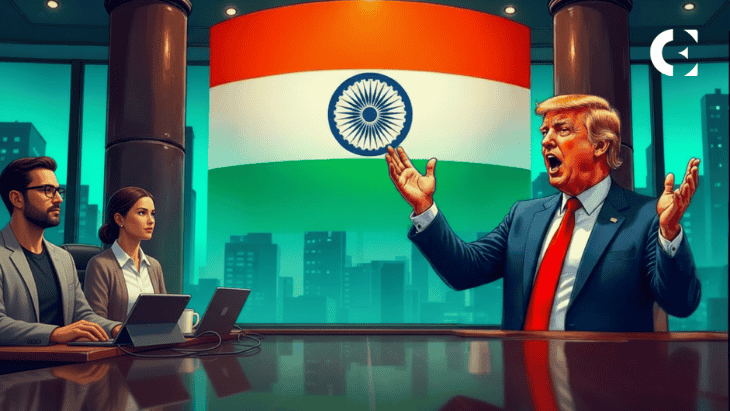

- The US is asking countries to choose between the AI networks of Washington and China.
- India’s strategic autonomy faces a new test as the US-China AI race intensifies.
- For India, the implications may go beyond AI, affecting its crypto and Web3 ecosystems.
The US and China are increasingly turning the AI race into a battle, with India now caught in between. The AI competition between these two countries has now become a geopolitical battle. The US is preparing to ask its AI partners to stay within its network, limiting their ties with China.
This has created a significant balancing pressure for countries like India. While India has been building a closer connection with the US in artificial intelligence, it has also tried to maintain ties with other global powers. If the divide between the US and China deepens, it could have widespread implications for India’s broader AI ambitions, technology sector, investment flows, and crypto ecosystem.
US Asks Countries to Pick an AI Side
According to the latest reports, the US may ask countries to choose between its AI ecosystem and China’s network. If a country signs up for China’s artificial intelligence framework will be excluded from the US-led AI coalition.
The US State Department prepared a draft letter addressing the 35 countries, including Kazakhstan, that signed the US “AI Opportunity Statement” in June. These countries had already shown interest in working with Washington on its AI initiatives. Now the US is trying to limit China’s access to AI resources by asking other countries to stay with Washington. This could help the country strengthen its position in the US-China AI race, preventing China from gaining a greater technological edge.
Further, the letter urged countries to “choose deliberately” on AI, adding
“To be part of everything is to be part of nothing. Signature of the Pax Silica Declaration is not merely a membership subscription, but a commitment…It cannot be held alongside membership in duplicative initiatives whose expectations conflict with our own.”
How the US-China AI Split Impacts India?
Looking closer at the US’s latest move, it is clear that the AI race is no longer just a battle to build better technology. The country sees AI as a strategic issue linked to national security, advanced chips, computing power, and global supply chains. As both the US and China continue to compete, countries like India that intend to work with both sides may face increased pressure.
For years, India has had stronger technological connections with the US, especially focusing on AI, semiconductors, and digital infrastructure. At the same time, the country has also been maintaining strategic autonomy, working with many other nations, including China. In simple terms, the country has traditionally avoided getting locked into a single global technology or geopolitical boundary. But a sharper US-China technology divide could make this balancing strategy harder to maintain.
(adsbygoogle = window.adsbygoogle || []).push({});Will This Impact India’s Crypto and Web3 Ecosystem?
It is also worth noting that the impact may go beyond AI. Other major areas like advanced chips, cloud services, computing power, and global funding are subject to geopolitical ties. This could make the AI battle more than just a policy issue. It could become a practical concern impacting technology companies, startups, and investors.
Indian crypto platforms may also face higher infrastructure costs. They can also face greater challenges in working with international technology and funding partners. Additionally, the companies will face challenges in securing global capital, reliable computing infrastructure, and partnerships across different ecosystems.
At this point, the most important thing for Indian investors is to watch how the US-China technology battle unfolds. The country should see whether it will lead to real restrictions on technology access and partnerships. While these changes can affect India’s AI and broader technology sectors, they can also help the country’s efforts to establish its own semiconductor and AI capabilities.
Disclaimer: The information presented in this article is for informational and educational purposes only. The article does not constitute financial advice or advice of any kind. Coin Edition is not responsible for any losses incurred as a result of the utilization of content, products, or services mentioned. Readers are advised to exercise caution before taking any action related to the company.