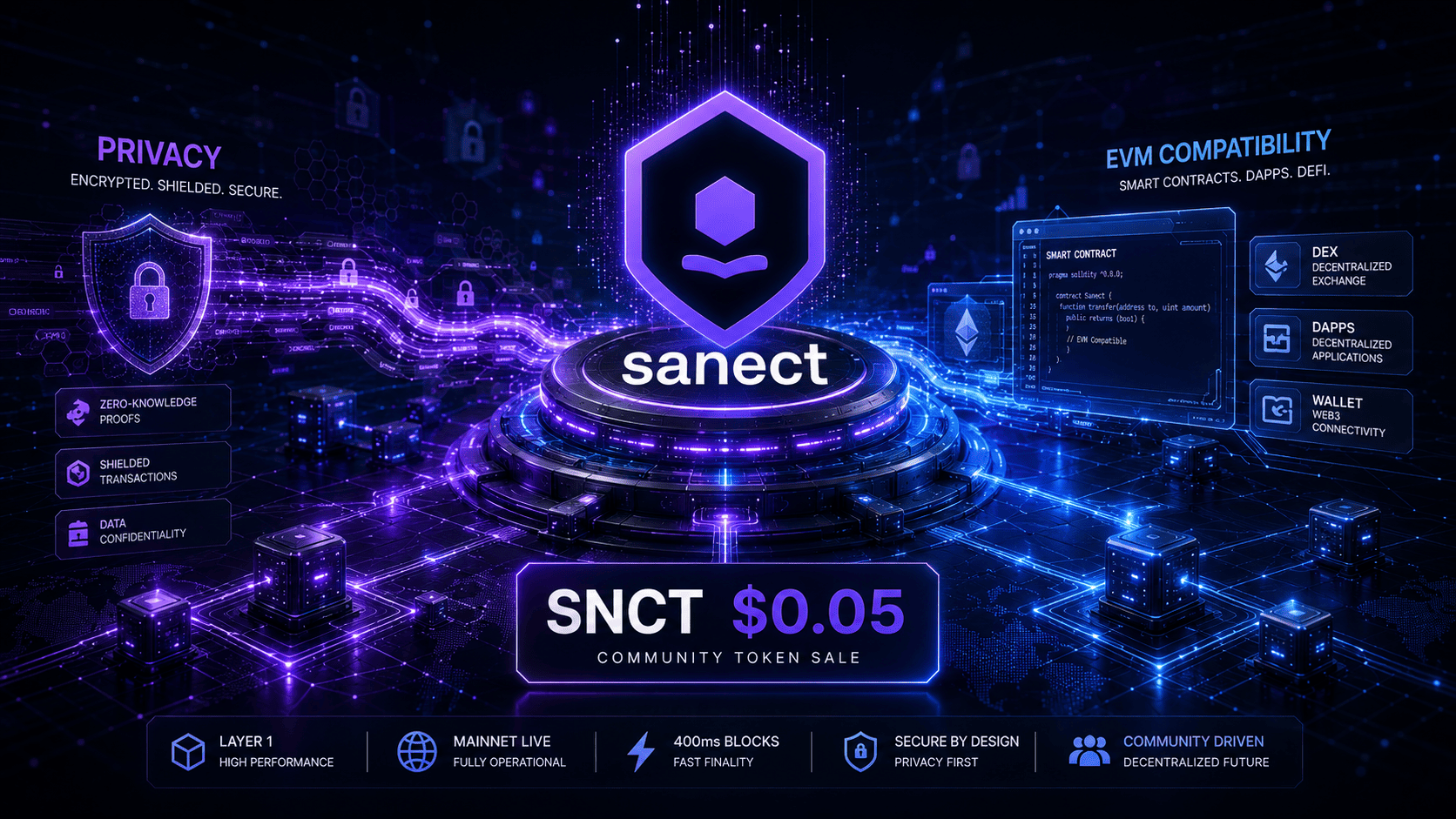

Many crypto projects ask the market to buy into what they plan to build. Sanect presents a different proposition: its mainnet is already live, its privacy system is already deployed, and its ecosystem already includes DeFi, staking, bridging and governance infrastructure.
At the center of that ecosystem is SNCT, the native token of Sanect Network. According to the project’s current sale materials, SNCT is being offered at $0.05 per token ahead of broader public-market availability.
So what makes Sanect different from other crypto projects?
The answer is not simply “privacy.” Privacy blockchains already exist. EVM-compatible networks also already exist. Sanect’s more specific proposition is to combine native, optional transaction privacy with a familiar EVM environment on the same Layer 1 blockchain. According to Sanect’s official documentation, users can run standard Solidity contracts and use familiar EVM tooling while choosing between public and shielded transaction paths.
1. Privacy Is Built Into the Network Not Added as a Separate Layer
Most public blockchains make transaction data broadly visible. Wallet activity can often be followed through explorers, allowing observers to map transaction histories and, in some cases, connect activity across applications.
Sanect takes a different approach with an optional shielded transaction path on the same network as its public EVM transactions.
Users can choose the privacy level appropriate to a transaction. Sanect documents four modes ranging from fully public transfers to fully private transfers where sender, recipient and amount are hidden from public observers. The project says this privacy functionality is powered by Noir and UltraHonk zero-knowledge proofs.
The important distinction is optionality. Sanect is not asking users to make every transaction private. Public and shielded functionality are designed to coexist.
That creates a straightforward narrative:
Public when transparency is useful. Private when privacy is needed.
2. EVM Compatibility Without Leaving the Privacy Environment
Privacy often comes with ecosystem friction. A user may need a different wallet, a different toolset or a separate chain.
Sanect is attempting to reduce that friction through native EVM compatibility.
According to the project’s developer documentation, Sanect supports standard Ethereum-oriented tools and workflows, including Solidity, MetaMask, ethers, Hardhat and Foundry. The mainnet uses EVM Chain ID 7628.
For developers, the proposition is relatively simple: existing EVM knowledge can be used to build on a privacy-focused Layer 1 without requiring an entirely unfamiliar smart-contract environment.
For users, the goal is similarly practical: access shielded functionality without necessarily adopting a separate wallet or managing another seed phrase.
3. The Mainnet Is Already Live
This is one of the most important distinctions in the current Sanect story.
According to Sanect’s official announcement, its mainnet went live on June 22, 2026. The network combines an EVM execution layer with a Cosmos SDK and CometBFT-based consensus architecture.
Sanect’s official materials also describe:
- Approximately 400ms block times
- A top-50 validator model based on stake
- Native shielded transfers
- EVM-compatible smart contracts
- A live blockchain explorer and public network infrastructure
These figures and metrics should be treated as current project specifications rather than permanent guarantees, since network conditions and implementation can evolve.
The broader point, however, is clear: Sanect’s story is not based solely on a future mainnet launch.
4. A Broader Ecosystem Already Exists
A live blockchain alone does not necessarily make a project useful. Applications and infrastructure around the chain also matter.
Sanect’s documentation describes a broader ecosystem that includes an AMM DEX, LP farming, an on-chain order book, staking, governance, a Hyperlane-powered bridge to Ethereum and a .snct name service. The project currently documents 14 bridged ERC-20 assets and a full set of public network endpoints and contracts.
This matters because it gives readers something concrete to examine beyond the SNCT sale itself.
Instead of evaluating only a token page or roadmap, researchers can inspect the network’s documentation, explorer, applications, architecture and developer environment.
That does not guarantee adoption or long-term success. A live ecosystem can still face competition, liquidity challenges and user-growth problems. But it changes the due-diligence process from evaluating a concept to evaluating technology that is already available.
5. SNCT Is Connected to the Network’s Core Functions
SNCT is the native token of Sanect Network.
According to Sanect’s official materials, SNCT is used for network gas, validator staking and governance. The project states a genesis supply of 1 billion SNCT and describes a token distribution that includes community, treasury, liquidity and other defined allocations. Its official FAQ also states that there is no VC allocation.
This does not mean SNCT is automatically valuable. Token utility and token market performance are different questions.
But it does mean the token is part of the network’s underlying economic and governance design rather than being presented as a disconnected asset.
Why Is SNCT Being Offered at $0.05?
According to the project’s current sale positioning, SNCT is available through a community sale at $0.05 per token before broader public-market availability.
The most important point is not whether $0.05 is “cheap.” A nominal token price does not determine valuation or future returns.
The stronger question is: what exists behind the token at the time it is being offered?
In Sanect’s case, the project says the answer includes a live Layer 1 mainnet, native shielded transfers, EVM compatibility and a growing ecosystem of on-chain products.
That makes the $0.05 sale part of a broader infrastructure story.
Prospective participants should independently verify the latest sale terms, allocation, vesting, delivery conditions and listing status through official Sanect channels before making any decision.
Frequently Asked Questions
What makes Sanect different from other crypto projects?
Sanect combines a live privacy-focused Layer 1, native optional shielded transfers and EVM-compatible smart contracts on the same blockchain, according to its official documentation.
Is Sanect Network already live?
Yes. Sanect’s official materials state that its mainnet launched on June 22, 2026, with EVM Chain ID 7628.
What is Sanect’s privacy technology?
Sanect documents a shielded transaction system using Noir circuits and UltraHonk zero-knowledge proofs, allowing users to choose different levels of transaction privacy.
What is SNCT?
SNCT is the native token of Sanect Network. According to the project’s official information, it supports functions including gas, validator staking and governance.
What is the current SNCT sale price?
The project’s current sale positioning states $0.05 per SNCT. Because sale terms can change, readers should verify the latest information directly through official Sanect channels before participating.
Does a live mainnet guarantee SNCT will increase in price?
No. A live blockchain, token utility or future public-market availability does not guarantee investment returns. Adoption, liquidity, competition and market conditions can all affect outcomes.
For more information:
Website: sanect.com
Presale: sale.sanect.com
X: x.com/sanectnetwork
Telegram: t.me/sanectnetwork
Disclaimer: The information presented in this article is part of a sponsored/press release/paid content, intended solely for promotional purposes. Readers are advised to exercise caution and conduct their own research before taking any action related to the content on this page or the company. Coin Edition is not responsible for any losses or damages incurred as a result of or in connection with the utilization of content, products, or services mentioned.