

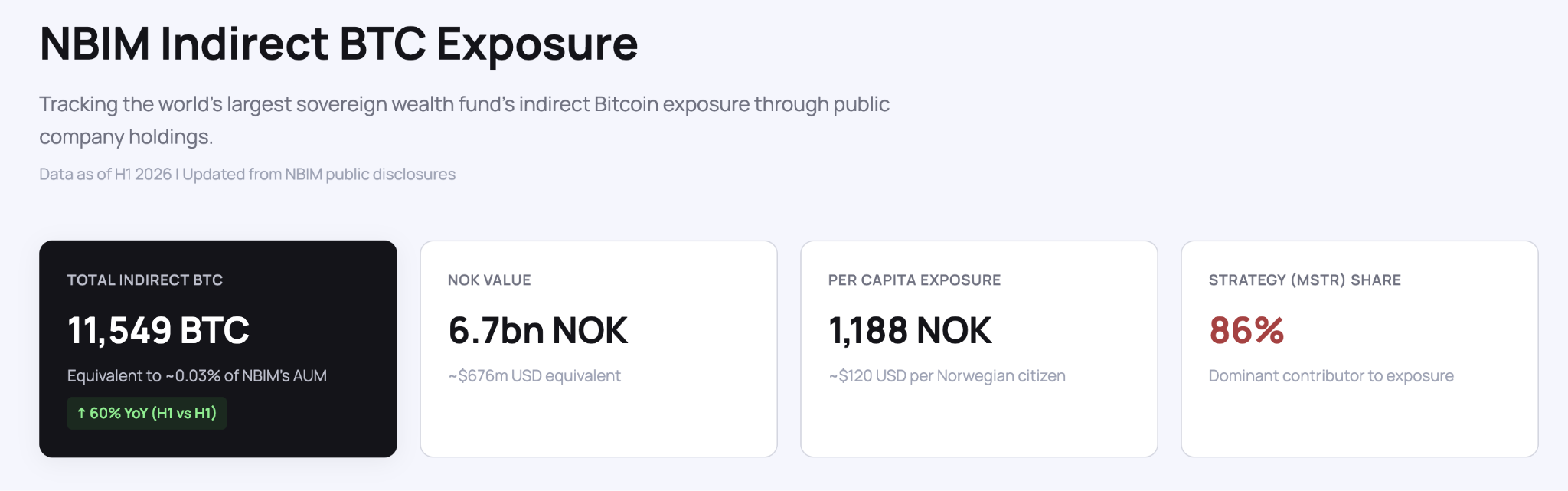
Norway just crossed a line without meaning to. Its $2.4 trillion sovereign wealth fund, run by Norges Bank Investment Management (NBIM), now carries indirect exposure to 11,549 Bitcoin.
That is up 21.2% in the first half of 2026 and 60.5% over the past year, according to K33 Research. It is the sixth straight reporting period of growth.
Meanwhile, NBIM did not buy a single satoshi to get there. It built the exposure through public equities: companies that hold Bitcoin on their balance sheets.
This is the model worth studying as it reveals how conservative institutions can gain exposure to Bitcoin without buying it directly or using a spot ETF.
Source: K33 Research
The 0.03% Formula
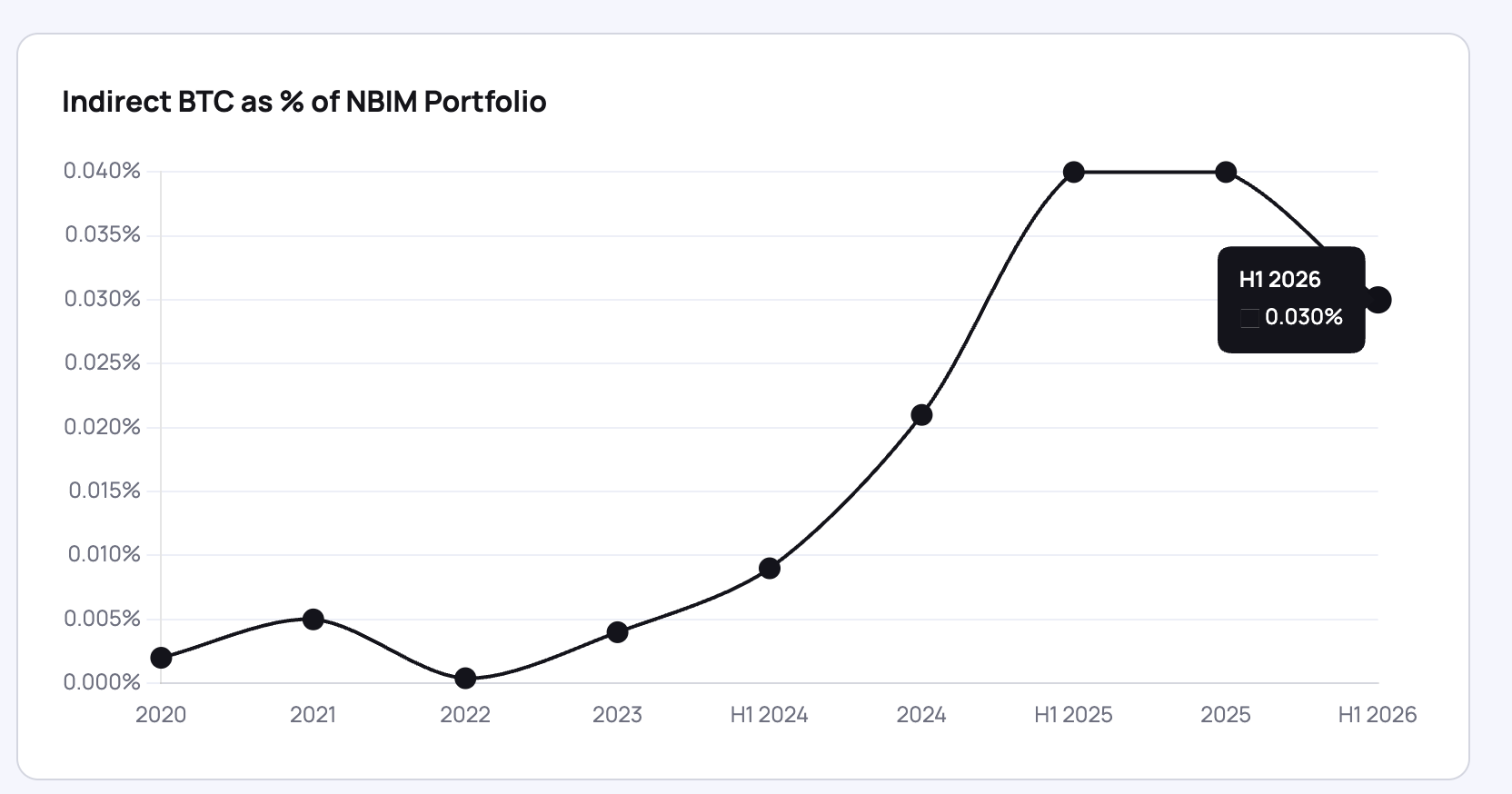
The key number is 11,549 BTC, worth about $725 million, which equals just 0.03% of NBIM’s total assets. Even though its Bitcoin exposure grew, its overall risk actually fell from 0.04% at the end of 2025.
Why? NBIM doesn’t buy Bitcoin directly. It invests in a global stock index. Some companies in that index—like Strategy, Metaplanet, MARA, Coinbase, Block, and Tesla—own Bitcoin.
So when those companies buy more Bitcoin, NBIM’s indirect Bitcoin exposure grows automatically.
NBIM gets some of Bitcoin’s upside without directly buying Bitcoin, using a spot ETF, or making a special crypto investment.
That’s the strategy: Bitcoin exposure grows in the background while staying a tiny part of the overall portfolio.
Source: K33 Research
The Micro-Allocation Breakdown
However, most of NBIM’s Bitcoin exposure comes from one company: Strategy. In particular, Strategy alone accounts for 86% of the total — 9,914 BTC — through NBIM’s 1.17% equity stake, worth about $622 million as of mid-August.
That single position grew by roughly 2,113 BTC-equivalent during H1 2026, more than the fund’s entire net increase for the period, which means some other holdings quietly shrank even as the headline number climbed.
Other holdings are much smaller:
- Metaplanet — 671 BTC
- MARA Holdings — 421 BTC
- Coinbase — 183 BTC
- Block — 120 BTC
- Tesla — 97 BTC
These positions are tiny on their own. But together, they spread NBIM’s Bitcoin exposure across different industries, including mining, exchanges, payments, and cars.
The bigger point is that NBIM didn’t set out to build a Bitcoin portfolio. Its exposure came from owning companies that hold Bitcoin. That’s portfolio construction by proxy — Bitcoin exposure without directly investing in Bitcoin.
The Ethereum Twist
The more interesting signal from the H1 2026 disclosure is what NBIM added, not what it grew.
For the first time, the fund reported a position in Bitmine Immersion Technologies, the Tom Lee-chaired company that has built the largest corporate Ethereum treasury in the market.
NBIM held 6.15 million Bitmine shares, worth $88.3 million, a 1.16% stake, at the end of June — up from zero at year-end 2025.
Bitmine holds roughly 5.8 million ETH. Scaled to NBIM’s ownership share, that translates to about 67,340 ETH, worth $126.3 million, in indirect exposure.
But a Bitmine share is not a pure ETH wrapper; it also reflects the company’s cash, staking income, other holdings, and whatever premium or discount the market assigns it. Still, the mechanism is the same one that built the Bitcoin position: buy the index, inherit the treasury.
And this shows the strategy isn’t just about Bitcoin. Wherever public companies adopt a crypto treasury strategy and land in a major index, large funds like NBIM can gain crypto exposure without directly buying crypto or changing their investment strategy.
Why Use the ETF Alternative?
Why would a large, conservative fund choose to get crypto exposure through stocks instead of buying a Bitcoin or Ethereum ETF?
There are three main reasons:
- No extra crypto fees. Buying companies like Strategy or Bitmine through a regular index doesn’t add a separate crypto management fee.
- Easier compliance. Buying a crypto ETF could require NBIM to create a new crypto investment category, with new rules, reporting, and approval. Buying global stocks already fits its existing mandate.
- Less political attention. A sovereign fund openly buying Bitcoin ETFs could attract headlines and political questions. Owning companies like Tesla, Coinbase, or Strategy looks like a normal stock investment, even if it gives the fund crypto exposure underneath.
Essentially, the fund gets crypto exposure without calling it a crypto investment.
The Takeaway
Norway’s fund isn’t directly betting on Bitcoin or Ethereum. Instead, it shows how large, cautious investors can get crypto exposure through regular stocks. This approach keeps fees, risk, and political attention low while still giving the fund some of crypto’s upside.
With more public companies holding Bitcoin and Ethereum, this kind of indirect crypto exposure is becoming more common.
Disclaimer: The information presented in this article is for informational and educational purposes only. The article does not constitute financial advice or advice of any kind. Coin Edition is not responsible for any losses incurred as a result of the utilization of content, products, or services mentioned. Readers are advised to exercise caution before taking any action related to the company.